There is a tectonic shift underway in the European economy. Old industrial strongholds in the western part of the continent are in decline, while countries in the east are on the rise. Britain fell from its position as a global industrial herald already in the 1970s; the world-renowned Swedish export industries lost their leadership in the 1990s. They were gradually bought up by foreign investors, who chopped them up for profitable components and discarded the increasingly unproductive parts.
France has also been diminished by global competition. So has Belgium, once an attractive hub for foreign manufacturing investments. In all these cases, the industrial degradation has been caused by domestic policy errors, ranging from increasingly unaffordable welfare states to crippling taxes, bureaucratic regulations, and business-hostile union practices.
Germany is next in line to fall from the throne of industrial might. After two decades of a slow but steady upcreep in taxes and the unforgiving sprawl of ‘environmental’ regulations, what was once the powerhouse of the European economy is now falling apart.
The German economy is in bad need of maintenance. In fact, it needs a lot more than that, but at the very least, the government in Berlin must execute a number of urgently needed reforms in order to stop the continued loss of jobs, capital, and industrial know-how. Yet, Berlin does absolutely nothing: the German government remains paralyzed by the tensions that are inherent to a Frankenstein government consisting of sharp ideological adversaries.
So long as the socialist SPD and the moderately conservative CDU continue to cohabitate in a governing coalition, there will be no move forward on meaningful, structural policy reforms. While the coalition partners bicker about very predictable disagreements on the federal government’s budget, the German economy continues its decay, and the German people keep sinking into the kind of industrial poverty and economic despair that the East Germans lived under for half of the last century.
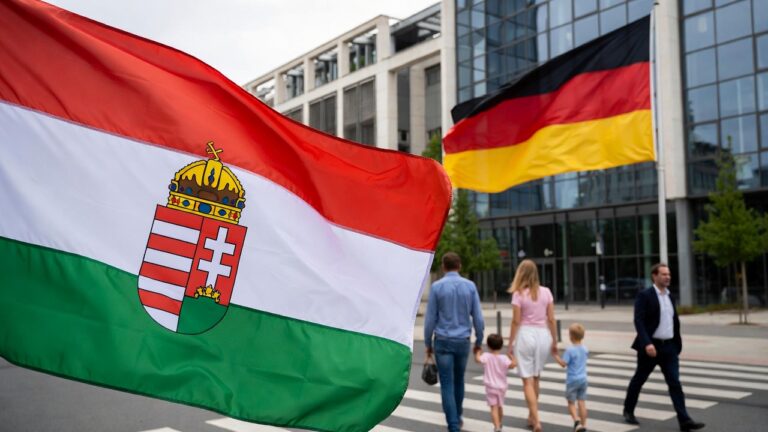
Nothing symbolizes Germany’s economic decline better than the steady migration of jobs and business investments to Eastern Europe, especially to Hungary. According to Hungary Today,
Mercedes-Benz is restructuring its European production network. As confirmed by the company and the Hungarian government, production of the A-Class will be gradually relocated to Hungary starting this year. While the German automotive giant talks about increasing efficiency, Hungarian politicians are celebrating the relocation as a historic economic triumph.
Oh, the irony: for the past 15 years, Hungary has had a government that in many ways practices precisely the patriotic version of conservatism that the current coalition in Berlin is trying to prevent in Germany. The more the Frankenstein coalition led by SPD and CDU doubles down on its disdain for the AfD and its national conservatism, the more German industries will migrate to countries where that very same national conservatism has been practiced with great success for many years now.
The Hungarian city of Kecskemét, south of Budapest, is the lucky recipient of the major Mercedes investment. It is meant to add to the company’s already existing presence in the city. Minister of Foreign Affairs and Trade Péter Szijjártó explained on Facebook that this is yet another sign of the strength of the Hungarian economy. He attributes this migration of productive capital from Germany to Hungary’s political stability, its highly competitive tax system, and a workforce with “outstanding vocational training.”
Back in Germany, reactions are understandably of a different kind. Among the more pointed reactions is a quote in Remix News from Christian Abel of AfD:
Mercedes-Benz has stood for German engineering excellence and Germany’s economic upswing for decades. Yet, like many other automakers, the company is cutting jobs in Germany and expanding in other countries.
Germany is not the only country from which businesses have come to Hungary to invest and grow. According to the OECD, over the past 15 years, German companies have expanded their foreign direct investment (FDI) position in Hungary by 2% per year, while investors from the EU-27 area as a whole expanded their FDI position by 3.2% per year.
This trend is not slowing down—it is growing stronger. In the most recent five years for which the OECD has numbers, namely 2020-2024, German corporations grew their FDI positions in Hungary by 3% per year. For the EU-27 as a whole, the expansion was 12.2% per year.
In 2024, the total FDI position held by EU companies in Hungary was worth €130.2 billion. Of this, €17.9 billion originated in Germany.
With all this positive news for Hungary, there is one question that often pops up in conversations about FDI in the country: how can Hungary be so attractive for foreign investors when its currency continues to depreciate?
The question has merit. The aforementioned increases in foreign direct investments have materialized during a period of time when the Hungarian forint gradually depreciated vs. the euro. In 2008, one euro was worth HUF251.51; in 2024, the exchange rate was HUF395.30 per €1.
This depreciation has influenced foreign direct investments both positively and negatively:
The fact that the FDI positions—the stock value of foreign investments—have continued to grow despite the depreciation of the forint is in itself strong evidence of how professionally the Hungarian government has managed the nation’s economy over the past 15 years. All other things being equal, a company that invested €1 billion in 2008 would, by 2024, have lost 63% of that investment to the depreciation.
At the same time, though, the value of the production—assuming it is all meant for export—would have benefited correspondingly from the same decline in the value of the forint:
This currency-dependent profit increase is more than enough to compensate for the depreciation in the FDI stock value. If we add other aspects to the equation, such as high productivity, lower labor costs, competitive taxes, a more streamlined regulatory environment, and all the factors mentioned by trade minister Szijjártó, then it is easy to see why Hungary continues to attract foreign investors at a high pace.