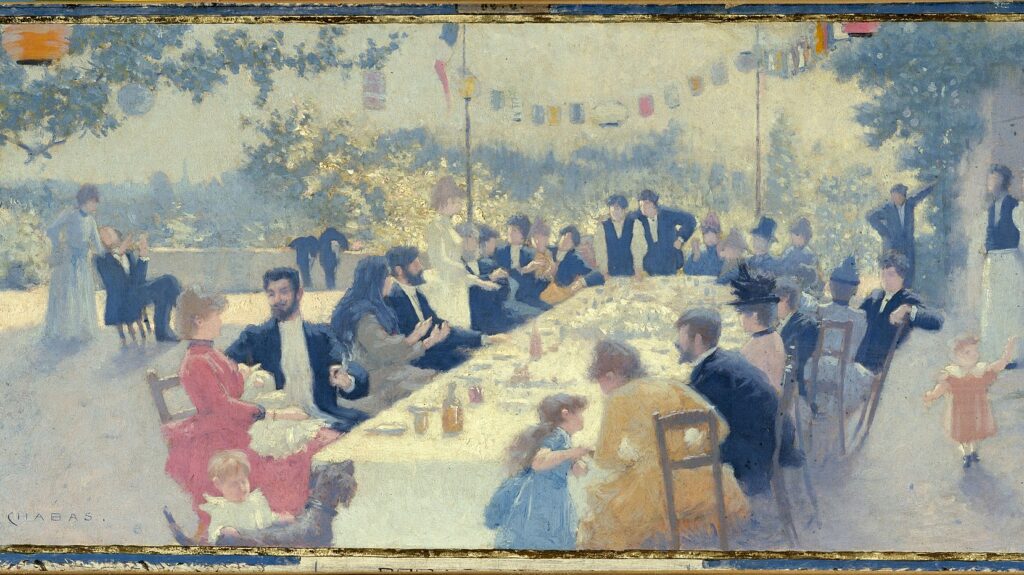
“Esquisse pour la salle des mariages de la mairie du 14ème : Repas nuptial” (1889), a 36 x 70 cm oil on canvas by Maurice Chabas (1862-1947), located in the Musée des Beaux-Arts, Paris.
Maurice Chabas, Public domain, via Wikimedia Commons
As mass migration, demographic and cultural anxiety, and cultural fragmentation intensify across Europe, the idea of remigration—once a fringe idea—has moved into the mainstream of the European Right and is beginning to enter the wider political conversation. Besides the problems of integration, crime, and social cohesion, remigration forces Europe to confront a deeper and long-avoided question. Namely, what is a nation, and who can truly belong to that nation? This is an important question for Europe, as most European states—setting aside long-standing indigenous and borderland minorities—could until recently treat this question as largely theoretical. Europe has never had to confront this question at today’s demographic scale or civilisational pluralism.
The first of the two current answers emerging from the European Right is what can be described as civic nationalism (or liberal nationalism), which claims that a nation is primarily based on legal status, constitutional loyalty, and formal integration. The United States is the classic example of this. If one obeys the law, accepts the constitution, and integrates into society, one can become an American. The United States was founded on a consciously constructed civic identity, in which immigrants were expected to abandon their old national identities and adopt a new American one. This model functioned as long as immigration levels were controlled and newcomers genuinely assimilated, learning the language, accepting social norms, and displaying constitutional loyalty. This model was later adopted by many Western European states. Post-war Germany is a prime example: national belonging was redefined in civic terms, such that legal status, constitutional loyalty, and linguistic integration became the formal criteria for becoming German.
Alongside civic nationalism, a second and radically different answer is now emerging on the European Right—that is, ethnic nationalism, or ethnonationalism. Ethnonationalism, although itself a form of nationalism, represents the opposite pole to civic or liberal nationalism. Where civic nationalism emphasises integration, loyalty, and obedience to law as prerequisites of belonging, ethnonationalism treats such criteria as secondary or irrelevant and grounds national membership solely in biological lineage rooted in shared ancestry and blood. According to this view, outsiders can never truly become part of the nation, regardless of their behaviour, loyalty, or degree of cultural integration. In some historical forms, ethnic nationalism has taken on explicitly supremacist or racialist characteristics, as in twentieth-century fascist and National Socialist movements. In other variants, it rejects racial supremacy, yet still opposes intermarriage and permanent assimilation, seeking to preserve strict biological boundaries between peoples. Unsurprisingly, these two conceptions of nationalism coexist uneasily. Each accuses the other of betraying the true meaning of the nation. This conflict stems from their radically different answers to the same foundational question of what a nation is and who can belong to it. One is, in principle, open to outsiders despite being a form of nationalism; the other is entirely closed to them.
In reality, both forms of nationalism have their advantages and disadvantages. Civic nationalism, for its part, can be far less discriminatory and carries a universalist, equal-rights appeal when its own principles are consistently applied. Yet this model presupposes additional conditions: low and controlled immigration levels, a host population with high civilisational confidence, and strong social pressure toward assimilation. Under these conditions, newcomers are able and expected to abandon their previous national identities and adopt a new one. Under conditions such as those prevailing in much of today’s Europe, these same advantages are transformed into clear disadvantages, both for the host population and for migrants themselves, who increasingly become victims of a dysfunctional immigration regime. One such disadvantage is that, by rejecting ancestral and historically grounded continuity, civic nationalism creates a thin, procedural, and ultimately interchangeable identity. Under the doctrine of equal rights alone, individuals become functionally interchangeable regardless of the organic cultures from which they originally stem.
Moreover, due to its tendency toward universalism, civic nationalism has no coherent answer to why millions of people from radically different civilisations, often incompatible with the host culture or with one another, should be admitted into the same national community. Over time, this hollows out national identity and creates a self-perpetuating cycle of ever-expanding boundaries. It also produces demographic transformations that many host populations experience as destabilising, accelerating the slide from civic nationalism into multiculturalism and, ultimately, social fragmentation. Moreover, civic nationalism erases ethnic continuity and increasingly treats ancestry and historical peoplehood as something inherently suspicious or even dangerous. Civic nationalism therefore works only when a nation exercises controlled immigration, enforces strong assimilation practices, and possesses sufficient civilisational confidence to remain the dominant cultural reference point. These conditions are largely absent in today’s Europe after decades of liberal universalism.
Ethnic nationalism, by contrast, has its own merits, foremost among them its insistence on preserving ethnic continuity and the historical peoplehood of a nation. Unlike civic nationalism, ethnonationalism does not treat the nation as a legal contract but as a historical lineage community grounded in shared blood and ancestry. This framework fosters kinship bonds and generational continuity and provides a clear boundary between those who belong to the nation and those who do not. In doing so, it resists the dilution of identity by remaining immune to demographic substitution, mass immigration, and the purely legal redefinition of peoplehood. In addition, ethnonationalism preserves a strong sense of peoplehood, communal solidarity, collective destiny, and deep emotional attachment to these bonds. The disadvantages of ethnonationalism, however, are equally profound. By elevating genetics and biology above all else, it treats tangible civilisational factors—such as culture, language, and loyalty—as secondary or even irrelevant. As a result, it effectively closes the door to deep assimilation by individuals who live by the nation’s values, love the country, and raise their children as natives.
Historically, this is a false way of interpreting both the nation and the past. Across Europe and beyond, many nations absorbed outsiders in one form or another without major civilisational disruption. A well-known example is the Huguenots who fled to England and the German states in the seventeenth century to escape religious persecution under Louis XIV. A crucial distinction, however, is that these migrants were not unskilled mass arrivals but highly sought-after artisans and professionals, ranging from bankers and shipbuilders to goldsmiths, engineers, gunsmiths, and clockmakers, who integrated rapidly and made tangible contributions to their host societies. Another example is Greece, which welcomed King Otto’s Bavarian entourage in the nineteenth century and, over time, fully assimilated them into Greek society. These cases illustrate that nations have long expanded and renewed themselves not through blood alone, but through civilisational assimilation, loyalty, and incorporation into an existing people.
This aspect of ethnonationalism creates permanent second-class citizens and invites moral incoherence: individuals who genuinely wish to belong to the nation, but lack the requisite blood, are excluded in principle. It also ignores the historical reality, demonstrated above, that nations and civilisations have always grown, absorbed outsiders, and transformed over time, thereby freezing the nation into a purely biological artefact both culturally and humanistically. Moreover, ethnonationalism offers no coherent way of dealing with mixed ancestry or with historical border populations that have long intermarried with neighbouring peoples. It cannot specify how far back ancestry must be traced, or what degree of ‘purity’ would ever be sufficient. Finally, in its most rigid forms, ethnonationalism can slide into racialist or quasi-eugenic reasoning by actively discouraging intermarriage and treating outsiders as permanently alien. In doing so, it dehumanises those who might otherwise display loyalty, contribute economically and culturally, and fully adopt the civilisation and way of life of the host nation.
Between these two answers to what a nation is and how remigration should be approached, a third way suggests itself.
The ancient Greek historian Herodotus, in his Histories, outlined a conception of the ethnos that remains relevant today. An ethnos is not identical to the modern nation, even if the two are often conflated. The nation, in its contemporary sense, is a juridical category that arose with the nation-state: anyone who holds membership in a given state is formally part of the nation. By contrast, the ethnos is an ancient conception of a people that long predates the modern state. Herodotus defines an ethnos as a people who share:
Common blood,
common language,
common sanctuaries and sacrifices to the gods,
and similar customs and ways of life.
This amounts to an early and clear formulation of what might be called ethnocultural nationalism. In this view, a people is defined not by law alone, but by shared ancestry, language, religion, and a common way of life. Unlike civic nationalism, this conception does not rest on contracts, laws, or constitutions as the basis of belonging. And unlike pure ethnonationalism, it does not reduce peoplehood to blood alone. While shared ancestry matters, Herodotus’ definition expands belonging to include a common language, a shared religious life, and similar customs and ways of life. In this framework, the door to belonging remains open through deep assimilation: adopting the language, entering the religious and cultural life of the people, forming families within the nation, and demonstrating enduring loyalty to the ethnos. This framework also has clear implications for remigration policy: those who neither share in the nation’s civilisational life nor seek genuine assimilation into it cannot plausibly claim permanent membership in the people. Moreover, it establishes that assimilation proceeds toward the existing ethnos and its culture, not the other way around.
A similar viewpoint has also begun to surface among contemporary thinkers grappling with the question of remigration. Douglas Murray has recently articulated a similar position. While insisting that ethnicity matters and should not be dismissed, he argues that any serious remigration framework must leave, using his phrase, “a breathing hole in the ice” for outsiders who have genuinely adopted the language, culture, and ways of life of the host nation, and who display enduring loyalty to it, even if they do not share its traditional religion. This modern, independent convergence with what Herodotus articulated over 2,400 years ago points to the same underlying ethnocultural logic: ancestry matters, but so do deep civilisational assimilation and exclusive loyalty to the host nation. This suggests that ethnocultural belonging is not a modern ideological invention but an anthropological constant that has recurred across civilisations and historical eras.
The emergence of remigration in mainstream right-wing discourse reveals not a failure of simple policy, but a deeper civilisational and identity crisis in Europe. Civic nationalism, one of the options on the table, dissolves peoplehood into paperwork and universal abstractions that can, over time, dissolve a people and their identity altogether. The other option, ethnonationalism, freezes identity into biology and erects an extreme boundary that, while clear, is also deeply exclusionary for those who genuinely wish to belong to the nation. Herodotus’ definition of the ethnos offers a third way, what might be called ethnocultural nationalism, which understands a people as a historical organism composed of ancestry, language, religion, customs, and a shared way of life. Like ethnonationalism, it recognises that blood and historical continuity matter and should be preserved. But it refuses to reduce belonging to genetics alone, insisting that deep civilisational assimilation and exclusive loyalty to the nation can also open the door to belonging. If Europe is to remain herself without falling into either dissolution or extreme exclusivity, it is this form of ethnocultural nationalism she must recover—on a pan-European level—and remember that paperwork alone does not make a people, and blood alone is not enough to sustain one.
Alexandros Dolgov is a Web3 developer and author with a deep interest in European myth, traditionalism, and thought. His book, Beginning Solidity, introduces readers to smart contract development on Ethereum.