Social media is often used for politically motivated campaigns. On the more nefarious side of those campaigns, we find a recent one that has been targeting Prime Minister Viktor Orbán. The message: Hungarians have become the poorest people in Europe thanks to Orbán and his government.
This is nonsense, of course: as I will show with numbers in a little bit, the Orbán era has been an economic blessing for Hungary, with strong economic growth and solid improvements in the standard of living. In fact, it is so easy to show that this social media campaign is wrong that I am surprised that the campaigners have been able to get away with their message so far.
Here are some examples of closely coordinated messages from different accounts on the platform X, around which the campaign appears to have been centered.
On June 19th, ‘sabine mescher’ wrote:
🇭🇺❗️Orbans Ungarn ist nun offiziell
— sabine mescher ❦ (@SabineMescher) June 19, 2025
das ärmste Land der EU❗️
… Hinter den Zahlen verbirgt sich eine schmerzhafte Realität: Unter Viktor Orbáns zunehmend autoritärem und prorussischem Fidesz-Regime wurde Ungarn systematisch ausgeplündert. Staatsbetriebe wurden ausgehöhlt, pic.twitter.com/4rc9ZsaPYZ
This one is from ‘Jürgen Nauditt’ on August 7th:
Orban has managed to turn Hungary into the poorest country in Europe. But putin's bootlicker lives like the Sun King, Louis XIV. https://t.co/Odm1OWmwYe
— Jürgen Nauditt 🇩🇪🇺🇦 (@jurgen_nauditt) August 7, 2025
Here is ‘Frid’ on August 25th:
While Viktor Orban has made Hungary the poorest country in the European Union and honest Hungarian citizens struggle with soaring inflation, his circle built a multi‑million euro castle. Corruption and luxury at the top while the people fight to survive pic.twitter.com/Q5XqIPrQUM
— Frid 🇪🇺🦌 (@Frid45) August 25, 2025
Behold ‘Jay in Kyiv,’ September 13th:
Hungary's Russian-backed Orban regime has spent over a decade looting the country into it's newly official status of poorest nation in Europe.
— Jay in Kyiv (@JayinKyiv) September 13, 2025
Infrastructure is breaking down while Orban and cronies build more palaces.pic.twitter.com/lc8cKfbcOW
On October 15th, ‘Michael A Arouet’ wrote:
It looks like Victor Orban will not only be sent into retirement soon, but that Hungarian opposition will get constitutional majority.
— Michael A. Arouet (@MichaelAArouet) October 15, 2025
Anyone surprised? Hungary under Orban became one of the poorest countries in the EU, at some point enough is enough. pic.twitter.com/Mq3sP84op7
People with more name recognition have also participated. Here is a contribution on November 8th by neoconservative American pundit Anne Applebaum (who, as it happens, is married to leftist-liberal Polish Deputy Prime Minister Radosław Sikorski):
In honor of Viktor Orban's visit to Washington, here's a reminder that, thanks to Orban, Hungary is corrupt, stagnant, and impoverished:https://t.co/FMBFhYokDT
— Anne Applebaum (@anneapplebaum) November 8, 2025
It is particularly interesting to see Applebaum’s comment, given the elementary factual errors in it. Applebaum is a widely recognized author of books on current and historical events, including a spin-off of Aleksandr Solzhenitsyn’s masterpiece Gulag Archipelago.
The numbers disproving this anti-Orbán campaign are easily and readily available to anyone who cares to do a fact check. To begin with, Hungary is not the poorest nation in the EU: in 2024, its GDP per capita, measured in euros at 2015 prices, was €14,880—a whopping 63% higher than in Bulgaria, which has the EU’s lowest GDP per capita.
Just as the poorest-in-EU allegation is false, so is the one suggesting that Hungary has been on a track of impoverishment in the past 15 years. To show what a difference the Fidesz government has made, let us continue with GDP per capita and look at it all the way back to the mid-1990s.
According to Eurostat’s national accounts data, Hungary’s GDP per capita grew by an inflation-adjusted annual average of 2.6% from 1996 through 2010. This is the pre-Fidesz economy. According to Anne Applebaum and others, the next several years should have been much worse.
Except, they weren’t: from 2010 through 2019, the Hungarian economy grew by a solid per capita 3.5%, again adjusted for inflation. As Figure 1 reports, this puts Hungary in the top nine of the EU’s current 27 member states:
Figure 1

In other words, during the first decade with Fidesz in government, Hungary’s economy outperformed supposed economic powerhouses like Denmark, France, Germany, the Netherlands, and Sweden.
But what about the pandemic and its aftermath? The problem with 2020 and 2021 is that they were characterized by artificial economic disruptions in the form of governments that were more or less aggressive in locking down their countries to fend off the pandemic. Due to those measures, the swings in economic activity in those years, and in part 2022 as well, were so wild and uncharacteristic that a year-by-year comparison would be badly distorted.
However, if we leap through the first half of the 2020s and compare 2024 to 2019, we get a reasonably good idea of how governments have managed to steer their economies through the pandemic, its aftermath, and back to normalcy again. Figure 2 reports how much bigger—or smaller—inflation-adjusted GDP per capita was in 2024 compared to 2019:
Figure 2
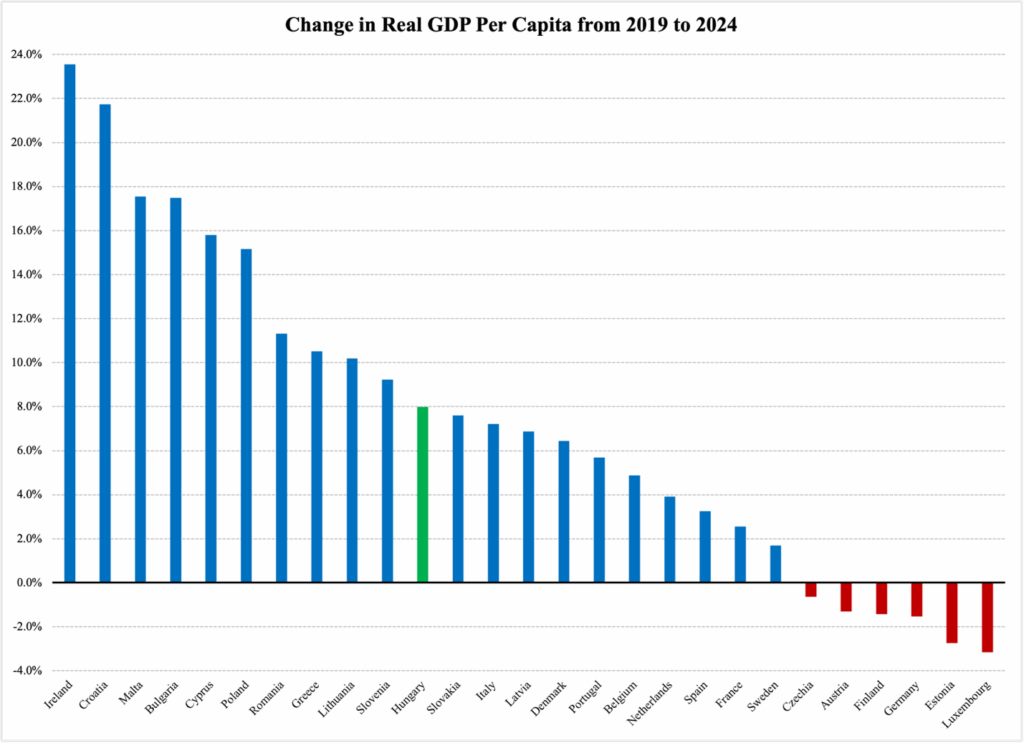
Hungary is one of 11 EU members where, from 2019 to 2024, GDP per capita increased by 8% or more after inflation.
No matter how we slice these numbers, the conclusion is simple: the economic policies by Viktor Orbán and the Fidesz government have significantly improved the Hungarian economy. The social media voices that suggest that Hungary has been impoverished under Orbán’s tenure as prime minister are as far from the truth as they could be.
But wait—a good growth rate in GDP per capita does not necessarily mean that the incomes of households improve, does it?
This is a good point. The correlation between per capita GDP figures and overall standard of living is normally strong, but the latter is not guaranteed by the former. Therefore, to check what difference Prime Minister Orbán has made for Hungary, let us look at inflation-adjusted private consumption broken down per capita.
In the pre-Fidesz period from 1995 to 2010, Hungarian consumer spending increased by a ho-hum 2.5% per year. This puts the country at 15th place among the current 27 EU member states; in a manner of speaking, this means a relative loss of standard of living as consumers in 14 other European countries increased their spending faster.
In the 2010s, the growth rate in per capita Hungarian private consumption was 3.5%, a full percentage point above the pre-Fidesz era. This was good enough to place Hungary 7th among its EU peers.
The pandemic-and-beyond years have been even better for Hungary’s households: from 2019 to 2024, they increased their spending by a real 3.5% per year. Only three EU states could beat this: Croatia at 5.1%, Bulgaria at 4.6%, and Romania at 4%.
Growth in consumer spending is not to be dismissed as a prosperity indicator: it includes everything from buying groceries and filling up the car on the way home from work to going on vacation, having a comfortable home, and paying for your children’s after-school activities. Private consumption includes clothes, home electronics, and concert and restaurant visits.
In a nutshell, at any moment in time, it is a snapshot of our standard of living. Its strong growth is a sign that a country’s economy is healthy—and, by the same token, its decline shows that households are not doing well financially.
Speaking of which: rather than making false claims about Hungary, social media pundits like Anne Applebaum should be worried about the six EU member states—Germany included—where in 2019-2024 consumer spending actually declined.