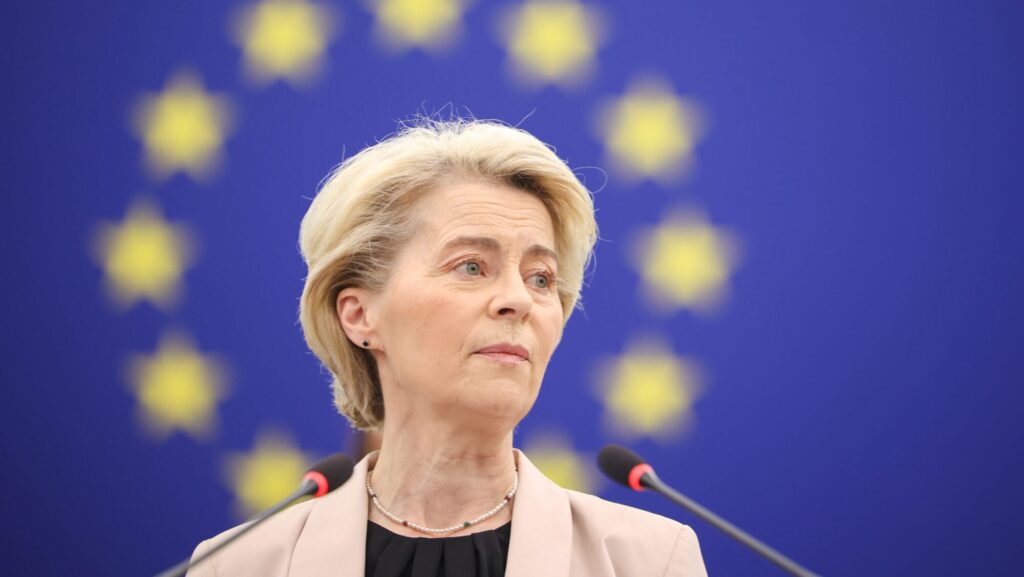
EU Commission President Ursula von der Leyen
Photo: Alexis Haulot / © European Union 2025 – Source: EP
President Trump’s second term brought about “historical changes” in the EU, as the deeper integration of the bloc’s common defense policy we see happening today would have been “inconceivable” without the geopolitical developments of recent months, EU Commission President Ursula von der Leyen said in a recent interview with the German Die Zeit, published on Tuesday, April 15th.
Indeed, what’s happening in the EU today fits well into the pattern established in the last two decades: the ever-repeating cycle of crises and centralization, advancing the ultimate goal of Europe’s “ever closer union” as laid down in Article 1 of the TEU.
Accordingly, von der Leyen didn’t shy away from portraying this process as the greatest ‘positive’ aspect of the war in Ukraine and the more pragmatist and transactional foreign policy shift in Washington. Whereas foreign and defense policies used to be exclusively member state competences, today, capitals increasingly surrender their agency to Brussels even in these areas that are pivotal to pursuing unique national interests.
The EU Commission chief didn’t mince her words when she pointed out that the common debt-fueled €800 billion ReArm Europe plan or the deeper industrial integration to boost competitiveness “would have been unthinkable just a few years ago.” Now they are taken for granted, all thanks to the ongoing geopolitical crises:
The readiness of all 27 Member States to strengthen our common defense industry would have been inconceivable without the developments of recent weeks and months. The same applies to the economy. Everyone wants to emulate our common plan for greater competitiveness, because everyone has understood: We need to stand firm in today’s globalized world.
Of course, what she left out is that there’s hardly any understanding between member states on the specifics of common debt, with many worrying about the long-term financial consequences of becoming a ‘debt union.’ But whether ReArm Europe would be financed by centrally issued EU bonds or ‘only’ by EU-backed national debt, the political direction is the same: surrendering more control to Brussels through gradually deepening financial dependency.
Europe’s ‘Hamiltonian moment’—deeper political integration made ‘necessary’ by joint debt—was regarded almost as a conspiracy theory a few years ago, with sovereigntists warning about the spiral of centralization once it begins, but is now touted as the solution by even the most EU-friendly mainstream media.
What’s even more striking about the speed of this process is that von der Leyen and others in the EU elite are becoming increasingly open about their federal agenda. While still dodging a question about the centralizing treaty change proposals on the table—including stripping member states of their veto power—the Commission chief instead opted for a deliberately vague call for “another, new EU,” which essentially means the same:
We need another, new European Union that is ready to go out into the big, wide world and to play a very active role in shaping this new world order that is coming. … And I firmly believe that Europe can do that.
Let’s look back at the last decade: the banking crisis, migration crisis, Brexit, pandemic, energy crisis, Russia’s war against Ukraine. All these are serious crises that have really challenged us, but Europe has emerged bigger and stronger from every crisis.
And people have learned that when there are big crises, Europe certainly provides some of the big answers.
Quite clearly, ‘Queen Ursula’ believes that in times of hardship, Europeans look to Brussels for solutions and not their governments. True or not, this certainly has been the narrative at least since the late-2000s, and especially since ‘Queen Ursula’ took over in 2019. And the EU Commission has been able to profit from this narrative with great success.
And von der Leyen is right that Brussels does not necessarily need to change any treaties and can still constantly and exponentially expand EU competences through what’s often called “integration by stealth” or “covert integration.” This is the strategy of catching countries off guard and pushing through power transfers wrapped in shiny emergency measures during times of crises—measures that then turn out to be permanent and irreversible.
According to Thomas Fazi, a British publicist and the author of The Battle for Europe: How an Elite Hijacked a Continent—and How We Can Take It Back (2014), the EU’s “silent coup” through covert supranational integration is “the root of virtually all the problems we now face in Europe.” In a report published by MCC Brussels last year, Fazi identified three pivotal “moments of public fear” that allowed the European Commission to take further steps toward becoming a supranational state.
The euro zone crisis between 2009 and the mid-2010s opened the door for the EU to become a sovereign entity for the first time, with the ability to impose budgetary rules. The COVID crisis was used to get member states accustomed to the strictly ‘one-time-only’ idea of joint borrowing, as well as to introduce the rule-of-law conditionality mechanism that can be used as a tool of ideological blackmail by withholding funds—both of which are set to become permanent features of the EU soon.
Lastly, the war in Ukraine allowed von der Leyen to establish herself as the bloc’s foreign policy chief overnight, making decisions over the heads of governments on sanctions and weapon deliveries while hiding behind an artificially created ‘consensus’ that she presents to member states, in the name of urgency, before any genuine one could emerge.
We see the second phase of this today, as the war in Ukraine combined with Trump’s presidency is used to justify further, irreversible power grabs that rapidly lead to the ‘Hamiltonian moment,’—the eventual birth of a federal Europe. Fazi’s observation about the EU’s past ‘crisis management’ will undoubtedly become true once more as “emergency solutions become the new institutional status quo.”
All this, including the fact that von der Leyen personally drives these changes—seeing herself as being entrusted with some civilizational mission to ‘guide’ Europe toward enlightenment—comes off clearly from the language she uses in the Zeit interview. Not national governments, not even the EU or the Commission, but she alone can and must save Europe:
What matters is that I have to keep the 27 Member States coordinated and give guidance. I need to have—or develop—a plan for each crisis. And it is important that we move forward very pragmatically and very quickly, because people expect Europe to be there for them.