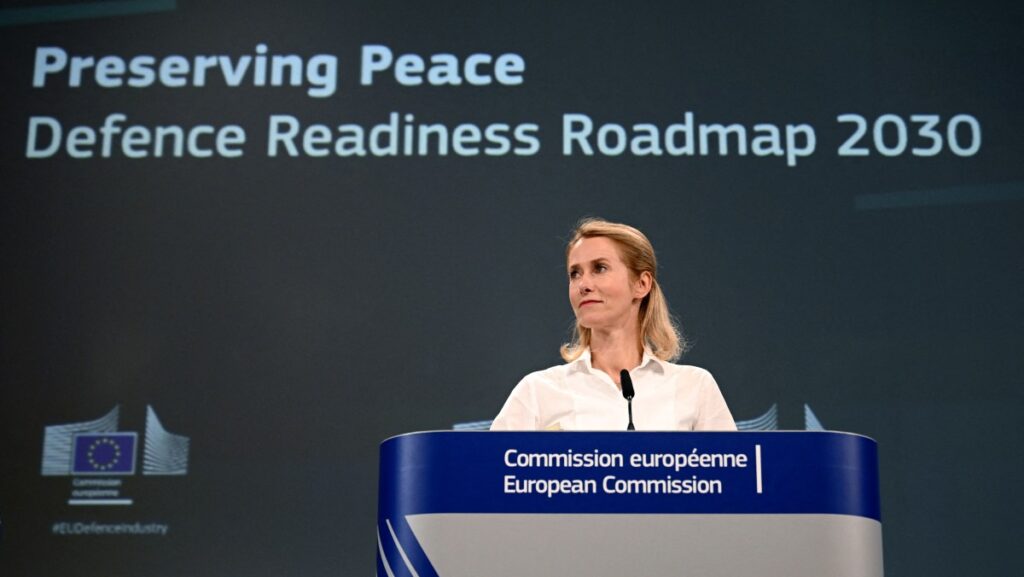
EU High Representative and Vice-President for Foreign Affairs and Security Policy Kaja Kallas gives a press conference on the Defense Readiness roadmap at the EU headquarters in Brussels on October 16, 2025.
Nicolas Tucat / AFP
The Roadmap on European Defence Readiness was unveiled by the High Representative of the European Union for Foreign Affairs and Security Policy, Kaja Kallas, and two other European Commissioners this week. It is due to be reviewed by EU leaders next week and officially launched in December. But, as with all things EU, despite setting itself up as a plan to be ready to fight a war with Russia by 2030, its primary focus is on addressing the “fragmentation, cost-inflation and lack of interoperability” it views as being driven by the national focus of member states.
The sorry truth is that projects, contracts, and financing only ever form one element of achieving real security. But even if you were to quadruple defence spending, if no-one is willing to fight for you, there would be no consequence. War is just as much about spirit as it is about kit. Probably more so. And on that, we know that, aside from in countries such as Finland and Poland, who know a thing or two about Russia from recent experience, right across Europe, there exists a somewhat febrile attitude, particularly among young people unwilling to fight for their country, let alone much else.
The usual response to this is to say that this would change if an invasion occurred. Such wishful thinking operates at every level of the EU, and the only reasonable responses are that by then, it’s often too late, but more importantly, that it might be worth taking their statements of support, or not, at face value.
George Kennan, the U.S. diplomat and historian most famous for his policy of containment in relation to the then Soviet Union, defined war as “collective killing for a purpose.” The challenge today is that most Western democracies have a problem with all three of those elements.
The demise of any sense of collective and an undue focus on individual identity are notorious features of the contemporary world. Killing is, of course, frowned upon in general, but we seem to have lost any sense that without struggle, there is no life. Nature itself would take us if we didn’t tame it, let alone our needing to feed ourselves rather than bugs, bacteria, viruses and parasites.
But the most important missing element from Kennan’s list is purpose. “Why should I fight,” young people ask, “especially for a state I feel no sense of loyalty to?” Aside from the “me, me, me” aspect of this, what is really at stake is addressing the questions; “Who are we?”, “What are we for?”, and “Where are we going?”
It is the failure of Western governments and the EU in particular to win the argument for national loyalty, a sense of duty and obligation among citizens, as well as a clear trajectory, that are the true barriers and that have shaped our cultures in this regard.
The Ancient Greeks considered patriots to be barbarians because their only loyalty was to their fatherland. In contrast, for them, it was membership of the polis (city states defined by active engagement) that distinguished them. And, as Crowley (2017) notes:
Greek poleis had to attract the loyalty of their citizens, because if those citizens did not fight on behalf of their collective, that collective could easily fall under the power of another, or worse still, cease to exist.
Simply put, that would mean dying or becoming enslaved. Accordingly, being a citizen meant more than calling a particular place, territory or country, “home.” Readiness for war was a civic duty and existential necessity. And the participatory nature of these societies meant that, despite inevitable antagonisms between elites and the masses, these all worked towards collective goals both domestically and on the battlefield, providing a capacity for socialisation far exceeding that of the modern nation-state.
Now we might well say that fighting others in this way is neither big nor clever. And we might hope it to be unnecessary in the modern world. But that is a very recent view. In the main, real wars continue to end not because of peace negotiations but because one side wins, a point easily lost on a generation who have not really experienced any until the last few years.
At the very least, if we hold ourselves to be better, as democrats, there is a need to engage in, and win, the battle of ideas. But, shockingly, more and more people consider freedom of speech itself to be an expendable luxury today. Too few understood the killing of Charlie Kirk for what it was—an attack on us all. And, by precluding taking on opposing ideas, it is those least up for war who are doing the most to shape future ones.
This points to a deeper problem that confronts us. The wars we may yet have to fight might not just be against external opponents, but, as the angry hoards on our street, who supported a fascistic, terrorist organisation with the stated aim of eliminating all Jews, showed, the internal conflict we have to confront may yet prove the more significant.
The challenge ahead is not one of mere financing and regulations, as the EU declarations might suggest. Even many of these are fudges, as building new roads becomes lumped in with increasing security. No, the real challenge is one of personal and collective commitment and loyalty to one’s own. If these elements need debating, then best that debate start right here and now. The alternative is capitulation.
As the Victorian philosopher and economist John Stuart Mill noted in his Principles of Political Economy:
War is an ugly thing, but not the ugliest of things: the decayed and degraded state of moral and patriotic feeling which thinks that nothing is worth a war, is much worse. When a people are used as mere human instruments for firing cannon or thrusting bayonets, in the service and for the selfish purposes of a master, such war degrades a people. A war to protect other human beings against tyrannical injustice; a war to give victory to their own ideas of right and good, and which is their own war, carried on for an honest purpose by their free choice,—is often the means of their regeneration. A man who has nothing which he is willing to fight for, nothing which he cares more about than he does about his personal safety, is a miserable creature who has no chance of being free, unless made and kept so by the exertions of better men than himself. As long as justice and injustice have not terminated their ever-renewing fight for ascendancy in the affairs of mankind, human beings must be willing, when need is, to do battle for the one against the other.
So, yes. We should be ready for war. Anything short of this is to abandon civilisation.