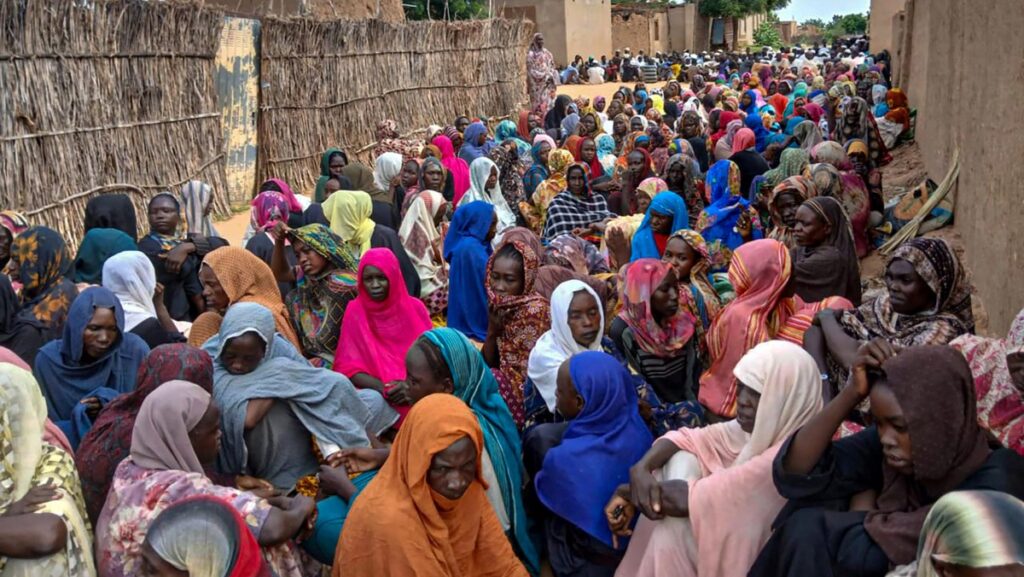
Sudanese residents gather to receive free meals in Al Fasher, a city besieged by Sudan’s paramilitary Rapid Support Forces (RSF) for more than a year, in Darfur region, on August 11, 2025. RSF attacked a famine-hit refugee camp in North Darfur state on August 11, 2025, killing at least 40 civilians and injuring 19 others, rescuers said. Al-Fasher is the last city in the western Darfur region still held by the Sudanese army, at war with the paramilitary group since April 2023.
AFP
In the city of Al-Fashir, Sudan, Islamists have killed in such numbers that the blood is visible in satellite images. A real genocide. Do you know Al-Fashir? Do you know where it is and how long this tragedy has been unfolding?
For months, this ancient city has been under siege. Entire neighborhoods have been erased, villages burned to the ground, and tens of thousands starved to death in the desert. The United Nations estimates that nearly 25 million Sudanese face acute hunger, and over half a million children have already died in a man-made famine born of war. Islamist militias, armed with Iranian drones, Turkish weapons, and a moral certainty that calls itself divine, have turned Sudan’s civil war into a theater of extermination. Some soldiers, caught on camera, were seen eating the hearts of their victims. It is a horror that defies comparison—not primitive but absolute; not ancient but modern.
And yet, the moral noise of the world remains eerily quiet. No great demonstrations in New York or London, no cries from ‘anti-colonial’ academics or human rights activists, not even the hollow echoes of hashtags. Only silence, dense and deliberate, a silence of self-protection rather than ignorance.
This kind of silence is not the absence of awareness; it is a defense mechanism. The modern Left has built its self-image as the guardian of moral consciousness, the eternal voice against domination and oppression. But Sudan’s agony does not fit this image. There is no ‘white oppressor’ to condemn, no colonial villain to resurrect. The perpetrators are Islamists, brown, African, and ideologically positioned as victims of the West. The moral geometry collapses, and so the Left retreats into quiet.
This is not mere political hypocrisy; it is existential. The conscience of the progressive West functions only within a familiar equation: suffering acquires meaning when it can be traced to guilt. Without that connection, empathy falters. Sudan is unbearable not because it is distant, but because it is ideologically unusable. The Left cannot absorb this kind of suffering; it cannot translate it into its moral grammar. To acknowledge Sudan would mean to confront evil without the mirror of imperial sin, and that would require an honesty few are willing to risk.
In our age, outrage has become a form of currency. Suffering must be visible, marketable, and symbolic in order to be recognized. This is why Palestine has become sacred in the moral economy of the Western Left: it offers consumable images, clear villains, and an easy narrative of virtue. The Palestinian child, the Israeli soldier, the white democracy, all neatly arranged for performance.
Sudan offers no such clarity. There are no cinematic frames, no eloquent victims with fluent English, no convenient empire to accuse. It is a darkness without a Western author, and therefore, in the emotional economy of the Left, it yields no profit. Today’s empathy functions like capital; it must produce a moral return. Outrage must affirm identity, pity must signal virtue, and silence becomes the price of ideological consistency.
Thus, the massacre in Al-Fashir, visible from space, passes almost unnoticed. The blood that cannot be politicized is ignored.
Behind this paralysis lies the theology of post-colonial thought: the belief that all suffering in the Global South is a byproduct of Western domination. This doctrine, born in the seminar rooms of Western universities, has replaced theology with guilt and politics with resentment. It cannot explain why Muslims massacre Muslims, why black militias butcher black civilians, or why Arabized Islamists enslave Africans in Darfur.
The same ideology that romanticized Che Guevara now sanctifies Hamas. The silence on Sudan is the natural consequence of this worldview. The Western Left cannot condemn the perpetrators without renouncing its own creed. The same intellectual mechanism that excuses jihadist violence against Israelis now blinds it to Islamist atrocities in Africa.
This is what the post-colonial Left calls ‘the oppressed.’ It is a complete inversion of moral order: the executioner becomes a victim, the fanatic becomes a revolutionary, and barbarity becomes resistance. The moral compass of an entire political culture spins in circles, pointing nowhere but inward.
What dies in Sudan is not only human life, but the credibility of the West’s moral discourse. The intellectuals who built entire careers condemning Western imperialism now find themselves mute before Arab racism, Islamic supremacy, and African despotism. The same moral vocabulary that once claimed to defend the weak has become an instrument of selective blindness.
The Left’s ethics no longer aim at truth; they aim at narrative coherence. Evil is recognized only when it speaks English, oppression only when it can be blamed on Europe. Universalism was always conditional, and solidarity always performative. Sudan exposes this for what it is: a theater of empathy whose stage collapses when reality refuses to conform.
The most terrifying fact about Al-Fashir is not only that it is dying, but that it is dying without witnesses. The Left, once obsessed with the language of conscience, can no longer even pretend to possess one. It has traded moral realism for moral theater, turning compassion into a costume worn only when convenient.
When famine kills half a million children, when Islamist militias devour the bodies of their victims, when blood stains the earth so deeply that it is visible from orbit, the self-proclaimed conscience of humanity looks away. Not because it does not know, but because it cannot afford to believe.
The silence of the Left in the case of Al-Fashir is not an absence of sound; it is the collapse of meaning.