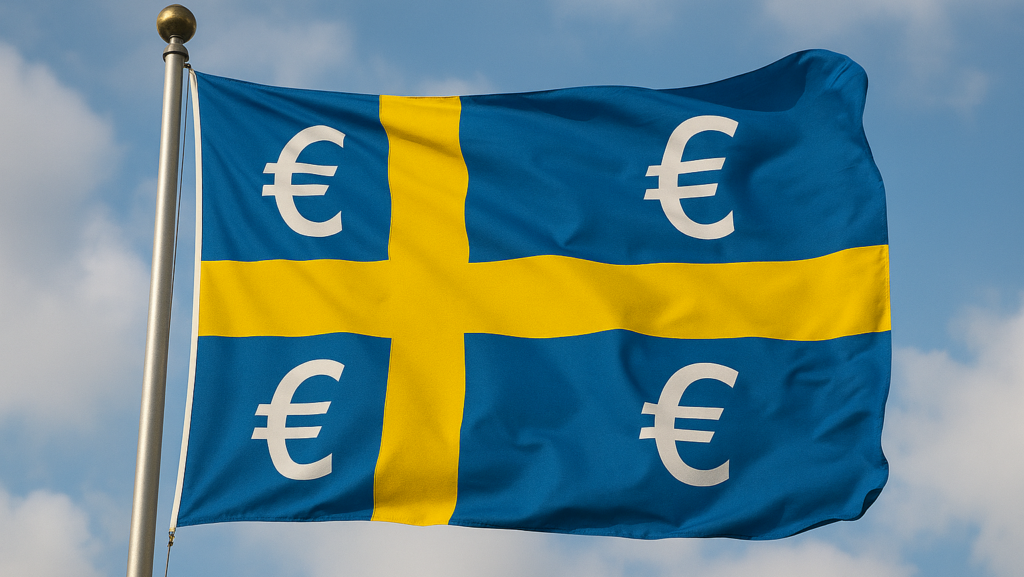
Let me make my forecast official: Sweden will become a member of the euro zone no later than 2028.
I have explained in the past that a Swedish euro membership is both inevitable and decidedly undesirable. Since a government of the right determination and fortitude could eliminate the inevitability, a Swedish euro accession would be driven by political preferences, not economic necessities.
That observation is reinforced by the fact that economies in the euro zone tend toward stagnation and industrial poverty, not growth and prosperity. The case for the euro is further compromised by the fact that the only major contemporary research report on the issue was published recently by the heavily pro-euro foundation Fritt Näringsliv (Foundation for Free Enterprise).
The chairman of the research group behind the report is Lars Calmfors, professor emeritus at the Institute for International Economics at the University of Stockholm. They spend 544 pages discussing rather minute—and sometimes downright irrelevant—aspects of the economic ties between Sweden and the euro zone. At no point does the report address the major macroeconomic problems plaguing the euro zone, problems that only reinforce what a solid body of economics scholarship has established, namely that the euro zone is dysfunctional due to unfixable inherent structural flaws.
These problems notwithstanding, on January 27th, the Swedish parliament held a debate on the possibility of euro accession. Of the eight parties, only two expressed euro skepticism—the Left and the Green Party—and one party, the Sweden Democrats (SD), forcefully rejected the very idea of a Swedish euro membership.
It was clear from the debate that there are five parties in the Riksdag (parliament) that want to somehow nudge Sweden into the euro zone. This means that the euro membership will become part of the campaign leading up to the parliamentary election in September.
As if anticipating that, on the morning of the euro debate in the Riksdag, SD announced on its Facebook page (in Swedish): “Do Not Touch Our Swedish Krona.” After more than three years carefully cooperating to govern Sweden, the SD is breaking away from its center-right coalition partners—at least on this particular issue.
Their representative in the Riksdag euro debate, Oscar Sjöstedt, opened his address with a historic overview of how the Swedish krona is closely connected to the very independence of Sweden as a nation. He then proceeded to point out that many euro zone members have government debt that often exceeds 100% of GDP. It is unwise, he explained, to “enter into an economic marriage” with a number of countries that are “extremely over-indebted.” He also predicted that with continued growth in public debt, “the euro will sooner or later collapse.”
Leading the pro-euro side was Finance Minister Elisabeth Svantesson of the Moderate Party. Following a long Swedish political tradition of downplaying big political changes, she called for more research on euro accession. She also made clear where her party stands: while the Swedes voted against euro membership in a 2003 referendum, the world has changed since then: the 2008-2010 Great Recession, the war in Ukraine, the Trump presidency, the 2020 pandemic.
She even brought up the Swedish NATO membership among the somehow relevant factors that would add up to a list of reasons why Sweden should join the euro.
One of the clearest signs of a Swedish euro membership in the making was Svantesson’s call for a parliamentary research report on how the euro accession should actually happen. According to Mikael Damberg of the Social Democrats, Svantesson’s proposal “merits serious consideration.”
In plain Swedish political parlance, this means that the euro membership is a done deal and that the two biggest parties in the Riksdag just have to find a way to sway the euro-skeptic Swedish electorate.
As I predicted back in October, Sweden is being quietly pushed into the euro zone.
Not all euro proponents are subtle about their stance. The Liberal party, which currently floats around an embarrassing 2.5% in the opinion polls, does not hold back:
In an unpredictable world there is no longer any room for doubt. The security, future, and cohesion of Europe are determined together—and then we have to stick together. It is about the economy, but even more so about safety, loyalty, and what community we want to belong to. Therefore, it is self-evident for the Liberals that we should have a complete EU-membership—and introduce the euro in Sweden.
Back in August, Karin Karlsbro, MEP for the Liberal Party, explained in an op-ed for the daily newspaper Göteborgs-Posten that she wants the question about euro membership
to be a main issue in the 2026 election. It is time for the rest of the parties in the Swedish parliament to take this issue seriously. It is not only about the long-term value of the krona and the uncertainty [of the currency’s value] that harms the Swedish economy. Replacing the krona with the euro means safety, stability, and stronger [European] cooperation. But most of all, it gives Sweden influence, all the way.
She also lamented that Bulgaria would join the euro before Sweden does.
As if to reinforce their stance on the euro, on January 22nd, the Liberal Party’s spokesperson on economic policy issues, Cecilia Rönn, carried the pro-euro argument a step further. Writing for the daily financial paper Dagens Industri, Rönn connects a Swedish euro membership to national security. Seduced by the high-pitch rhetoric around Greenland, she advocates closer collaboration between EU member states, which would include Swedish euro-zone accession.
To exemplify how Sweden can benefit from the euro membership, Rönn points to how Europe could respond to President Trump’s overtures about Greenland. By coordinating a sell-off of U.S. Treasury securities, she explains, Europe could send a message “in the form of capital flows” that Trump understands.
As I explained in two recent articles, any such ‘retaliation’ by European investors would be competently absorbed by the U.S. Treasury market but have significant negative consequences for Europe in general and the euro in particular. However, when politicians play games with economic variables, they usually rank the political fallout as more important than any repercussions for the economy.
The capacity for financial retaliation in international diplomacy is probably not an argument that Swedish politicians will consider when moving Sweden into the euro zone. That is good, of course; what is not so good is that they also appear to be blissfully oblivious to the serious macroeconomic consequences of a membership.
There is still time for the euro skeptics to put those consequences before the voting public. Let us hope they use that time well. Sweden deserves better than to be thrown to the gargoyles of economic stagnation.