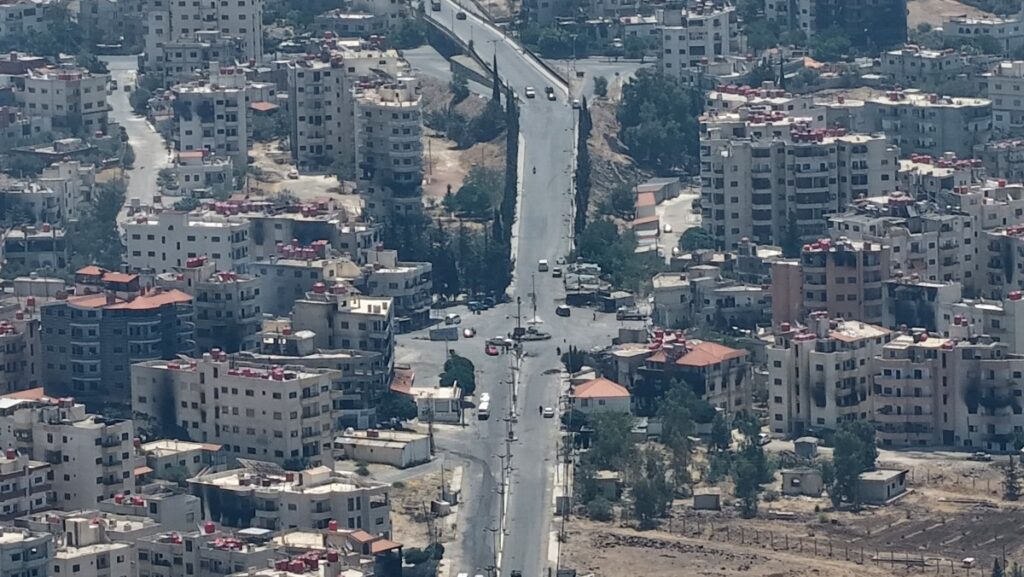
This aerial picture shows a view of the predominantly Druze city of Sweida in southern Syria on July 21, 2025.
Bakr Alkasem / AFP
The city of Suwayda in southern Syria is currently blockaded by the country’s new Islamist regime. City residents say they have a significant need for food, fuel, water, electricity, medical and other basic supplies such as shelter materials (mattresses, blankets, and chargers). Further, they say that there is a major need for psychological support for thousands of families. They are asking for urgent humanitarian aid and intervention from the international community. The medical staff at the Suwayda Hospital also asks for emergency help.
The al-Qaeda-affiliated terrorist group Hay’at Tahrir al-Sham (HTS), led by Abu Mohammad al-Julani/Ahmed al-Sharaa, conquered the Syrian capital of Damascus in December of 2024 with the help of Turkey. The new Islamist regime of Syria has since systematically targeted, abducted, and massacred the Druze, Christians, Alawites, and other religious minorities.
On July 13th, the regime forces launched an incursion against the majority-Druze city of Suwayda (also spelled Sweida) and its surrounding villages. Large numbers of civilians (mainly the Druze) as well as children were massacred by Islamists. Several women and children were abducted and remain missing. The victims were singled out due to their religion. They were tortured and murdered. Many cases were filmed and posted by perpetrators on social media.
Among the victims were Pastor Khalid Mezher, who led the Good Shepherd Evangelical Church in Suwayda, and roughly 20 members of his family—siblings, children, and parents.
Although Suwayda is primarily populated by Druze people, it is home to a sizable Christian community. Currently, Suwayda is under a siege at the hands of the new regime led by the self-ascribed “president” of Syria, al-Julani/al-Sharaa, the commander of the terrorist group HTS and the former head of the Syrian al-Qaeda.
A Druze living in Syria told europeanconservative.com on condition of anonymity how:
At the onset of the incursion, the majority of residents in the towns located in the northern and western sectors of the Suweyda governorate fled their homes toward the eastern regions. Many residents of the city fled as well, resulting in a large-scale displacement that exceeded 100,000 people. In the absence of a plan or prior preparation to accommodate such displacement, the displaced were hosted in the homes of the towns that they had fled to. This sudden rush multiplied the number of residents in those homes by at least tenfold. This situation lasted for no less than ten days, leading to the depletion of all food and water reserves in the host towns.
After the incursion subsided, some of the displaced were able to return to their homes, but the majority remained refugees—particularly those from over 30 towns whose homes were burned and looted, leaving them with no place to return to.
During the invasion [by Julani’s forces], the infrastructure supplying the city with electricity and water was destroyed, disrupting the normal provision of water to residents.
Sweida is further suffering from a severe drought, there are not enough crops or agricultural products this year that can support self-sufficiency.
Fuel reserves have been exhausted, severely impacting the ability to provide logistical services such as pumping water from underground wells or transporting water via tankers to the residents.
A blockade is imposed on Sweida, along with a boycott by Syrian merchants, halting the daily trade that supplies the governorate with essential food goods. The daily fuel allocations for Sweida have also been halted. All businesses and work activities in Sweida have ceased, leaving families with no source of income. Households are surviving either on their remaining food and water reserves (if any were left), or on the little aid they had previously received.
The current primary goal on the ground is to activate the following essential sectors: water, health, food, and shelter.
Many civil society activists are working on the ground with Red Crescent teams to provide support and assistance. They are entirely dependent on aid delivered by the Red Crescent convoys. To date, Sweida has not received its fuel allocations, and the aid which has been delivered covers only a small fraction of the daily needs—no more than 10%.
Our source added:
There have been numerous instances of delayed or cancelled planned convoys, which has made operations extremely difficult for relief teams inside the governorate. There is also a blockade that limits the fuel access which is essential for operating hospitals (to generate electricity amidst the ongoing power outage), pumping water from wells, operating bakeries for bread production, etc.
The Syrian Red Crescent branch in Sweida lost its main warehouses, located by the city’s sports stadium, after they were burned down during the incursion. The situation severely limits the branch’s ability to respond to emergencies.”
Direct sources and staff at the Suwayda National Hospital said food, fuel, and medical supplies are among their most urgent needs.
Fuel/diesel is needed for the hospital in particular due to the continuous power outage since July 13 (the regime is allowing very small amounts of diesel, but blocking the entry of petrol/gas that is needed for ambulances).
There are groups of independent doctors and healthcare workers, who are providing urgent and free health and humanitarian care on the ground, outside the domains of the 3 main hospitals in the city, due to some hospitals being out of service or lacking capacity. They’re also extremely lacking in support and need all the help which we can provide.
On July 16, Syrian regime forces also reportedly carried out a massacre at a hospital in Suwayda. Videos posted on social media showed dozens of dead patients on the ground in the wards or bundled up in their bloodied bedsheets.
Another video showed hospital staff kneeling on the ground as armed men violently drag one individual away, beat him, and shoot him at close range before moving his body elsewhere. The authenticity of the footage has been confirmed by the independent dis/mis-information monitor Verify-Sy.
Christians are also being increasingly targeted by Islamists in Syria. A Syrian Greek Orthodox church bombing was carried out in Damascus by Islamists on June 22 and left at least 25 Christians dead and more than 50 traumatically injured. One of the injured, Antoinette Ghamid, succumbed to her wounds on July 19.
Writing for the human rights organization Open Doors, a Syrian Christian expressed the community’s concerns regarding the new regime: “An uncertain future and fear have long dominated the daily thoughts and conversations of Christians, particularly given the new government’s background.”
In a video plea posted on social media on July 18, Metropolitan Antonius of the Greek Orthodox Archdiocese of Bosra Horan, Jabal-Arab and the Golan, said:
We, in the mountains of Suweyda, have 300,000 families … We have been under siege for the past 6 to 7 days with no water, no food supplies, no electricity. Nothing at all. Not even bread. Absolutely nothing from the governorate [the government in Damascus]. This is a humanitarian appeal to all people of conscience around the world. Please direct your attention to your brothers and sisters in Suweyda. Look to your brothers in humanity. Open humanitarian corridors and crossings. Bring into Suwayda everything that is needed, medicine, flour, bread, and so on. We need everything in Suweyda.
In another statement, Metropolitan Antonius asked “the entire world to intervene quickly to stop the terrorist massacres in Suweyda”:
I address this humanitarian appeal to the bright minded people who love peace. The ongoing war in the Suweyda Governorate is a barbaric war. It kills the young and the old. I raise my voice loudly to the international community and to the United Nations [asking them] to help us. I hope that this cry will reach the entire world.”
HTS, which took over Syria and topped the Assad regime last December, had close links with both al-Qaeda and the Islamic State (ISIS), as did its leaders.
Because of their association with al-Qaeda and ISIS, Sharaa and HTS are designated as terrorists by several countries—including the United States (but only until recently, July 2025) and the United Kingdom, as well as the United Nations and the European Union.
Abu Bakr al-Baghdadi—the leader of ISIS—sent Sharaa to Syria to form a contingent of al-Qaeda. Sharaa then formed the Syrian al-Qaeda, also known as the Nusrah Front (Jabhat al-Nusra), in 2012. In Syria, Sharaa taxed civilians, looted factories, and conducted kidnappings for hefty ransoms. At one point the Nusrah Front was helping support the Islamic State in Iraq. In 2013, Sharaa declared his organization’s allegiance to al-Qaeda leader Ayman al-Zawahiri and expressed their “pride in the banner of the Islamic State in Iraq.”
In 2017, Sharaa formed the HTS. In the same year, HTS announced the creation of what it called the Syrian Salvation Government (SSG) in the governorate of Idlib, with Sharaa as its de facto ruler. There, HTS forces forcibly evacuated from homes, detained, tortured, or murdered many civilians. They also removed crosses from church buildings and prevented pastors and priests from walking outside in religious attire.
Syria’s new self-appointed ‘president’ is a former ISIS and Al Qaeda militant. Unsurprisingly, his regime continues to massacre, abduct, rape, and starve members of religious minorities. Should an ISIS and al-Qaeda terrorist be allowed to be Syria’s president? An equally important question is: Why is the world so silent in the face of the murdered, persecuted, and starving religious minorities in Syria?