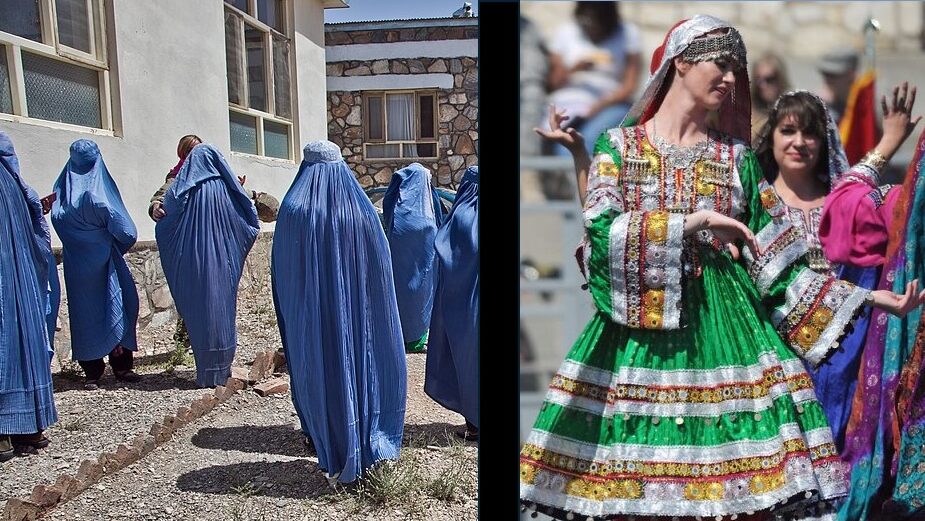
Photo montage of Afghan women under Taliban rule (L) and women in traditional Afghan clothing (R).
SPC Jessica Reyna DeBooy, Public domain, and Weaveravel, CC BY-SA 4.0, via Wikimedia Commons
Governments attempting to restore ties with the Taliban are instead risking the legitimization of oppression. Doing so would deepen Afghanistan’s crisis, an independent UN human rights expert cautioned on October 30, calling for a principled approach that defends the rights of women and girls.
As the Taliban tighten control over Afghan society, everyone is forced to follow regulations and norms that the group has imposed. This includes the ban on women employees and a requirement that women must wear a burqa and have a male companion while traveling outside of the home. Everyone is expected to rigidly follow Islamic disciplines, especially going to the mosque. Failure to observe such requirements raises suspicion, and anyone can report violators to the local imam and/or Sharia police.
The Taliban is a Sunni Islamic movement founded in the early 1990s that ruled most of Afghanistan from 1996 until October 2001. The movement’s founding nucleus (the word “Taliban” is Pashto for “students”) was composed of peasant farmers and men studying Islam in Afghan and Pakistani madrasas. The Taliban found a foothold and consolidated their strength in southern Afghanistan.
By 1994, the Taliban had moved their way through the south, capturing several provinces from various armed factions who had been fighting a civil war after the Soviet-backed Afghan government fell in 1992. By September 1996, the Taliban had captured Kabul, killed the country’s president, and established the Islamic Emirate of Afghanistan.
The Taliban’s first move was to institute Koranic instruction and jurisprudence. In practice, this meant often-merciless policies on the treatment of women, all political opponents, and religious minorities.
In August 2021, the Taliban took control again and reintroduced strict Sharia (Islamic law). The swift takeover of Afghanistan by the Taliban has effectively stopped the advancement of women’s rights introduced by the U.S. government. Afghanistan is a country where women have long had a lower social status and been viewed as second-class citizens.
Meanwhile, there are indications that many of the Taliban’s policies of the 1990s are reappearing. One of the latest examples is the edict ordering the resumption of stoning of women as criminal punishment.
With power now in the hands of the Taliban, all Afghan citizens are facing strict limitations in everyday life inspired by Islamic tenets—and women even more so.
On August 15, 2021, the Taliban launched their grim campaign to erase women from public life. Since seizing power, they have implemented more than 70 decrees violating the rights of girls and women—especially their right to education.
Today, Afghanistan stands out tragically as the only country in the world where secondary and higher education are strictly forbidden to girls and women. Nearly 2.2 million of them are now barred from attending school beyond the primary level due to this regressive decision.
In addition, women and girls are forced out of their jobs, restricted in their ability to move around, and denied rights, amounting to gender persecution so severe that it has been named by some as “the Taliban’s war on women.”
Because the Taliban enjoy widely unchallenged power and are implementing Islamic Sharia law, Christians cannot expect any space in society. A Taliban spokesman has denied outright that Christians exist in Afghanistan, and this is the official standpoint of the Taliban whenever they are asked any questions. The Islamic Emirate of Afghanistan neither allows Afghan citizens to become Christians nor recognizes converts as such.
Under the Taliban, Afghanistan is an Islamic nation, and any deviation from Islam is forbidden by law and tradition. Conversion to another religion is punishable by death. The Taliban’s position (as well as that of the average Afghan in the street) remains that Afghans cannot be Christian and that it is illegal and impossible for an Afghan to convert to any other faith than Islam.
The human rights organization Open Doors reports that the punishment for blasphemy is a societal issue in Afghanistan. It is carried out swiftly by the local Islamic religious authorities, jihadist groups, or, since the Taliban takeover, by regime authorities. In many cases, blasphemy charges are reportedly made for reasons of personal enmity or envy. Even a mere suspicion or allegation can end in immediate death or the individual fleeing.
There is no publicly accessible church in Afghanistan. For almost fifty years, Afghanistan has not had an official church building. The only functioning chapel was reported to be in the basement of the Italian embassy in Kabul and only open for the small number of expatriates still working in the city—mainly diplomatic and military staff—but it is closed for the time being.
According to Open Doors, all Christian meetings in Afghanistan are underground and secret. Christian materials are hidden, and even sharing them electronically can have life-threatening consequences if traced. As one of Open Doors’ field experts said, “Anyone in possession of Christian materials, especially the Bible, will be subjected to harsh punishment, even death. Naturally, this will extend to investigating to find the source of such material.”
The small groups of Christians in the country have adapted to the new circumstances by either relocating within the country, seeking refuge abroad for security reasons, or trying to stay hidden.
Groups supporting the rule of law, participation in the political process, or government accountability are quickly suspected of being agents of the international community who further the West’s agenda. These are also often labeled ‘infidels’ or ‘kafirs.’ The Taliban have carried out targeted killings of ‘collaborators’ with the previous government and of citizens claimed to be ‘militants.’
The Taliban is not the only radical Islamic entity in Afghanistan. A considerable number of people have been killed in attacks or displaced by the Islamic State in the Khorasan Province (ISKP).
Religious minorities, including Hazaras, Christians, Hindus, Bahais, and Sikhs, all face intensified persecution. The Hazaras are Afghanistan’s third-largest ethnic group and are predominantly Shia Muslims. They have been directly targeted both by the Taliban and by ISKP, who frequently attack minority religious sites and gatherings. By virtue of being Shia, the Hazaras are seen as apostates and a direct threat to the Taliban’s regime.
Women from religious minorities, including Christians, are especially vulnerable. When an Afghan woman converts to Christianity, she is likely to keep it a secret, risking physical abuse, house arrest, forced marriage, and rape.
According to Open Doors, in the first few weeks after the takeover, Christian women and girls were targeted and abducted in order to be forcibly married to Taliban fighters. Fathers were forced at gunpoint to give up their daughters. A country expert explained that women were perceived as “spoils of war.” Christian converts experienced abduction, escaped into hiding within the country, or even tried to relocate abroad. As a result, they lost their homes, most of which were either destroyed or seized by neighbors or Taliban fighters moving in.
According to the US State Department’s 2023 Report on International Religious Freedom in Afghanistan, minority religious groups reported discriminatory treatment by the Taliban and feared they risked being tried unfairly by Taliban-appointed judges if they took their legal cases to court.
The Taliban are quickly implementing their vision of a truly Islamic society. The group’s ideological resolve can be seen in the dedication with which they took hold of the education sector in what they believe is a “war of thoughts.”
The Taliban’s tightened grip on the education system is following up on their ambition to build new madrassas (Islamic schools) in each province of Afghanistan. They started by installing Taliban sympathizers to take charge of university leadership. In a second step, university courses were revised in such a way that mandatory religious Islamic topics were streamlined to fit Taliban ideology.
Political parties, which were a driver up to August 2021, are now eliminated. The voice of independent media from within the country has also been silenced completely. When the Taliban ruled Afghanistan in the 1990s, they became infamous for banning all ‘objectionable literature,’ particularly anything deemed as ‘contrary to Islam.’ After returning to power in August 2021, they imposed 11 rules for journalists, which essentially rephrase and reinstate this ban, according to the organization Reporters without Borders (RSF).
However, the country that is now Afghanistan has not always been an Islamic state. Before the arrival of Islam in the 7th century CE, the area of modern-day Afghanistan was home to a mix of religions, including Zoroastrianism, Hinduism, and Buddhism. These religions had various concentrations in different parts of the region. For example, Zoroastrianism was prevalent in the west, while Hinduism and Buddhism were concentrated in the east and southeast.
Christianity first arrived in Afghanistan in the second century A.D., brought by the apostles Thomas and Bartholomew. It was established by the Church of the East, with bishoprics in cities like Herat and Balkh, but its influence was eventually destroyed by Muslim conquests beginning in the seventh century. A modern Christian presence began in 1921 when Italy opened an embassy and secured the right for a chapel.
As Europe is struggling with mass Islamic migration, it also risks having a future similar to today’s Afghanistan. Importing large numbers of Afghans and other Muslims has introduced Europe to a regressive Islamic culture hostile to women. Throughout the whole history of Islam, there has not been a single case in which Islam took over a society and women’s rights were elevated. The full Islamization of societies invariably leads to the enslavement of women and girls. Hence, Europe should urgently reshape its immigration policy and ban sharia law in order not to end up being ruled by Taliban-like regimes.