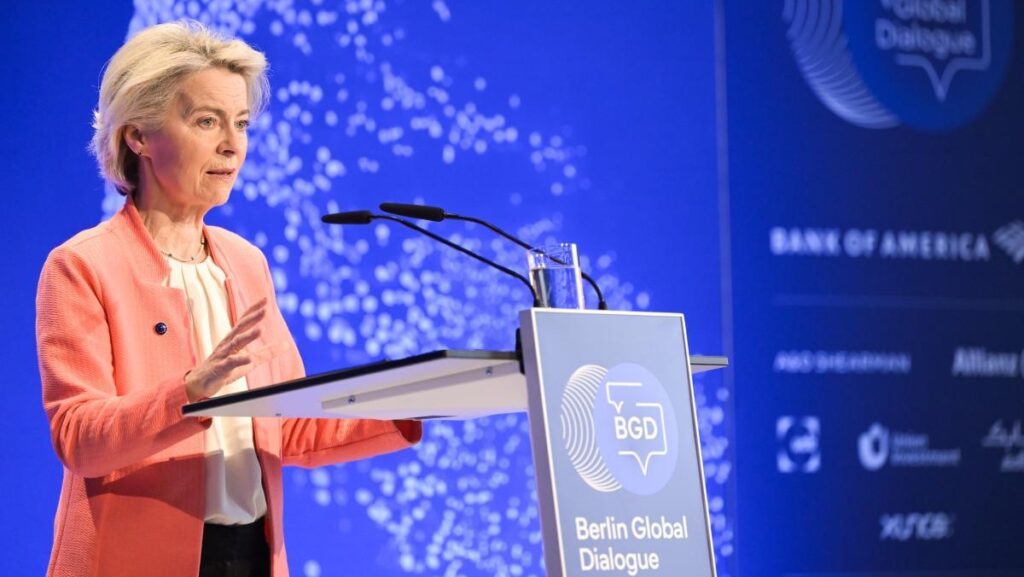
Commission President Ursula von der Leyen
Dati Bendo, © European Union, 2025. Source: EC – Audiovisual Service
Although the Commission unveiled its proposal back in August, Brussels is only now beginning to grasp what the next seven-year budget framework truly entails. Officially called the Multiannual Financial Framework (or just MFF in EU jargon) for the 2028-34 period, it comes with an audacious promise: it “will be much more than just a financial plan. It will be a strategic statement of the Union’s collective ambition.”
The familiar justifications follow swiftly: Russia’s war against Ukraine, inflation, trade tensions, and Europe’s broader economic malaise. Each serves as a convenient pretext for what is, in fact, a fundamental redesign of the EU’s fiscal order. Behind the rhetoric of urgency and unity lies a quieter, yet more substantial revolution: not through treaty reform, but through spending. The new MFF is less a budget than a political mutation: an attempt by the Commission to extend its power by means of fiscal engineering.
The language of “partnership” and “cooperation” is meant to conceal a more sobering reality: in almost every paragraph, the new budget tightens Brussels’ control at the expense of the member states. Nothing illustrates this better than the crown jewel of the proposal, the merger of 14 separate EU programmes into a single framework of National and Regional Partnership Plans, one per member state, worth a total of €865 billion.
It sounds efficient, but step back for a moment. Each of those 14 programmes once had its own regulation, budget line, and monitoring system. Crucially, member states enjoyed an almost automatic right to access funding if they met the legal conditions of each fund. A dispute about those conditions in one area did not spill over into others. National and regional authorities developed expertise in implementing specific EU policies: local administrations, for example, have long distributed Common Agricultural Policy (CAP) payments or cohesion funds according to clear criteria laid out in EU regulations. This system balanced EU-wide regulations with the option of real discretion for governments and regions to decide which areas would benefit most from EU support.
The new Partnership Plans break with that logic. They are modelled on the Recovery and Resilience Facility (RRF) (also known as the “COVID Fund”, created in 2020) where member states submit milestones and targets for Commission approval, which Brussels then evaluates against its own political priorities and rule-of-law conditions. This way, Brussels can suspend or withhold payments for “non-compliance,” and it reserves the right to reallocate resources during the MFF period.
Together, these provisions create a steering mechanism that undermines the predictability of EU funding for member states. National governments can no longer count on Brussels to reimburse the real costs of implementing EU policies. They now must cross their fingers that the Commission deems their benchmarks ‘fulfilled’ and releases a lump-sum payment that might, or might not, cover what was spent. This is not flexibility; it is the quiet transfer of budgetary sovereignty from national and local governments to the Commission.
Key to understanding the Commission’s new power is the notion of conditionality. The new MFF cements the Rule-of-Law Conditionality Regulation as a central mechanism of the EU budget. What was once an exceptional safeguard is now built into the system’s core. Previously, the regulation was invoked only reactively, like famously against Hungary and Poland. Under the new framework, however, every single Partnership Plan depends on the Commission’s approval of a member state’s “rule-of-law conditions.” If Brussels judges any government to be non-compliant, the money does not simply remain unused; it can be reallocated to “civil society” and “Union-values” programmes of the Commission’s choosing.
This marks a profound political shift. The Commission now wields discretionary authority over vague, expandable criteria, replacing the older, rule-based procedures of the previous MFF with a mechanism of permanent political leverage. The consequences reach far beyond budgetary management. The EU once integrated through spending; now it disciplines through it. Yet the irony is that this logic also undermines the uniformity of EU law itself. To claim that individual Partnership Plans meet their “benchmarks,” Brussels must tolerate different interpretations of compliance with EU law. Uniform legal enforcement has quietly given way to selective political judgment. The Commission, it seems, has decided that bureaucratic discipline is no longer enough and has reached for the big political guns: a signal more of weakness than that of strength.
Remarkably, this transformation of the MFF also produces a host of technical headaches. How do the new conditionality criteria of the Partnership Plans relate to the dense web of existing regulations that still govern each EU programme? Brussels has never been shy about regulation: by the Commission’s own count, accessing EU funds currently requires navigating some 5,000 performance indicators across 32 programme-specific reporting schemes. They now promise to reduce those to 900 indicators and merge the various plans into one. Judging by the Union’s bureaucratic history, however, the likelier outcome is 5,900 indicators and 32 programme-specific plans plus 27 national plans.
Yet some of these ‘problems’ appear less like design flaws than deliberate features. By merging so many programmes under broad headings, transparency declines sharply. The two largest spending lines (the CAP and the cohesion funds) are now folded into a single ‘Partnership Plans’ envelope, obscuring how much actually flows to farmers or poorer regions. Meanwhile, the bland heading ‘Global Europe’ (an oxymoron if ever there was one) conceals €200 billion for external action and a special reserve of unknown size for Ukraine beyond public scrutiny. The paradox is striking: the more the EU spends, the less Europeans can see where the money goes. Simplification has become a form of camouflage.
The EU is retreating from its flat countryside, both financially and politically. The new MFF makes that unmistakable. Take the persistent myth that farmers are awash in subsidies. CAP payments have already fallen from about 0.6% of GDP in the early 1990s to barely 0.3% in 2020. In real terms, farmers receive roughly half of what they once did. While the current budget devotes 31% of total spending to the CAP, the new framework cuts that share to just 15% (€295.7 billion). A dramatic contraction, and this in an era of soaring food prices.
The same uncertainty hangs over the cohesion funds, so vital to poorer and rural regions. The Commission insists they will be “strengthened,” which in Brussels usually means further centralisation and new conditionalities. Under the logic of the new Partnership Plans, regional and local authorities lose political weight as decision-making gravitates toward national capitals and, ultimately, toward Brussels. What once defined the Union’s political model—multi-level governance—now survives only as vocabulary.
The new MFF is larger than ever, both in nominal and relative terms. The Commission proposes €1.98 trillion, equal to about 1.26% of the Union’s GNI, compared to €1.21 trillion (1.10%) in the current framework. That is an increase of roughly €770 billion, or more than 60% in nominal terms! Which naturally raises the question: where will the money come from?
Brussels has not been short on creativity. A new wave of so-called “own resources” (the “EUphemism” for taxes) will help fill the gap. These include an expanded emissions-trading system, a carbon tariff (CBAM), an EU corporate tax, tobacco excises, and an e-waste levy. All these measures are, in essence, new indirect or direct taxes on citizens and businesses. They make energy more expensive, consumption less affordable, and Europe less competitive.
The contradiction could hardly be starker. EU leaders promise to fight the cost-of-living crisis and revive competitiveness, just then to introduce fiscal tools that do the opposite. Even so, these “own resources” are expected to cover only about 30% of the additional needs. The remaining 70% must come from higher national contributions. In other words, just as member states struggle with ballooning welfare costs and debt, the EU asks them to send more money to Brussels. France, for instance, is already in political turmoil over domestic spending cuts, and now imagine adding another European bill on top.
To sell this to national governments, the Commission invokes the familiar argument of European efficiency: money spent collectively, it claims, yields higher returns than money left in national budgets or in citizens’ pockets. Central to this promise is the new European Competitiveness Fund: a €409 billion instrument meant to finance defence industries, innovation, and industrial policy.
The rhetoric sounds familiar. In 2020, the RRF was supposed to unleash a new growth miracle. It didn’t. Now, the MFF repeats the experiment on a larger scale. In practice, the mechanism remains the same: take money from citizens, channel it through layers of national and European bureaucracy, and then wonder why so much of it disappears along the way. The only real innovation lies in the scale of the operation. Consequently, the Commission also requests 2,500 additional staff in the first three years, citing “new policy needs”. At the same time, it introduces new central instruments (like AgoraEU, ProtectEU, and the Competitiveness Fund itself) that multiply administrative layers rather than reduce them. And if the Commission proceeds with its plan to institutionalise joint borrowing (using the RRF as a template once again), Europe may soon discover the paradox of integration by debt: a larger budget, a heavier tax burden, and still no growth.
Remember the RRF? Its role model goes one step further. The RRF introduced joint EU borrowing for the first time (breaking a long-standing taboo) on the promise that faster growth would eventually repay the debt. According to the new proposal, beginning in 2028, around 9% of the entire EU budget (€24 billion per year) will be devoted solely to repaying that borrowing, drastically reducing the Union’s room for manoeuvre. And remember, too, that the RRF was supposed to be a one-off emergency instrument, created in the exceptional circumstances of the pandemic.
Never mind that: the new MFF reopens the same door, just wider. It allows the EU to establish new crisis tools financed by borrowing whenever “extraordinary circumstances” arise. In other words, if the Council loses its composure only once in seven years, the Commission can repeat the same failed experiment. But this time by design, not by exception, let us be honest. The result is a European Treasury without a European demos. Now the EU can raise and spend money on behalf of citizens who were never asked whether the political reasoning behind such institutionalisation of EU borrowing aligns with their interests.
The MFF has quietly become the EU’s de facto constitution. Amended every seven years, negotiated in technocratic silence, and ratified not by citizens but behind closed doors. More than ever it does not merely redistribute money; it redistributes authority towards Brussels. Through the MFF, Brussels is building a fiscal centre without a political core, a Union held together less by democratic will than by the logic of conditionality and debt repayment. No wonder. It is already known that the actual draft was written by three unelected bureaucrats: Ursula von der Leyen’s chief of cabinet Björn Seibert, the all-powerful budget director-general Stéphanie Riso, and the head of the RRF Céline Gauer; names that hardly anyone in Europe has ever heard of.
The real MFF negotiations are only at their beginning. Till the end of 2027, ideally before, the EU states and the European Parliament must define their positions. It is already clear that Ursula von der Leyen’s Commission may have overreached. National budgets are bled dry, and few governments are eager to send more money to Brussels. Even the traditional constituencies of von der Leyen’s own European People’s Party, farmers and industrial workers, are turning in growing numbers to parties on the right that promise lower taxes and fewer transfers to Brussels’ pet projects. And because the MFF now functions as the Union’s de facto constitution, a budget crisis is no longer just fiscal. It is existential: a life-threatening condition for the political mainstream and for the institutional architecture that has sustained the EU for decades.