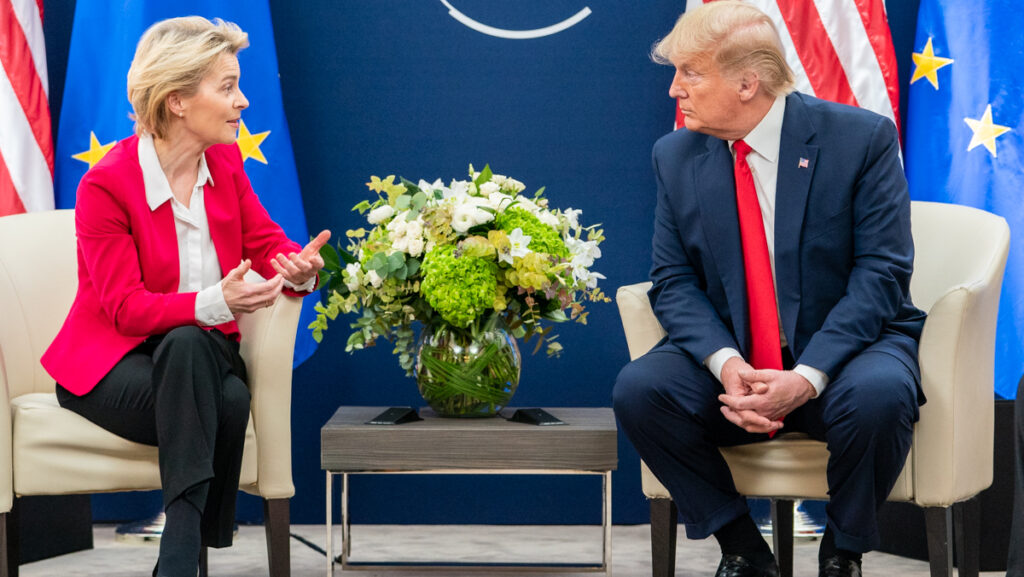
President Donald J. Trump meets with the President of the European Commission Ursula von der Leyen during the 50th Annual World Economic Forum meeting Tuesday, Jan. 21, 2020, at the Davos Congress Centre in Davos, Switzerland.
Photo: Shealah Craighead, The White House from Washington, D.C., Public domain, via Wikimedia Commons
There is, finally, some movement forward in the trade negotiations between the United States and the European Union. According to Yahoo Finance,
the European Union has agreed to fast-track trade talks with the US in a bid to avoid President Trump’s 50% tariffs—which, in an about-face, he announced would be delayed until July 9. … EU’s trade chief, Maroš Šefčovič, will lead political negotiations and is focusing on key sectors such as semiconductors, automobiles, pharmaceuticals and aluminum to avoid tariffs, according to sources.
This is good news, especially since Commission President Ursula von der Leyen said back in April that Trump’s tariff policy was “unpredictable” and that his tariffs were bad for both consumers and businesses.
She is correct, of course, but her statement shows that she totally misunderstood the point behind Trump’s decision to upset America’s trade tariff status quo.
Interestingly, a month later she seems to have gotten the message. After Trump’s threat of 50% tariffs, von der Leyen had what she herself referred to as a “good call” with President Trump.
Why did the president of the European Commission not get Trump’s message from the beginning? Why did it take over a month, and threats of crippling tariffs, for her to let the trade negotiators engage in productive talks with their American counterpart?
The reason is simple: the European Union suffers from a self-image that gets in the way of productive policymaking in general, and especially in its relations with the United States. This self-image has two components:
It did not take much from Trump to poke a hole in the first part of that self-image; it remains to be seen if the EU’s member states will see the trade-talk advantages in deflating the other part. If they did, namely, they could get more individualized deals with the United States and thereby tailor their trade conditions to their national interests.
The part of the EU self-image that pertains to Trump is in no way isolated to bureaucrats in Brussels. To be fair, it even incorporates some U.S. mainstream media, as the aforementioned story from Yahoo Finance illustrates. Their characterization of Trump’s 50% tariff threat as an “about-face” is incorrect. On the contrary, this was a well-calculated move on behalf of the president, one that got him exactly what he wanted: a genuine European desire to sit down and actually talk trade.
American media notwithstanding, it is remarkable that the top political brass in Brussels had to be pushed this far before they began to understand who President Trump really is. His threat of higher tariffs is nothing more complicated than a classic business negotiation tactic. The current American president is an expert at negotiating big deals, and at getting what he wants.
At the same time, he is not a man who wants to walk away from a deal with a humiliated party on the other side of the table. He knows that such dealmaking is bad for business over the long term, and he has brought that knowledge with him into politics. The president’s decision to upset America’s trade relationships with a slew of new tariffs was meant to benefit America—but not at the direct expense of other countries. It was meant to create better conditions for trade in both directions.
Or, in the words of Liam Murphy of The Tariff Times:
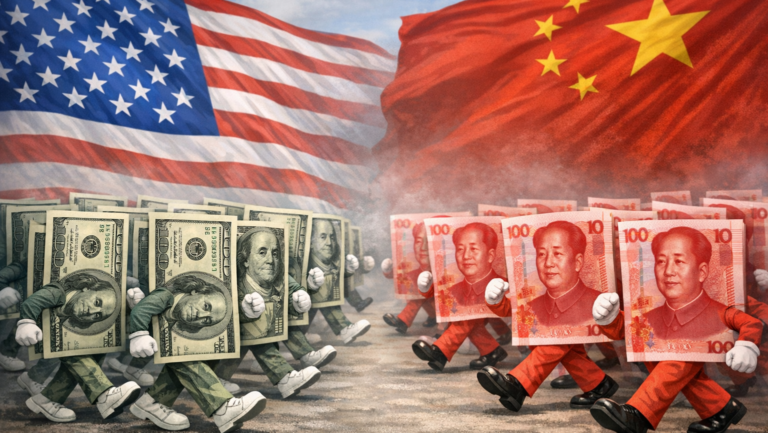
President Trump is not looking to punish Europe with his tariff policy. The Europeans continue to misread the strategic situation! What President Trump is interested in accomplishing, is the reindustrialization of both the United States, and the European Union, both of whom are being destroyed by the aggressive Chinese Communist Party.
I would not go as far as to say Trump’s trade talks with Europe are explicitly directed at China, but at the same time, with a better transatlantic trade deal, Europe will undoubtedly have less to gain from Asian trade.
Furthermore, it is essential that the EU leadership understand Murphy’s more profound message: President Trump does not treat Europe as an adversary. The purpose behind his administration’s trade talks is not to weaken Europe, but to build stronger, better, and more durable economic relations between the United States and the European Union.
Looking at the U.S.-EU trade talks so far, and at the EU’s attitude toward Trump in general, I am convinced that Europe’s political elites have not at all seen Trump as an international partner, but as an erratic, buffoonish politician who turned himself into their adversary with his desire to negotiate new trade deals.
The image of Trump as foolish, even crazy, is by no means limited to circles among the political elite. Behold Simon Tisdall of The Guardian, a British news outlet. In November last year, he called President Trump a “superspreader of craziness” who “destroys reasoned debate, splits the country into opposing camps … and sends blood pressure soaring.”
One of the more urgent consequences of this European disdain for President Trump is the slow-moving conversation on trade between Brussels and Washington. While the British government realized that they were talking to an international partner and quickly negotiated a new U.S.-UK trade deal, the EU approached the trade talks as if they really were dealing with a crazy adversary.
Trump, on the other hand, skillfully plays them like a violin. His 50% tariff threat proved that he knew exactly which strings to pluck. But he may very well achieve more than that: he could in fact have set a process in motion that will permanently weaken the authority of the EU on matters of international trade.
In 2024, the 27 EU member states exported goods and services to the United States worth $810 billion, equal to 7.8% of their total exports. However, individual EU member states vary significantly when it comes to their interest in foreign trade, including with the United States. To take a prominent example, German exports to the United States last year amounted to $208 billion. This is equal to 10% of Germany’s exports globally—and 26% of the EU exports to the United States.
By contrast, France contributed only $91 billion to the EU’s U.S.-bound exports. Needless to say, Paris is significantly less invested than Berlin is in piecing together a new trade deal with America.
To further highlight the economic heterogeneity of the EU, Thomas Kolbe recently pointed out here on europeanconservative.com that the EU area is
a patchwork of protectionist engines. Estimates suggest Brussels and its member states together direct over €500 billion annually in subsidies to prop up domestic industries.
Simply put, the more a country spends on such subsidies, the less its government cares about good trade deals—even with the world’s largest economy.
President Trump and his administration are not unaware of the tensions between Brussels and the member states. Recently, Scott Bessent, the U.S. Secretary of the Treasury, expressed hopes that the 50% tariff threat
would light a fire under the EU, because … [the] EU has a collective action problem here. … It’s 27 countries, but they’re being represented by this one group in Brussels. So some of the feedback I’ve been getting is that the underlying countries don’t even know what the EU is negotiating on their behalf.
If the EU can negotiate a good trade deal for all of its member states, then they deserve respect for having done so. However, if they fail—especially because their inflated self-image gets in the way—then some member states will in all likelihood take U.S. trade-talk initiatives themselves. If that is one of the outcomes of the current negotiations, it may be followed by a slow but important shift in power between the EU and its 27 member states.