On Friday, February 20th, the United States Supreme Court (SCOTUS) released its opinion—the technical term for its verdicts—in a case where a plaintiff challenged President Trump’s use of tariffs in disputes with other countries. Bombastic reactions rapidly spread across the internet:
Interestingly, the more measured reactions originated in Europe, where President Macron
warned against drawing rapid conclusions. “We shouldn’t go too fast,” he said, noting that Trump had responded within hours by reworking the measures to introduce new tariffs that could apply more broadly.
The French president is correct. As much as many media outlets, especially American ones with a leftist slant, would like to see the SCOTUS ruling as a broadside against a president they don’t like, reality is far less exciting. The main part of the opinion was not even concerned with the use of tariffs as a weapon in trade disputes; it was concentrated on a matter related to the U.S. Constitution.
Nobody should be surprised at this. After all, SCOTUS is the last-word expert on the founding document of the United States. It is in that function we find the bulk of the Trump tariff ruling; there is, of course, also a part that relates to foreign trade, but, as Macron noted, this part may be far less consequential than many seem to believe.
The big constitutional question in the Trump tariff ruling is about the jurisdiction over tariffs. Does the executive branch, i.e., the president and the federal bureaucracy that works for him, have that jurisdiction, or does it lie with the legislative branch, namely Congress? This question boils down to the definition of a trade tariff: is it a fee or a tax on imported products?
According to the Supreme Court, tariffs are taxes or imposts on goods and services imported into the United States. Therefore, the Court explains, they clearly fall under Article I, Section 8 of the Constitution. That section gives Congress jurisdiction over “Taxes, Duties, Imposts and Excises.” Without explicit delegation of power from the legislative branch to the executive, the president has no authority to impose tariffs.
Please note the part about “delegation of power” from Congress to the president. This is essential to understanding why the SCOTUS ruling is not a sweeping rebuke of Trump’s tariff policy per se. The president has claimed that a law called the International Emergency Economic Powers Act, IEEPA, does delegate enough Congressional powers to impose tariffs, but the Court disagrees, cogently and convincingly.
The practical meaning of this is that Trump must withdraw the tariffs that were introduced with reference to IEEPA—but it does not mean that no Congressional tariffs delegation exists. That delegation is explained by Justice Kavanaugh, one of the three justices who disagreed with the six justices who formed the majority behind the Court’s opinion.
In his dissenting note, Kavanaugh lists examples where the IEEPA and the law that preceded it have been used for purposes equal or similar to Trump’s use of it. More importantly, though, he points to other statutes alongside the IEEPA, which
authorize the President to impose tariffs and might justify most (if not all) of the tariffs at issue in this case—albeit perhaps with a few additional procedural steps that IEEPA, as an emergency statute, does not require.
In other words, if President Trump makes some limited modifications to his tariffs, they are likely to survive future constitutional scrutiny. Since the majority opinion of the Court only rejects the IEEPA motivation for the tariffs, not the tariffs per se, it is very likely that the Trump administration will follow Justice Kavanaugh’s reasoning on this point.
Simply put, Europe would be wise to listen to President Macron on this point, take a deep breath, and calmly await the tariff modifications that are certain to come.
Overall, the Supreme Court ruling clarified three things:
The last point should have gotten more attention. The SCOTUS opinion has some things to say about economic emergency powers, but nowhere near the substance it could have. It would have been valuable to have a thorough discussion of what an economic emergency actually is.
It was wrong, namely, of the president to declare an economic emergency in the first place. Trump is worried about the American trade deficit, and for good reasons, but as Figure 1 shows, it is not the case that this deficit has suddenly exploded. The red segments show the U.S. trade balance as a percent of exports; red means a trade deficit:
Figure 1
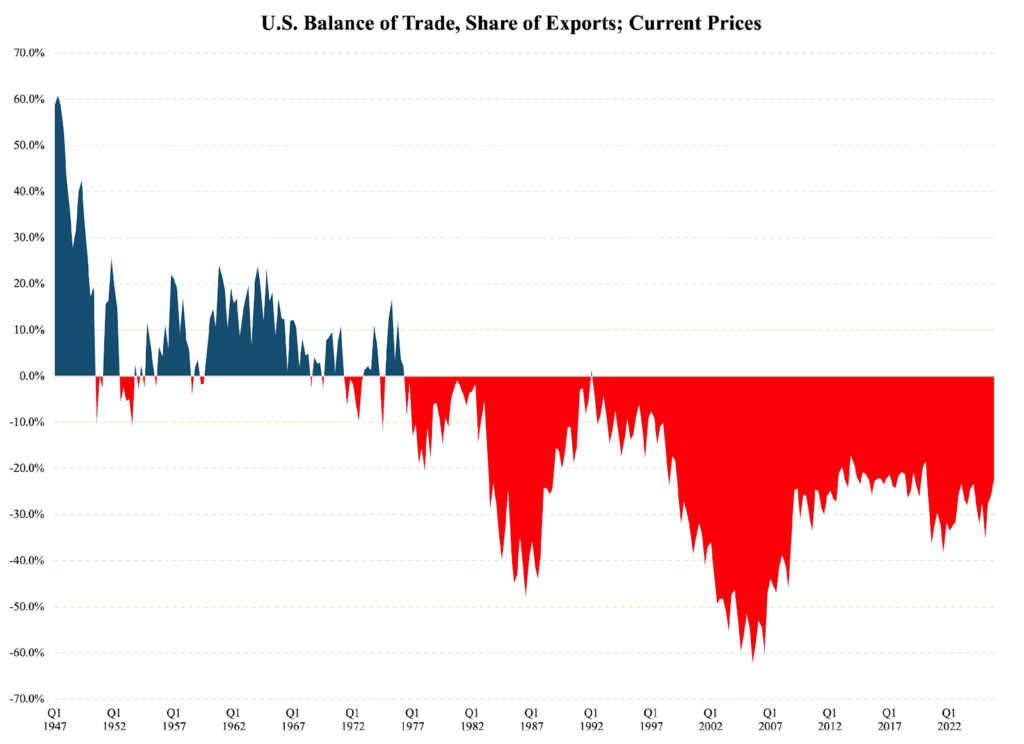
It is never good for a country to run trade deficits for decades, but the United States has not yet experienced the sustained rise in inflation that comes from persistent trade deficits. The reason is that our financial markets—from Treasury securities to stocks—have continued to attract enough inflow of financial capital to offset the trade deficit’s depreciating effect on the dollar.
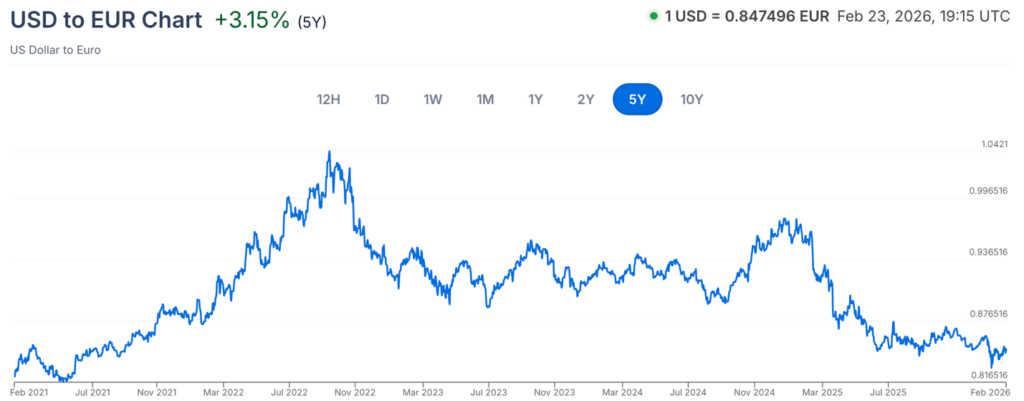
If that financial inflow dwindled and the dollar came under sustained depreciation pressure, then the case for an economic emergency could change. Looking at, e.g., the dollar’s decline vs. the euro over the past year, the case for some sort of emergency declaration could perhaps be made (if we stretch the vocabulary of the English language far enough), but as Figure 2 shows (courtesy of xe.com), this depreciation merely restores the dollar-to-euro exchange rate that we had five years ago:
Figure 2
Another approach to the concept of ‘economic emergency’ would be that the United States were to suffer a major decline in its terms of trade. This is a concept in trade theory that compares the revenue from exports to the costs of imports on an item-by-item basis. The question that the terms-of-trade concept answers is: if country A trades with country B and they sell one another exactly the same amount of goods and services, which country would make the most money?
Figure 3 reports the U.S. terms of trade index vs. the European Union. An index figure above 100 means that on a per-unit basis, the trade between these two economies would benefit the United States. For example, in early 2022, the United States made $9 more on every item exported to the EU than it paid for importing an item from the EU.
Figure 3
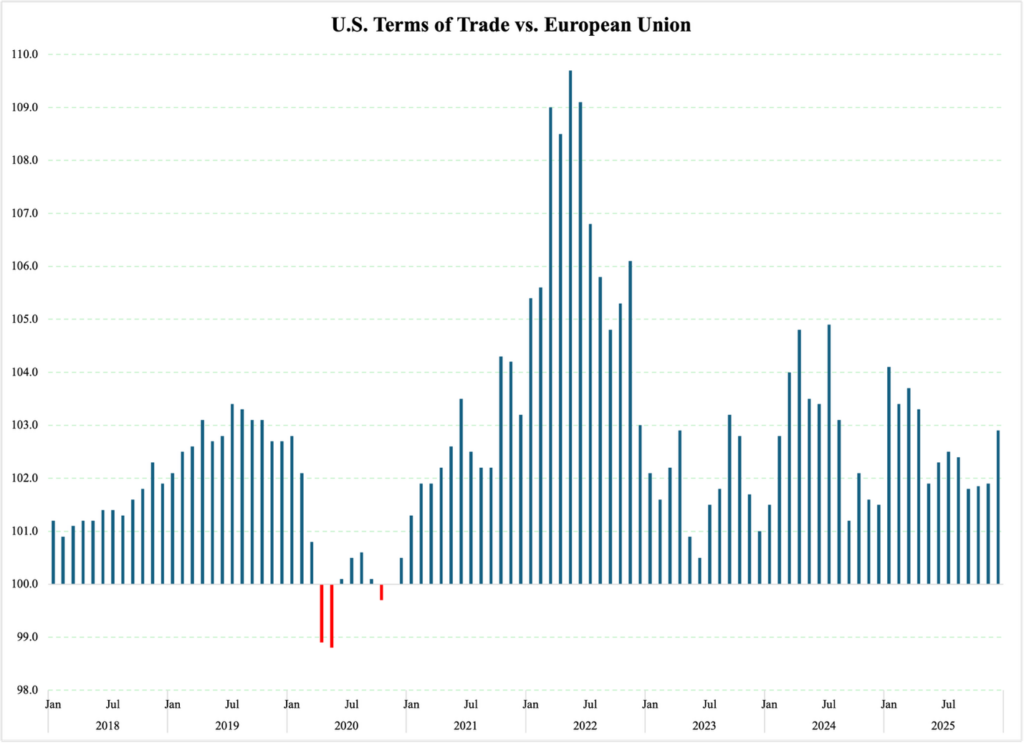
With strong terms of trade, the U.S. economy is relatively well equipped to sustain trade deficits over an extended period of time. That does not mean there is no problem with a trade deficit—it makes the U.S. economy more vulnerable to episodes of financial instability where foreign investors withdraw money from U.S. markets—but as a general point, strong terms of trade speak against the president’s case for an economic emergency.
President Trump is a capable and effective president. One year into his second term, he has already accomplished a lot. But he also has a tendency to act boldly and sometimes brazenly when a more measured approach could have been warranted. His use of tariffs under the IEEPA is a good example.