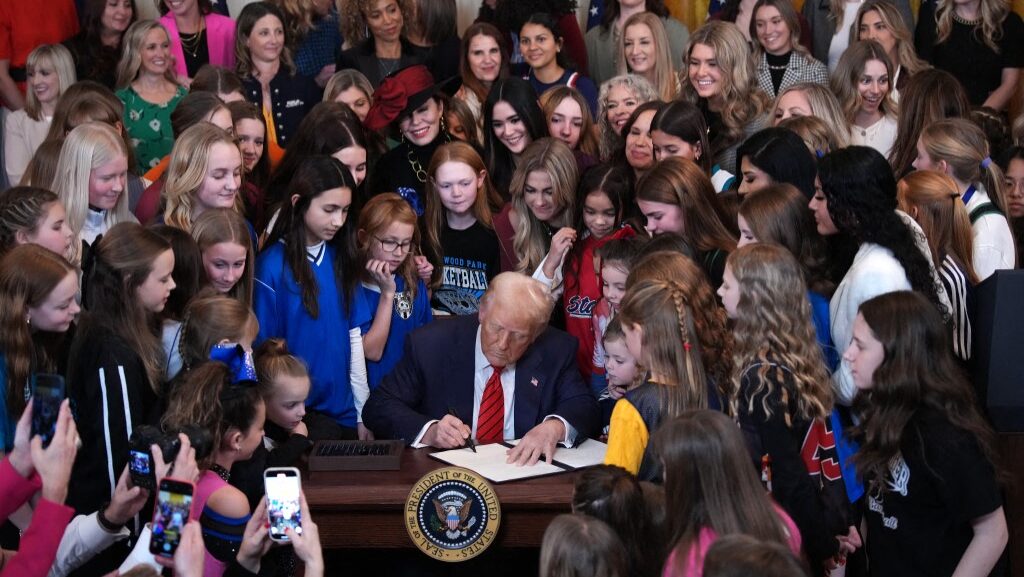
U.S. President Donald Trump joined by women athletes signs the “No Men in Women’s Sports” executive order in the East Room at the White House on February 5, 2025 in Washington, DC. The executive order, which Trump signed on National Girls and Women in Sports Day, prohibits transgender women from competing in women’s sports.
Andrew Harnik / GETTY IMAGES NORTH AMERICA / Getty Images via AFP
This week, the United States Supreme Court is hearing two important cases—West Virginia v. B.P.J. and Little v. Hecox—on whether female athletic categories may continue to be defined by biological sex or must be redefined based on perceived ‘gender identity’ and consequently, whether states can pass laws to protect the integrity of women’s sports. While these cases arise in an American legal context, the questions they raise are relevant internationally. They go to the heart of how the law defines reality—and whether women’s rights can be meaningfully protected anywhere if the category “woman” itself becomes legally indeterminate.
Women’s sports exist for a simple and well-established reason: men and women are biologically different. Male athletes, on average, possess significant advantages in strength, speed, and endurance, which are only accelerated by male puberty. Female categories were created not to exclude, but to ensure fairness—to give women and girls a meaningful chance to compete, excel, and succeed.
Opponents of sex-based sporting categories often frame these protections as discriminatory. In reality, removing them undermines equality. Women do not gain opportunities when female categories are redefined; they lose them. When biological males are permitted to compete in women’s sports, the result is predictable and measurable: fewer podium places, records and victories and, another key factor in the US-context, fewer scholarships and therefore fewer educational opportunities for women.
This is not a question of politics or cultural preference. It is a question of principle and law. If legal and institutional definitions of “woman” become fluid or subjective, then the protections designed specifically for women and girls—in sport, education, and public life—lose their foundation. Rights that cannot be clearly defined cannot be reliably protected.
The consequences of ignoring biological sex are no longer theoretical. In 2024, a United Nations report by the Special Rapporteur on Violence Against Women and Girls documented that hundreds of female athletes had lost medals when male competitors were allowed to compete in female categories. Across 29 different sports, more than 890 medals were affected. This represents years of training, discipline, and sacrifice erased—not by superior female competitors, but by a redefinition of the rules themselves.
These realities underscore why the issue before the U.S. Supreme Court matters far beyond American borders. Across Europe, and around the world, governments, sporting bodies, and courts are grappling with the same tension: how to protect sex-based rights in an era increasingly shaped by gender ideology.
The core legal issue is universal. From school sports to university athletics to elite international competition, female categories depend on sex-based definitions. Remove those definitions, and the category collapses.
The legal advocacy organization I lead, Alliance Defending Freedom International, has long engaged at the international level on this issue. In 2024, we submitted a petition to the International Olympic Committee (IOC), supported by more than 40,000 signatories from around the world calling on the IOC to ensure that female athletes are not forced to compete against biological males. This was not a rejection of dignity or respect for any person. It was a defence of fairness, safety, and equal opportunity for women and girls.
What is essential—and what the Supreme Court cases place squarely in focus—is that female sporting categories remain protected in law and policy. Without such protection, women face systemic disadvantage, and the erosion does not stop at sport. Once sex-based distinctions are treated as optional or discriminatory, the legal safeguards built around them weaken across society.
The decisions now before the U.S. Supreme Court are part of a wider global reckoning about sex, gender, and equality. They highlight a fundamental truth: to uphold women’s rights, the biological categories “man” and “woman” must be clearly specified in law. That is not only an American concern. It is a question that touches every society striving for fairness, clarity in law, and the protection of women and girls.
Editor’s note: A ruling in the two cases is expected sometime in spring or early summer 2026.