

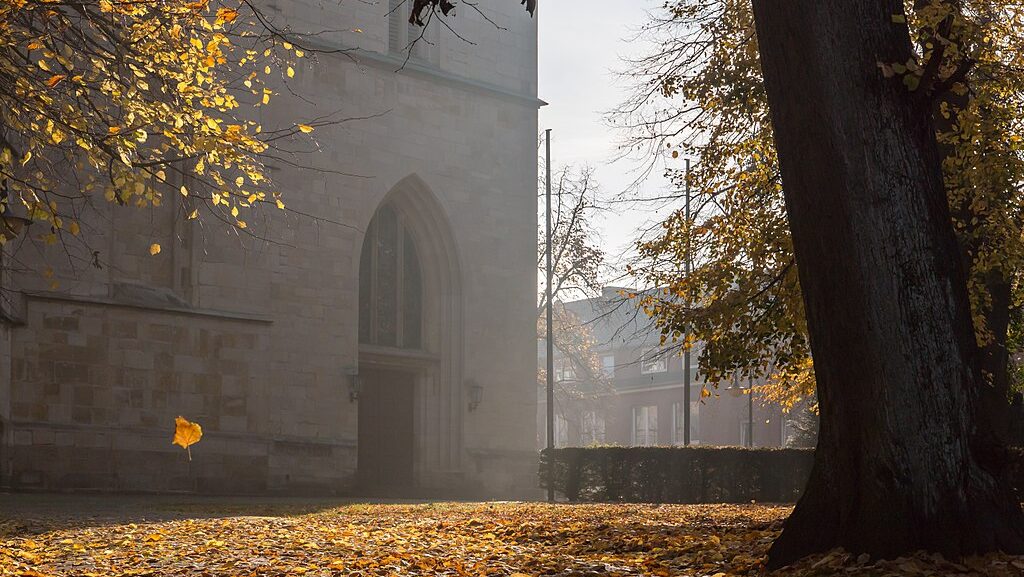
Entry of the St Viktor Church in Dülmen, North Rhine-Westphalia, Germany, dating back to around 780 A.D.
Donald Trump has issued a warning to the EU from Scotland: “On immigration, you better get your act together.” He added, “You’re not going to have Europe anymore.” The U.S. president has told European leaders to their faces what almost everyone already acknowledges in private. The Great Replacement was not a conspiracy theory. It is a sad reality. And perhaps Trump’s words are a good opportunity to go back to the beginning and, frankly, answer the big question that concerns all Europeans: When did we lose Europe?
Often, in a process of identity demolition, it is difficult to pinpoint a single moment in history as the sole trigger. But the truth is that, in this case, we Europeans have the death certificate in writing—and it was drafted twenty years ago. The constitutional text of the new European Union had been under discussion since 2002. The point of contention that went most unnoticed has turned out to be crucial in light of later events: the refusal to include in the Constitution an explicit reference to Europe’s Christian roots. Countries such as Poland, Ireland, Spain, and Italy supported this common-sense reference, which was also an unquestionable historical truth. France, Belgium, Sweden, Denmark, Finland, and the Netherlands were adamantly opposed, demanding instead a secular constitution. They won. In 2004, the European Council approved the final text without any mention of Europe’s Christian origins. In its place, the Union’s moral and cultural framework was handed over entirely to the familiar preaching of French Freemasonry.
And although the rejection of the Constitution by the French and Dutch in referendums brought it down the following year, the 2007 Treaty of Lisbon revived the constitutional text while maintaining the deliberate omission of Christian culture as Europe’s unifying backbone. This would not have been possible without yet another betrayal by Germany’s CDU, which preferred to insert ambiguous wording on the grounds that the reference lacked practical significance. If you lived through that time, you will surely remember when the German Christian Democrats believed that the only thing citizens cared about was the economy, not cultural battles.
None of them, of course, bothered to heed Christopher Dawson’s warnings in Understanding Europe: “It is essential to realize that the Christian community in the past was not a pious ideal, but a juridical fact which underlay the social organization of Western culture.” Nor did they pay any attention to Hilaire Belloc in Europe and the Faith:
This our European structure, built upon the noble foundations of classical antiquity, was formed through, exists by, is consonant to, and will stand only in the mold of, the Catholic Church. Europe will return to the Faith, or she will perish. The Faith is Europe. And Europe is the Faith.
Let us return to 2025 and indulge for a moment in an exercise of poetic justice: France, Belgium, Sweden, Denmark, Finland, and the Netherlands—the countries that most strongly pushed for a secular Europe—are the ones now facing the worst security problems stemming from illegal immigration of Arab origin. They are regular targets of attacks and suffer extreme Islamization in the vast ghettos of their major cities. No one should be surprised: eliminating Christianity did not yield freer, more tolerant, more democratic societies, but rather societies more easily colonized by Islam—which is the opposite of freedom, tolerance, and democracy. Sadly, bad ideas cannot be tested in a laboratory or tried out on rats: history itself delivers the verdict once they become reality.
The founding text of the new Europe diluted the Union culturally by abandoning what had once been the cause of its unification: Christianity. The drafters of the European Constitution would have done well to attempt a simple historical thought experiment—to rethink matters from an alternative scenario. What would Europe be without the historical expansion of Christianity? Doing so today, in 2025, is chilling, because the result resembles—in a macabre way—the state of the Old Continent as we now find it. Let us imagine how history would have been written if the disciples of Christ had failed to evangelize Europe:
1st century A.D.: Rome still worships Jupiter. The Empire knows nothing of monotheism, and its territories are fragmented into local cults. Although the mystery cult of Mithras has become the religion of the armies, the peoples of the North, for example, still worship Thor. The fall of the Empire leaves behind a heterogeneous, polytheistic territory. Without Christian monasteries, monks, and priests—without copyists—the legacy of Classical Antiquity is lost, while Latin and Greek fragment and localize, with no common linguistic vehicle to unify the Old Continent culturally.
From the 7th century onward, the Islamic expansion into Europe meets no opposition; the caliphates conquer Hispania, southern Gaul, and Italy. Europe’s great cities become Islamized, and there is no trace of Crusades: the only wars are tribal, or fought over scarce resources.
There is no Pope—or if there is, he is no universal spiritual guide—and Rome is not the spiritual center of the Western world. The Renaissance does not emerge in Italy but in Alexandria and Baghdad. There are no Catholic universities, only local temples crowned with pagan beliefs. Christianity never appears in art: no Christs, no Virgins, no great cathedrals—only vast temples to the Sun in the centers of towns and cities.
Inevitably, no one discovers or evangelizes America; there, the natives continue offering human sacrifices to their gods—at least until the Arabs arrive, who favor a different form of worship: sacrificing the natives.
By the 17th century, the notion of universal rights emerges in diluted form, for it is not grounded in the equality and dignity of all men as children of the same God, but in a purely tribal moral code that varies from people to people, just like the laws that govern coexistence. The only thing linking Europe’s cities is trade—but even then, we cannot speak of ‘Europe,’ because no such unity exists.
Morally, Europe is divided between Odin- and Thor-worshiping northerners, the Mediterranean cult of Mithras, western caliphates, and Celtic zealots of Beltane and Samhain in the British Isles. The seasons dictate the calendar: harvest time, sowing time, time for offerings to the gods. Meanwhile, Europe, dominated by these pagan beliefs and culturally backward, is swallowed by Islam—which exploits both the moral vacuum left by Enlightenment secularists and the inconsistency of religions that bow to the elements of nature.
As deranged as this imagined scenario may sound, it is precisely the Europe that the most important European leaders sought to embrace twenty years ago. And that is, in the end, the Europe they now have: a nihilistic, secularist Europe which, as Chesterton said, does not believe in God and therefore believes in anything; which abandons human rights; which no longer sees human life as possessing unquestionable inherent dignity; which permits the killing of unborn human babies but forbids it if those babies are animals, to which it offers an environmentalist cult eerily reminiscent of pre-Christian paganism. And, of course, meanwhile, it slowly succumbs to Islamization, watching its own people die in terrorist attacks without even being able to face the problem of illegal immigration head-on.
I don’t know if it will make any difference, but somehow Trump’s brief, blunt words have reminded European leaders of their greatest failure. In reflecting on this unforgivable collective disaster, one cannot help but hear the old sermon of Ronald A. Knox:
We can only abandon the Catholic Church for some spiritual home which is more of a home than the Catholic Church … Where are we to bind such a revelation, such a spiritual home, such sources of inspiration? Nowhere; there is no other system in the world which does even to claim what the Catholic Church claims. Are we to abandon the Catholic faith for something less than the Catholic faith?





2 Responses
The EU leaders responsible for this suicidal path of allowing islamization should all be tried and executed for High Treason.
France, Belgium, Sweden, Denmark, Finland, and the Netherlands: Fucking idiots have been leading these nations, islamization will swallow up them all.