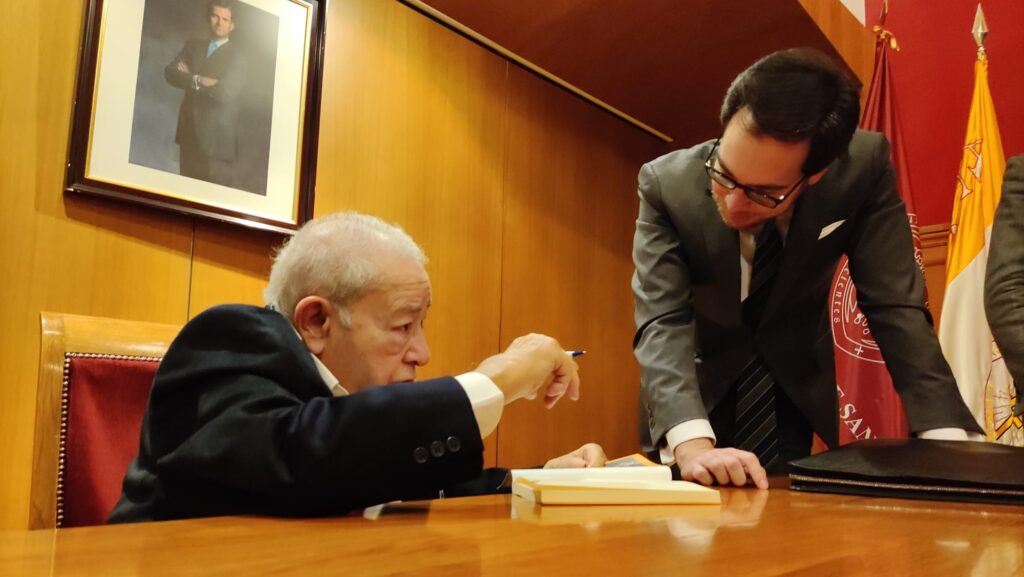
José Antonio Pérez Ramos—a member of the AcDP and CEU-CEFAS in Madrid, and a member of our Editorial Board—confers with Don Dalmacio at one of his last public appearances.
Spain, a defeated and weary empire, became a pawn in the chessboard of international politics during the 19th century, a saeculum horribilis for the Spanish nation. The naval defeat at Trafalgar and the terrestrial loss at Ayacucho (in the Viceroyalty of Peru) marked the irreversible decline of the Hispanic Monarchy. London shaped Spain’s foreign policy while Paris dictated it: as a foreign dynasty, the Bourbons had worn its crown since the reign of Louis XIV and his Grand Siècle. It should come as no surprise that the marriage of Queen Isabella II in 1846 was not decided by the Madrid government but by a clandestine resolution of Anglo-French diplomacy. From 1809, with the Bayonne Statute—the first of Spain’s written constitutions—a succession of fundamental laws and granted charters, steeped in French influence, shaped Spanish constitutionalism and political thought. Spain languished politically, afflicted by a ‘constitutional mania,’ where public opinion was led to believe that a constitution could resolve any crisis and remedy all ills. A tragicomic revolution dubbed ‘La Gloriosa’ (1868), with its turncoats, exiles, and executions, followed by the exotic and fleeting reign of Amadeo of Savoy (1871-1873) and a federal republic that inflamed regional separatisms (1873-1874), culminated in disaster: the 1898 victories of the American fleet at Santiago (Cuba) and Cavite (Philippines). This bore the semblance of a finis Hispaniae.
Ousted from the Western Hemisphere by the Treaty of Paris (1898), Spain found itself entangled in the Mediterranean, burdened by the great powers’ Machtpolitik and saddled with the ill-fated Rif Protectorate in Morocco. “The Rif is a bone for a dog, and that dog is Spain,” wrote the literato Ernesto Giménez Caballero. As the nation hit rock bottom, some months before, with the proclamation of the Second Republic, this same idiosyncratic figure published Geniode España(1932), a probing examination of Spanish decline and a therapeutic call for its resurrection, a milestone in the spiritual formation of the younger generation.
In this context—in a period marked by the enervating despondency and defeatism of the generation of ’98 (i.e., Unamuno, Baroja, Azorín, and Maeztu), and embodied in the even bleaker, frivolous little 1921 book of José Ortega y Gasset, España invertebrada (Invertebrate Spain), and buoyed by the hope of a new cohort of university students, young minds eager to elevate the nation’s spiritual and scientific tone through tectonic reforms—Dalmacio Negro Pavón was born, two weeks after the approval of the 1931 Constitution, on 23 December 1931.
A Madrileño with Old Castilian and Galician roots, Negro Pavón was the son of a lawyer and civil servant in the General Directorate of Security and a teacher dedicated to educating deaf-mute children. Known to his students as Don Dalmacio, he experienced the tragedy of the Spanish Civil War at the tender age of five. His father—a classmate of José Antonio Primo de Rivera at the University of Madrid’s Faculty of Law, and a republican without significant political involvement—was abducted from his home by the Popular Front government, imprisoned in a checa [Editor’s note: these were unofficial detention centers and torture chambers during the Spanish Civil War], and murdered by the communists during the Spanish holocaust at Paracuellos del Jarama in the autumn of 1936. Rescued by the (British) Red Cross alongside his mother and brother, Negro Pavón escaped besieged Madrid. After the war, like much of the country, he was raised in a spirit of national reconciliation, though some now, for convenience, disavow this through infamous ‘historical memory’ laws.
The young Dalmacio studied law and philosophy, though he had initially considered medicine—a choice that, perhaps unconsciously, informed his “pharmacological” conception of politics, advocating strong remedies for states of exception and anomalous political situations.
Don Dalmacio, sincerely unassuming without affectation, described himself as a “transmitter” of the teachings of his mentors, an exceptional group of intellectuals he encountered at the Central University in the early 1950s: a cohort of jurists and historians of political ideas unrivaled in Spain’s recent history. These men, born in the early 20th century, formed the most cohesive, creative, and original generation of Spanish political thought since the sixteenth and seventeenth centuries—the golden age of Hispanic culture. While notable 19th-century political writers like Juan Donoso Cortés or Jaime Balmes were exceptions to the general decline of Spanish political thought, it was not until the mid-20th century that a revival occurred. Between 1935 and 1969, the ‘jurists of ’27,’ Don Dalmacio’s mentors, shaped Spain’s transformation, lifting it from its status as the ‘sick man of Europe’ and fostering political and economic development under the influence of the ordoliberal school. Carl Schmitt, who knew Spain in the 1920s and 1940s, noted in 1951 a rekindling of its national consciousness and pride.
Don Dalmacio remained steadfastly loyal to his mentors, whose intellectual legacy he could not disown. They gave substance to what could be called a “golden quarter-century of Spanish political thought.” Figures like Francisco Javier Conde and Luis Díez del Corral, primarily through their oral and direct teaching (magistri ex auditu), were closely tied to him, alongside other luminaries such as José Antonio Maravall, Manuel García Pelayo, and Jesús Fueyo. These men—friends and occasional classmates at the University of Madrid—were fellows at various European universities, but their intellectual affinities pointed toward Germany as a destination for their generation akin to Renaissance Italy for earlier Spanish scholars. Inspired by Ortega y Gasset, they sought the ‘blonde ferment,’ the spiritual and scientific catalyst—the ‘German science’—capable of renewing Spain from top to bottom. Half-jokingly, it was said that these young Spaniards, sponsored in Berlin, were “palms aspiring to become firs.”
The jurists of ’27 played a pivotal role in building a modern state in Spain during the 1950s and 1960s. As Don Dalmacio elucidated in Sobre el Estado en España (On the State in Spain, 2007), their work culminated—under the “constituent developmental dictatorship” of General Franco, a prominent figure in times of decadence akin to General de Gaulle—in the 19th-century liberal efforts to establish a state and an efficient public administration. As Spain’s foremost historian of the state, Don Dalmacio illuminated the contributions of these men and the foundational significance of this era in contemporary Spanish history. He thus expanded our horizons, pointing toward Spain’s future. It has been said, shortly after his passing, that our debt to Don Dalmacio is immense, for through him, his students and readers have at least a chance of not dying politically ignorant. The same could be said of two other keen Spanish political minds of his generation: Gonzalo Fernández de la Mora and Álvaro d’Ors.
Yet Don Dalmacio was more than an epigone or transmitter of an intellectual legacy. On his own, in a Spain of the 1970s and 1980s hostile to liberal and conservative ideas, he restored the splendor of the ‘liberal tradition of the political,’ identified with Western politics—an endeavor projected through time, built on Greco-Roman and Christian foundations. He often noted that it was in Greece where humanity discovered the logos of politics, the possibility of a political way of life. In La tradición de la libertad (The Tradition of Liberty, 2019), his intellectual testament, he distilled the “political tradition of liberty,” clearing away economic (Austrian Economics) and moralistic (progressive individualism) confusions to distinguish political liberalism from regalist (or statist) liberalism. The latter, paradoxically distorted by the French Revolution and the expansion of the state, fueled what he, with Thomas Molnar, termed “totalitarian liberalism.” For Don Dalmacio, the true liberal was the European archetype of the political realist, akin to Raymond Aron’s “moderate Machiavellianism.”
Don Dalmacio explored other important topics in his El mito del hombre nuevo (The Myth of the New Man, 2009) and La ley de hierro de la oligarquía (The Iron Law of Oligarchy, 2015). But his most original contribution lies in the concise essay Gobierno y Estado (Government and State, 2002). Here, he articulated a metapolitical distinction as significant as those advanced by Carl Schmitt—das Politische (the political) and der Staat (the state)—and Julien Freund—le politique (the political) and la politique (politics): the distinction between state and government, often overlooked in political science. Government, as the expression of power and command, is a historical constant (“there is always a government”), while the state is a specific, historical, and somewhat contingent political form. The notion of a ‘medieval state’ is nonsensical—did Charlemagne drive a car? The state, and thus Staatlichkeit (statehood), aligns with modernity, meaning “there has not always been a state.” This “superior and forgotten banality” is another hallmark of his thought, developed with great erudition in Historia de las formas del Estado: Una introducción (History of the Forms of the State: An Introduction, 2010). This work also reflects his extraordinary pedagogical gift, encapsulating over half a century of teaching in his university chair of ‘History of Ideas and Political Forms,’ a German historicist invention perfectly adapted to Spain.
A lover of chrestomathies and the noble art of the footnote, Don Dalmacio was not only a writer but also a reader—and, as he so often acknowledged (quoting Alfred N. Whitehead), a debtor (“no one is born with their own ideas”). A simple meal with him naturally turned into a reading list for his companions. His irony and calm demeanor offered lessons in how to navigate the world. As a liberal political realist, he cautioned against the feelings of “indignation” or the equally futile “despair,” both antipolitical attitudes so typical of (respectively) the inexperienced young or their anxious, fossilized elders. Don Dalmacio’s most enduring legacy, however, was his commitment to truth. By his side, we learned that truth was unbearable and the search for it afflicts most people. Submitting to its demands exacts a toll. Yet, we have willingly paid it, knowing that the authentic freedom of humanity depends on the measure of truth one can finally endure.
This essay appears in the Winter 2025 issue of The European Conservative, Number 37:57-59.