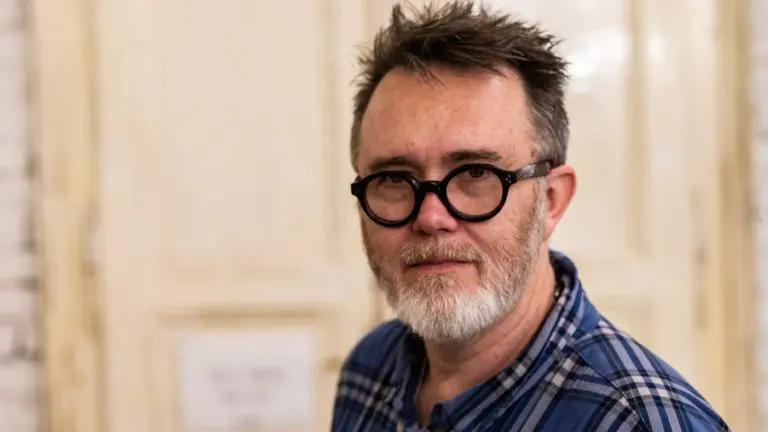
Olavo de Carvalho sitting at a desk in his home outside Petersburg, Virginia, in May 2019. He moved to the U.S. in 2005 and lived there until his death in 2022.
Photo by Terrance McCoy/The Washington Post via Getty Images.
Treat yourself to the right’s conference circuit these days and you’ll hear the same chorus call—not just for new institutions, but for a refreshed cadre of thinkers to inspire and lead them. The need is easier acknowledged than filled. Where are the candidates? What ought be sought in that pool? How to scout talent and promise with hostile departments and faculties? What pathways to reputation should be built as alternatives? How to separate the loud conspiracists and cranks from the timid geniuses?
The abortive headhunt leaves a paralyzing deficit. Candidates and office-holders are even gaslit into dismissing potential recruits as bigots or hucksters, if not pseudo or anti-intellectuals. Our political-activist sphere lacks the countervailing influence of an intellectual class to reaffirm their instincts and to ground them in serious philosophical, historical, and social-scientific soil. Excellence is thus relegated to the coffee-soaked pages of obscure scholarly journals, seldom to be taken seriously even by our own side.
This unfit pipeline, which is depriving us of an intelligentsia, has been noted in these pages. But the deficit is compounded in Latin America—where few such initiatives exist—by a slimmer tradition of scholarship and argument distinct from European imports, with conservatives at pains to draw on the wellspring of Western tradition. Initiatives like this magazine’s forays are requisite, yet scarce. It is then doubly jarring that the intellectual godfather of the region’s new Right, a man who impels us to oppose neo-Marxism by rearming ourselves with Western thought, remains overlooked: Olavo de Carvalho.
I was only vaguely aware of Olavo until a trip to São Paulo in 2023. I spoke only to self-styled ‘pupils’ of the erudite Brazilian, from the heir to his intellectual estate, Silvio Grimaldo, to Mariana Deis, who recently edited a collection of Olavo’s key writings and lectures. The neglect is unfounded, characterised by smears framing Olavo as a conspiracist bigot alongside other ad hominems. Most unfairly, he remains posthumously besmirched as a “self-proclaimed philosopher.” The innuendo aims at his preference to spreading ideas far and wide over pursuing pedigree, the unusual channels he employed, and the coarse language in which he indulged. These facile charges misconceive what a “philosopher” does. If Olavo’s accusers intend ‘philosopher’ only to mean ‘someone with a Ph.D. in philosophy,’ then their credentialism sullies inquiry. Olavo hearkened back to an older style of philosophizing. His threshold was laid at the rigor requisite to undertake “the search for unity of knowledge in the unity of consciousness, and vice-versa,” per his famous definition of the discipline.
Despite the clouds of defamation, rediscovering Olavo’s thought is of the essence. It is nowhere more urgent than in Brazil, amidst the onslaught on speech taking place under the juristocracy of left-wing strongman Lula, and headed by its chief censor, justice Alexander de Moraes. Olavo succumbed to a respiratory disease in 2022 at his home in Virginia, a tragedy misrepresented by his enemies as the result of his COVID skepticism, even though the virus wasn’t the cause. His death midway through the presidency of Jair Bolsonaro, who lost power in the following year, paired the philosopher’s legacy even more tightly with the former president’s name. Bolsonaro’s election in 2018 owed a debt of gratitude to Olavo’s influence that is acknowledged on both sides, but the latter’s warnings about Bolsonarism’s shortcomings weren’t heeded during the philosopher’s life. The debt won’t be settled unless they are.
Olavo’s stature transcends the ranks to which most Europeans are accustomed. Bolsonaro rode a cycle of discontent directed at the rank corruption of the Workers Party under Lula’s tutee, Dilma Rousseff, which erupted due to her mismanagement of the 2014 World Cup. Olavo had sown the seeds of that backlash for decades. When he died, headlines cast him as “Bolsonaro’s right-wing guru” in profiles and obituaries, a treatment few Latin American intellectuals of any persuasion get these days. Then, in 2019, mere weeks into Bolsonaro’s term, Walter Russell Mead and Anastasia O’Grady attended a much-discussed dinner that Brazil’s U.S. ambassador convened in Olavo’s honor, testifying to the interest he aroused in right-of-center circles. He wrote a total of 40 books, delivered innumerable lectures and briefings, and spoke countless hours online. He suffered worse than below-the-belt attacks: Sleeping Giants, a sleazy left-wing executor of cancel culture, bullied PayPal into withdrawing access for Olavo’s blockbuster e-academy, which at its peak enrolled over 2,000.
In fairness to the dim-brained snubs, Olavo did eschew conventional academia, and was even put off from undergraduate study in his 20s. He viewed Brazilian education and scholarship as bewitched by the myth of peaceable revolution, embodied by João Goulart, the Marxist leader overthrown in a 1964 civic-military coup. The lack of any Brazilian history—even late into the ’80s—that wasn’t decolonial and left-wing, and the neglect of Western tradition, so upset Olavo that he changed tack in the 2000s. Dropping a successful column at the O Globo daily and other influential papers, he forewent traditional channels for a more didactic mode of communication with his readers. He began penning a blog, virilizing online posts, and e-lecturing. His alienation from Brazil’s mediascape culminated with his move to Richmond, Virginia in 2005, where he dwelt amidst dogs, books, and firearms. He became even less inclined to return, becoming enamored with his adopted nation’s Tocquevillian culture of faith and civic life. He had regular visitors, but visited others less often.
Olavo’s online popularity is dismissed by those who would refuse to engage with him even if he’d joined their academic reclusion. Reaching millions more than were possible from within the ivory tower, he drew a blueprint of how new institutions can be built when the old can’t be reconquered. His strong language—porra!, the Brazilian ‘f-word’ with which he routinely spiced his talks—often mirrored the treatment he received, choosing to call his slanderers by the vulgar name instead of permitting attacks upon his integrity. His eldest daughter, turned a left-wing activist, was prodded into accusing him of intra-family abuse. His past as an astrologer and a member of Tariqa, an esoteric Sufi order, were unearthed—but tellingly, only in the wake of Bolsonaro’s victory. The media sought then to tarnish his name, hoping to sully the whole political enterprise that he had helped ignite.
In reality, what Olavo abandoned in favor of his staunch, adult Catholicism wasn’t Islam, but an interest in perennialism and its syncretization of world-faiths. Oddly for a conservative, Olavo was drawn to universal truths about reality, human nature, and consciousness. He fell prey, in his youth, to the illusion of a “transcendent unity of religions,” per Tariqa’s founder. Olavo eventually abandoned heterodoxy, yet what could have been an asset had he remained an ivory-tower intellectual instead became a liability in the Bolsonaro era. He was irrepressibly interested in other cultures and felt alienated, even underwhelmed, by the prevailing narrow-mindedness of leftists—and some traditionalists, too. This dovetailed with his demure intellect. After the “indecent hurry of youth,” he spent 30 years grappling with doubts. He returned to the fray aged 48, reinforced by the imprimatur of intellectual maturity.
In the age of partial narratives and media distrust, it was the smear of ‘conspiracist’ that weighed most on Olavo’s repute. He warned of a “global socialist dictatorship” plotted by a blob of financial interests that he termed the “Syndicate.” Charges of antisemitism, though, would have fallen flat on Olavo. He both abhorred Jew-hatred and was immune to such accusations, pointing to the presence of leading Protestant interests in the Syndicate, and to the large Jewish role in opposing it as incarnated by Israel and most traditions within Judaism. Presuming a worldwide Marxist regime in the making appeared odd at the time, and may well have been far-fetched on his part. Olavo was irrepressibly skeptical, allergic to teleologic history, and alert to logical inconsistencies. Yet his term “globalism,” now common parlance across the new right, spoke to a widening disconnect between the interests driving the West’s foreign policy and those of Western peoples. Olavo proved a visionary, too, in arguing for transcending traditional left-right divides in favor of a conservative-versus-revolutionary dichotomy.
His intuitions have seeped into the consciousness of millions. Olavo sensed that Capitalists’ tug-of-war with Marxism was giving way to a new predicament. The former may still tout the old antagonism, even as they push for new mutations of their foe, including social engineering and wokeism, while never missing a chance to lock in their juicy oligopolies. Olavo wasn’t, to be sure, an anti-capitalist. He knew the Western genius was built partly on bourgeois values and risk-prone innovation. But his fiery anti-communism stretched into skepticism of capitalism’s role in these anomalies. This all sounded conspiratorial when he wrote it, but our hindsight may rehabilitate his foresight, as capitalism turns woke and multinationals profiteer in state-capitalist countries, phenomena he termed “meta-capitalism.” Debating Aleksandr Dugin, Olavo wrote that “Capitalism is the godfather and protector of communism; the real war is between communism and Christianity.” Calling himself a counter-revolutionary, he drew a straight line from the French Revolution to the onward march of progressivism, and stretching to issues of gender and race. This Jacobin “revolutionary mentality” had taken over the West, he warned, embodied in the Syndicate, the ultimate driver of Western capitalism and foreign policy.
Olavo’s global outlook sounded even bleaker. The Syndicate was but one of the three “globalist forces” vying for worldwide supremacy, along with Islamism and Dugin’s Eurasianism. And just as he had disproved the charges that traditional Western spirituality incubated antisemitism, by emphasizing the irreducible Jewish contribution to it, he also put the lie to claims that skepticism of the West necessarily meant Russophilia. Olavo was not just anti-Putin; he was averse to the whole experiment of Russian nationalism, which he framed as a failure either to cage Orthodox Christianity into Russia’s borders or to let it expand peacefully through the lure of its spiritual contrast with Western decadence. Olavo was never blind to the decay of a West devoid of spirituality. Yet in Russia’s “imperial religion,” not unlike in China’s hardening state-capitalist regime, he sensed a similar secret police, unaccountable for the atrocities it committed in the name of an atheist dogma for which he advocated reparations. Even as the West converged with the Russian-Chinese axis in the revolutionary nature of its telos, he saw Bolshevik and Maoist crimes as incomparably worse, yet the cause of far less guilt.
Olavo pointed to re-enchantment as a re-infusion of traditional Judeo-Christian spirituality. He accused Dugin, an antisemitic holist, of murderous collectivism. Refuting individualism as the West’s doomed endpoint, he instead located the roots of our decay in Karl Popper’s “open society.” The two differed in method, too: Olavo believed in objective truth. He claimed that, for all of his adherence to a postulate, the social scientist differed in stance from the actors under his social “microscope.” One pursues clarity, the latter seeks to advance their interests. Dugin spoke from the standpoint of a Putin stooge. Olavo sought to explain, grasp, and decipher what laid behind his adversary’s Eurasianism.
Ultimately, Olavo’s legacy remains wedded to the Bolsonarism he inspired, precisely when it suffers its worst setbacks under Lula’s persecution. And yet, Olavo and Jair Bolsonaro represented diverging—at times conflicting—elements of the Brazilian new Right. Those looking for a future beyond Lula’s corrupt socialism would do well to seek a fine understanding of their differences—not to discard either, but to elucidate their mutual dependencies. Olavo’s enabling role in enthroning Bolsonaro earned national attention. Crowds gathered in São Paulo on 2018 election day chanted, “Olavo is right!” with the slogan printed on yellow-gold t-shirts. In a victory-day livestream, Bolsonaro was seen flanked by one of Olavo’s film-adapted blockbusters, O Jardim das Aflições. Along with A Nova Era e a Revolução Cultural (1994) and O Imbecil Coletivo (1996), these make up a trilogy of Olavo’s ‘combat works.’ One of the former president’s sons, Congressman Eduardo, avowed that “Without Olavo, there would be nothing.” Countless Olavist media, think-tanks, and other initiatives flourished under Bolsonaro and in his wake, often as a way to illuminate his failures with Olavo’s insights. My trip acquainted me with many, including Brasil Paralelo, a literal conservative Netflix focussed on the nation’s former imperial glories and current socialist miseries under the aegis of Lucas Ferrugem, and the scholarship of Dr. Rafael Nogueira, Bolsonaro’s pick to helm Brazil’s National Library.
Olavo swung some key appointments, too, not least the intellectual-diplomat Ernesto Araújo to Itamaraty Palace, Brazil’s powerful Chancellery, and the Colombian-Brazilian Ricardo Vélez Rodríguez to the Education Ministry. Along with Araújo, he introduced Bolsonarism to U.S. intellectual circles, conferring it with stature. He allegedly coveted the U.S. ambassadorship to excuse his exile. Though a shadow ministerial role of some kind in Brasilia would have befitted him, being at arm’s length allowed him to befriend thinkers whom he could interest in Brazil. Paulo Guedes, the neoliberal banker whom Bolsonaro appointed to the post of Finance Minister, told Olavo, “You’re the leader of this revolution.” Interest on the American Right was considerable, even if only at the elite level: Chris Buskirk and Roger Kimball attended the Washington dinner on the intellectual side, while Steve Bannon and the Schlapps did so on the activist end.
Yet, that’s about as far as ties went. Olavo tirelessly downplayed achieving office as only a superficial victory, emphasizing that, without organic structures to sustain governing elites and roll back cultural neo-Marxism, the 2018 win would amount to little in the end. As early as 2019, he clashed vigorously with Bolsonaro’s V.P., general Hamilton Mourão, calling him the vulgar name and indicting the top brass for sharing in what he called a “coup mentality.” The coup to which he accused Bolsonaro’s generals of hearkening was, again, 1964: the toppling of a Marxist status quo that kept the underlying cultural battlelines intact. Araújo held similar views and was shown the door, allegedly for opposing Chinese encroachments in Brazil.
Olavo’s scorching critique lays bare divergences between an emboldened Brazilian Right and the “martial” mentality of Brazil’s positivist generals, steeped in a tradition going back to Auguste Comte, the Frenchman behind Brazil’s motto (“Order and progress”). Prizing the country’s development over all else, these men in uniform had sought to govern in a soldierly way along non-ideological lines. Rather than choosing one over the other, Bolsonaro’s aftermath—and Olavo’s afterlife—keep revealing the need for complementarities. Few better examples exist than Olavo criticising Bolsonaro for not fighting left-activist judges forcefully enough, a failing that has violently come back to haunt the country in the form of censorship and the exiling of critical journalists.
Olavo’s name means “savior” in Norwegian, and points to the endurance of his legacy beyond attacks and above intra-right feuds. His burial place in Petersburg attracts Brazilian pilgrims on a regular basis, many of whom have been molded by his influence. His blog’s name, too, points to preserving the flame he lit: “Malice does not overcome the wise.”
This essay appears in the Autumn 2025 issue of The European Conservative, Number 36:30-33.