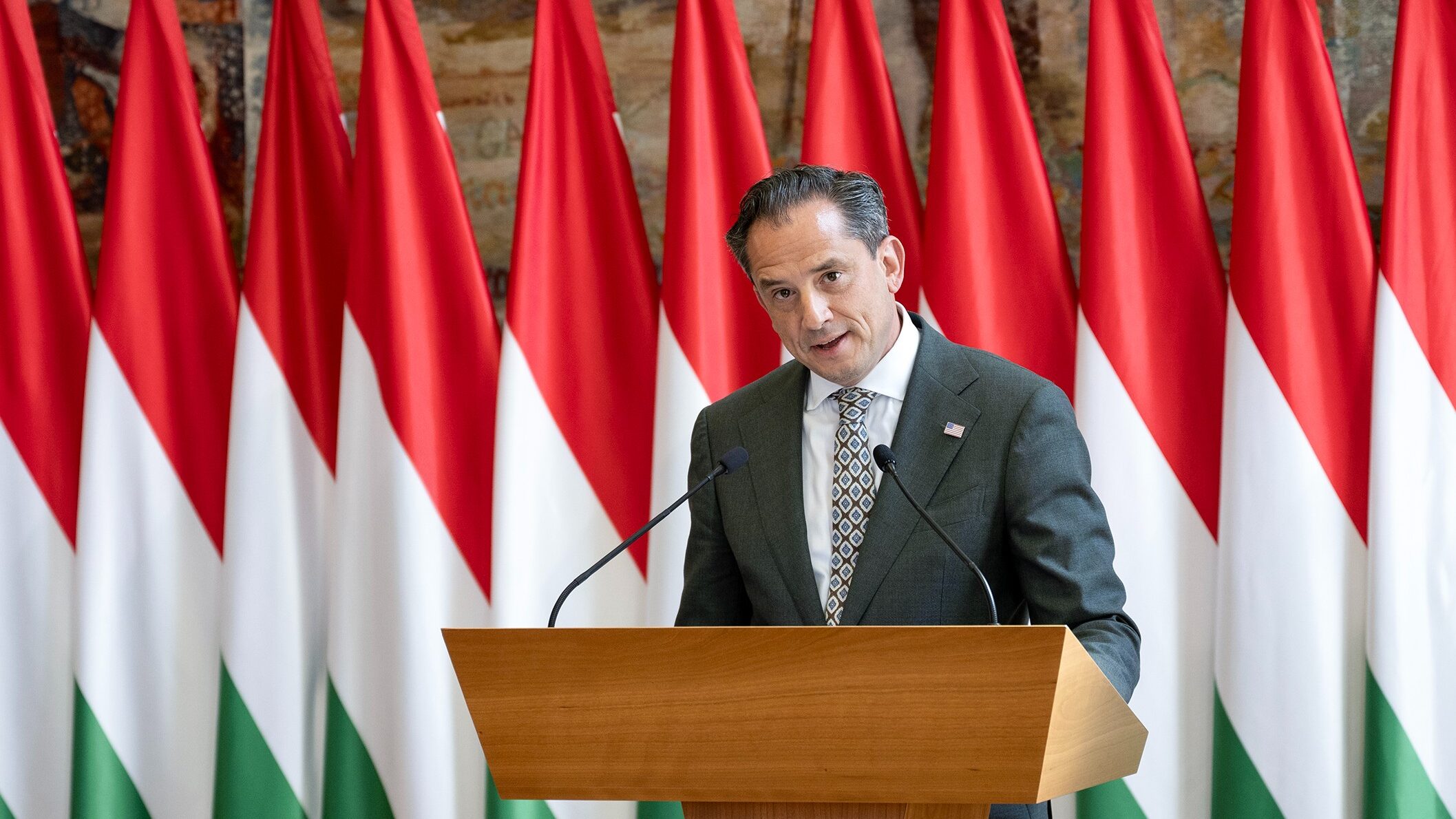
Robert Palladino
U.S. Embassy Budapest
Relations between the United States and Hungary have gone through very different phases over the past decade, shaped by the political direction in Washington. During Donald Trump’s first presidency, Budapest and Washington found common ground based on the defense of national sovereignty, firm control of borders, and respect for traditional values, especially family and faith. This climate of harmony contrasted with the chill—and even confrontation—that characterized the subsequent years under the Democratic administration, when ideological differences and the globalist approach of U.S. foreign policy strained bilateral ties to the limit.
Trump’s return to the White House has meant a fresh start. Hungary is not a problematic partner for the new presidential team but an ally with whom principles and strategic objectives are shared. In this context, Secretary of State Marco Rubio appointed Robert Palladino as Chargé d’Affaires at the U.S. Embassy in Budapest, ensuring the diplomatic representation applies the America First doctrine without ambiguity.
Palladino, with experience in the State Department and a profile aligned with the president’s sovereigntist vision, stresses that today “the United States and Hungary treat each other with mutual respect” and that cooperation is already yielding concrete results in key areas such as energy—with an agreement to explore the deployment of U.S. small modular nuclear reactors—defense, and border security.
The interview took place during the latest edition of the MCC Festival in Esztergom, a city on the banks of the Danube that has become a reference forum for conservative thought, and that this year brought together political leaders, academics, and diplomats from around the world. Against this backdrop, Palladino analyzed the current state of bilateral relations, Hungary’s role in Europe, and the future of U.S. foreign policy under Trump’s leadership.
Secretary Rubio asked me to come to ensure that our embassy was aligned with President Trump’s America First policies, and that is precisely what I have done. Our new policy is very focused on sovereignty, realism, and respect. I think it’s hard to find another country whose foreign policy has changed so drastically from one administration to another, and we are already seeing results. We have returned to classical diplomacy, focused on practical interests such as energy, defense, space, and commerce.
I lead the diplomatic mission on behalf of Secretary Rubio. President Trump appoints ambassadors, and in the meantime, I am executing the United States’ foreign policy. The difference from the past is remarkable: the United States and Hungary are once again treating each other with mutual respect, which allows us to talk and advance our common interests. Recently, a letter of intent was signed to explore the deployment of U.S. small modular nuclear reactor technology in Hungary. This potential multi-billion-dollar agreement will help meet its growing energy needs.
President Trump values leaders who do not apologize for loving their country. Prime Minister Orbán has defended Hungary’s faith, family, and future—something that resonates deeply with the president and millions of Americans. Both men understand that strong nations are built on moral foundations, not on bureaucratic mandates. Hungary has dared to stand up to the internationalist progressivism that seeks to impose a single model of democracy. And on migration, it was ahead of the curve: it understood before many others that if you don’t secure your borders, you have no nation.
What Hungary has achieved in border security is admirable. It was understood early on that each country must decide who enters its territory because its national identity depends on it. This requires assimilation, not mass migration. In the United States, for years, changes were promised that never came. President Trump acted from day one: he reinforced the border, reactivated deportations, and returned control of our borders to our country. In Europe, there are still places where governments ignore the popular will on this issue and do so at their own risk.
Trump’s foreign policy is based on realism and respect toward other nations. He is a man of peace: he has worked to end conflicts and prevent others from starting. He should be given more credit for this. The examples are there: easing tensions between India and Pakistan, the withdrawal of troops from the Democratic Republic of the Congo and Rwanda, or the mediation that avoided open conflict between Cambodia and Thailand. We must also measure success by the wars we have prevented. In that respect, the president deserves great credit.