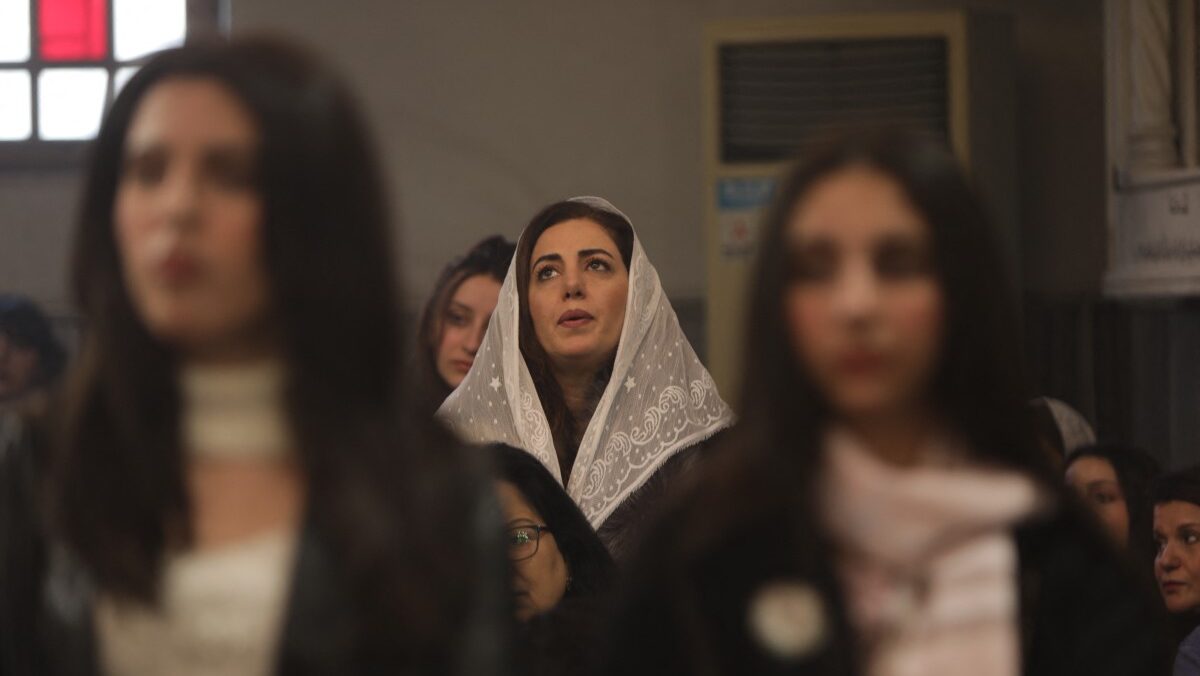
Worshippers attend Christmas celebrations at the St. George’s Syriac Orthodox Church in the old city of Damascus on December 25, 2025.
BAKR ALKASEM / AFP
The situation of Christians in the Middle East has largely disappeared from the headlines, but it has not stopped deteriorating. Following the territorial defeat of the Islamic State, persecution has not vanished; it has become quieter, more structural, and in many cases more definitive.
Entrenched conflicts, fragile states, radical Islamism, and ongoing geopolitical realignments are accelerating a process of disappearance that threatens to empty the very lands where Christianity was born of their Christian presence.
In this context, voices such as that of Charles de Meyer, president and co-founder of SOS Chrétiens d’Orient, are essential to understanding realities on the ground. Since 2014, the organization has deployed thousands of volunteers in countries such as Syria, Iraq, Lebanon, and Armenia, working directly with local communities on reconstruction, education, and humanitarian aid—independently of government agendas and funded exclusively through private donations.
In this interview, De Meyer offers a clear diagnosis of the present and future of Eastern Christians: the concrete impact of regional instability on daily life, the risk of becoming bargaining chips in geopolitical power games, the constant pressure to emigrate, and the discomfort their witness creates in increasingly secularized Western societies. It is a conversation that forces Europe to confront a reality it prefers to ignore—and one that continues to cost lives.
Christians in the East experience contrasting situations, but these converge on the same conclusion: a drastic reduction in the number of Christians in the Middle East. While Copts enjoy a demographic dynamism that is unique among Eastern Christian communities, they are isolated in this case.
Several factors explain this situation: the radicalization of Islamism and the numerous conflicts that regularly engulf the region, with direct or indirect effects on Christians.
Take the case of Syria, for example: before the start of the civil war, Christians accounted for 7–8% of Syria’s 20 million inhabitants. Today, their number has been reduced by at least half. There are now only about 25,000 Christians in Aleppo, compared to 150,000 at the beginning of 2010.
The weakening of ISIS has of course been a blessing for Christians who were under its occupation, such as in Mosul or the Nineveh Plains, but it also means that Eastern Christian communities are once again invisible in the media. It is as if Europe and the West only care when barbaric acts are widely reported in the media.
Eastern Christians will only be able to regain prosperity once the Middle East has stabilized. The current reconfiguration, which is still struggling to take its final shape, is not without negative consequences for Christian communities.
For example, Christians in southern Lebanon had to leave their lands during the Israeli strikes in the country, even though they were targeting Hezbollah. The Christian areas of this region were not spared the effects of the war: I hope that they will receive all our help so that they can return to their homes and live in dignity.
Peace is the prerequisite for a return to normal life for Christian communities, and a peace whose future is being considered by those who cherish the Christians of this region. In Syria, like many other segments of society, Christians are still waiting to see what decisions the transitional authorities will make. In Iraq, there are still many tensions surrounding the ability of Christians in the Nineveh Plains to fully exercise their rights.
In daily life, many Christian families in the Levant are tormented by the question: Does it still make sense for my family to remain on the land of our fathers? Fathers wonder whether they can fulfill their duties to protect and care for their children. Mothers wonder whether they will see their daughters grow up in societies that respect their identity and integrity.
These questions must, of course, be answered according to the realities of each society, but one thing is certain: chaos only encourages Christians to emigrate, to flee their lands.
My experience is simple: wherever historical continuity is preserved in the Middle East, Christians are respected. They have cared for, taught, educated, translated, and helped their neighbors from various communities for centuries. Societies often have longer memories than international decision-makers.
Unfortunately, many want to disrupt this long memory. Some Islamists want to portray Eastern Christians as traitors by nature, as the Ottoman Empire had already done during the Armenian genocide, while others believe that Christians should have a minority status, close to or identical to dhimmitude.
Lebanon would not exist without Christians, the Egyptian elites have drunk from the sources of Christian schools for decades, and Syrian society would betray its history if it allowed Christians to leave the country. When they have rational interlocutors, Eastern Christians know better than anyone how to defend their interests. However, they must not be confronted by Islamists who want to enslave them and supported by Westerners who claim to understand the interests of Christianity in the Middle East better than Eastern Christians themselves.
We have more than 3,000 volunteers who have been working in the field since 2014, so we have undergone many changes to adapt to evolving local situations.
We always define our projects from the ground up, receiving requests from various local actors: clergy, members of civil society, and public partners. The huge advantage of SOS Chrétiens d’Orient is that we are entirely funded by private donations, so we are free to decide how we distribute our aid.
Of course, some realities impose themselves on us: in Iraq, for example, we financed camps for displaced persons for a long time before turning our aid to the reconstruction of Christian communities liberated from the Nineveh Plains and Mosul. In Armenia, on the contrary, we had to intensify our aid to families driven out of Nagorno-Karabakh.
More generally, we always try to remain faithful to our motto: help us here to help them there. Everywhere, we do our utmost to show Christian communities that their very existence has value and meaning in our eyes. This was the case in Lebanon during the economic crisis, after the explosion at the port of Beirut, and during the Israeli offensive. It is also the case in Syria, where we continue to spend hundreds of thousands of euros after the departure of the former authorities.
Everywhere we go, we want those we help to say to themselves: yes, in practical terms, our presence is certainly a filial duty, but it is also a gift for all Christians throughout the world.
Of course, we see jihadist metastases everywhere: in Sudan, eastern Congo, West Africa, and of course Nigeria.
We believe that there is an ecumenism of suffering in the name of Christ, who after all was the rock of the early church. It is very interesting to go beyond the present suffering, mainly under Islamist fire. It is very edifying for us to read the testimonies of Christian resistance to totalitarianism in the 20th century. For example, we learn a lot from those who have experienced the horrors of communism, with very fruitful exchanges in Lithuania, for example, but also elsewhere.
As for the present day, we can clearly see that jihadists are learning from each other: the Muslim Brotherhood has served as a bridge for dozens of figures who have evolved towards even more radical fanaticism, for example. And it is clear that despite very different dynamics in the persecution of Christians by Islamist organizations, they all learn to condemn Christians, mobilize the same religious interpretations, and the same thinkers. In short, while the objectives vary, when analyzed closely, the argument is often the same. And that argument is nothing less than a call to murder.
I believe that first and foremost there is a lack of faith.
If we truly believe that persecuted Christians die because they bear witness to Christ, who himself gave himself up to the torment of the Cross to redeem humanity, then we enter a whole new dimension. And from this perspective, distance is no longer appropriate.
Those who die in the name of Christ disappear for nothing if our hearts do not burn to defend them, to admire their courage and their spiritual attachment. This is most certainly why they disturb modernity so much: it would like to portray Christianity as an outdated relic, and is faced with the eternal contradiction that is martyrdom.
Martyrs do not pay lip service; they resist all ideologies. They die because evil rejects the Savior. Evil takes various forms, expressions that are more or less barbaric, but it is always there, lurking and fighting against the people of God.
Yet these realities disturb our secularized societies, which are intrinsically incapable of being touched by this witness. They speak of fatality, of blunders, of harmful consequences; they do not want to talk about martyrdom. And yet that is what it is all about.
First, we must “weep with those who weep.” We must allow ourselves to be moved. We must refuse to remain silent about the suffering of Christians who are persecuted or victims of war, whether they live in Aleppo, Baghdad, Goris, or Tyre.
Next, we must pray, for prayer is the first step and the one that strengthens us in our genuine commitment to stand alongside those who suffer for Christ.
Prayer is the mother of action. It will lead us to question what needs to be questioned: to combat indifference, to bring the situation of Eastern Christians to the forefront of international negotiations, to refuse to play into the hands of persecutors who are convinced that Christian communities have become too cold to defend persecuted Christians.
At this price, we will be able to immerse ourselves in our European heritage, which has never doubted its duty to provide spiritual, political, and material support to our Eastern brothers and sisters.
On this subject, as on so many others, we must ask ourselves what would happen if we were unworthy of the duties of our peers, of the sacrifices of generations of Europeans who gave their lives and sacrificed their heritage so as not to abandon the lands evangelized by the companions and first disciples of Christ.
And if we feel bold enough, we must go out and meet our Christian brothers and sisters. For example, by volunteering with SOS Chrétiens d’Orient in one of our missions? It’s up to you!