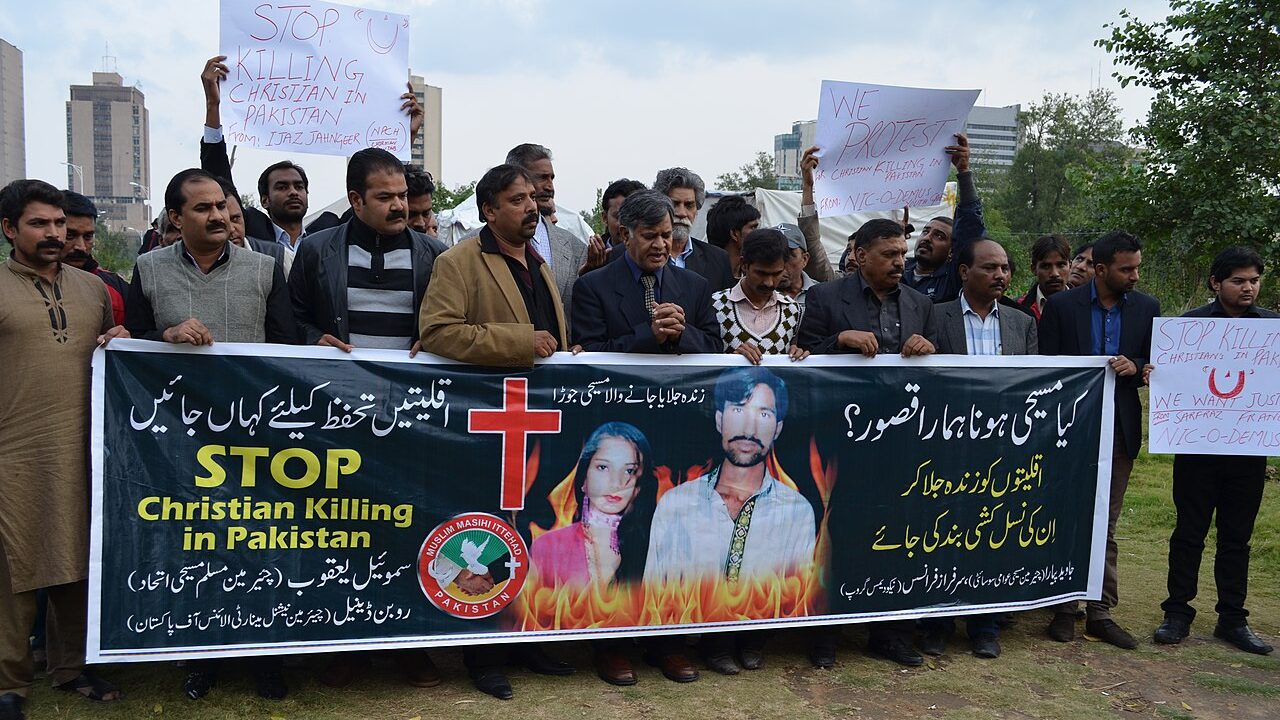
Christian demonstration in Pakistan, 2020.
Photo: Voice of America / Public Domain CC-BY-SA 4.0 via Wikimedia Commons
“If the European Union starts to consider democratically elected governments illegitimate simply because they do not share the dominant political line in Brussels, then the problem is no longer Viktor Orbán.”

Father Federico Suaya is an Argentine priest and missionary, as well as a lawyer trained at the University of Buenos Aires. He holds two doctoral degrees—one in theology and the other in philosophy. He is the co-founder, alongside Father Dr. Javier Olivera, of the Order of Saint Elias, a missionary order established in 2015 to bring the Catholic faith to regions where the Church’s presence is minimal or non-existent. Fr. Federico has led missions in places such as India, as well as in remote regions like the Himalayas and isolated parts of Africa.
Currently, Father Federico is leading the PaX Project to rescue Christian slaves in Pakistan.
That’s the way it is. Christians face violence, sexual harassment, and social exclusion. Their churches are attacked and they are kidnapped, often leading to slavery, and forced apostasy—violent conversion to Islam—is common.
It’s not. Basically what we do is what we call special missionary operations and our goal is to rescue Christian slaves from the clutches of their oppressors. There are three kinds of slavery in Pakistan. First, there are the sex slaves—women who are kidnapped and forced to convert to Islam and marry their captors. Then the ‘husband’ decides whether to keep her, sell her, or prostitute her by offering her to his relatives or friends who come and rape her.
Then we have debt slavery. To pay off the debt, the debtor and usually his whole family become slaves for generations, because we are talking about amounts that in many cases are impossible to pay because of the exorbitant interest on the loans. Many of these slaves work in brick kilns, which I have seen with my own eyes. [There are more than 18,000 brick kilns in Pakistan, producing 60 billion bricks a year, largely operated using slave labor.]
Finally, there is a third form of slavery, which is sexual slavery due to debt.
We entrust ourselves to God and to the Blessed Virgin and we draw up a rescue plan and a post-rescue plan, which has three levels. The rescue has different modalities, because no two cases are the same, and we act according to prudence, the virtue of prudence; many people think that prudence is cowardice, but it means doing what needs to be done at any given moment. Sometimes we use the classical method, the Mercedarian method, and pay a ransom. [Founded in 1218 by St. Peter Nolasco, the Order of the Mercedarians was born with the mission of freeing Christians held captive by Muslims by paying a ransom.] Other times we use the secret method, at night, and an escape is organized. And any other method, according to the Gospel, that prudence dictates.
Yes, that’s right, but to carry them out we rely on the work of volunteers. Christians suffer from slavery and constant oppression, and their situation is terrible. The Christian is considered “chura”, which in the local language means “sweeper.” For us, it does not have a negative connotation, but there it is equivalent to saying “excrement.” In Pakistan, Christians are attacked, raped, beaten, or burned alive. Blasphemy laws are used as a weapon of terror by radicals to accuse innocent Christians of crimes they did not commit. Typically, there is no punishment for the criminal, and the persecution of the Christian is often celebrated.
There are two levels. One is the local police, who are systematically bought by the slavers and are totally corrupt. Then you have the national police and the state services, which are on a different level and deal with problems like the more than forty terrorist groups operating in the country.
Yes, debt slavery is banned in Pakistan. Therefore, our activity is legal and we do not violate any Pakistani law. If the police ask us anything, we are perfectly fine.
It was very clear to me that this is what God wanted me to do, and when you have that clarity, you can only say: Go. What brought me to Pakistan was a news item I saw in Infocatolica where a woman had her nose and private parts cut off. I told this to a woman I had baptized, and she told me that if they found out she had converted, the same thing would happen to her. When she told me that, I started to read about it and I came to sex slaves and I couldn’t think of anything else to do but to help. And we began to help.
At the very least, we are talking about hundreds of thousands of Christian slaves. There is an estimate, which also includes Muslim slaves, that speaks of two million people. There are also thousands of slave camps; you walk two steps and you find a brick kiln.
We are children of the Church. I had a meeting with the Pope and he almost cried when I told him about the terrible situation of the sex slaves. He supported me and gave me his blessing to continue this work.
So far we have rescued 93 slaves in 12 expeditions. We started in August last year, although we did one remote rescue a little earlier. Once rescued, these people are offered a safe place to live, a weekly food allowance, and education for the children. This is the second part of our work, the PaX Project, which is establishing gated communities in Pakistan for freed Christian slaves. We are raising funds to open the first gated community this year. We still have a long way to go.