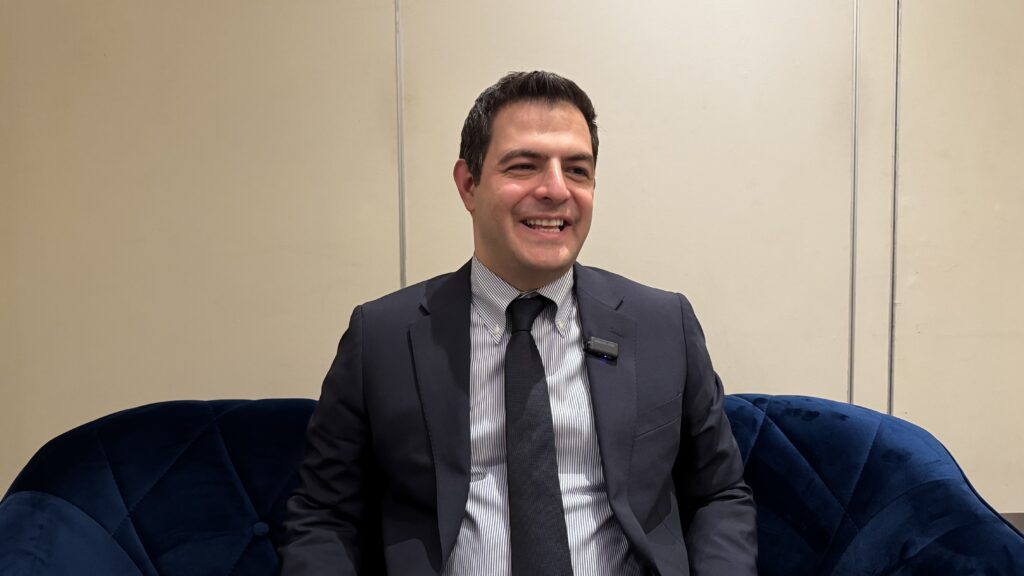
Fabrice Leggeri MEP
Courtesy of Fabrice Leggeri
“The best response to the violence is not hatred, but the daily courage of those who continue to believe that ideas are fought with other ideas. Never with violence.”
Fabrice Leggeri is a senior civil servant and Rassemblement National MEP since 2024. A former director of Frontex (2015-2022), the European border and coast guard agency, he is a member of the European Parliament’s Committees on Civil Liberties, Justice and Home Affairs (LIBE) and the Special Committee on the European Democracy Shield.
I can see a difference after Ylva Johansson’s departure, because she was so bad that it is not complicated to be better. The new Commissioner for Migration and Home Affairs, Magnus Brunner, is better, comes from the EPP and not from the Left, and wants to improve border control and the return of migrants.
In fact, he has proposed to change the return directive to a return legislation and has accompanied his proposal with two new drafts on “safe third countries” to which illegal immigrants can be sent. The first draft is much more flexible than previous ones, which is a step in the right direction, and the second is a list of those countries. Brunner is not a spokesman for the NGOs, and a good sign is that in the LIBE Committee, he was criticized by Renew, the Socialists, the Greens, and the Left. Moreover, he has turned to me, as coordinator of the third largest group and former director of Frontex, and sees me as a key partner to talk to.
The question is whether the commissioner has the support of Ursula von der Leyen, who increasingly needs the support of Renew and the Socialists. So von der Leyen has to give something to the left, and that would explain her position on Israel. Anyway, we have to be cautious and see if the EPP maintains a firm stance, and together we can push for a strong agenda on migration.
France is nowhere because we have Macron, who is a supporter of the woke ideology and is scared to lose the vote of the Arab population, so he condemns Israel. And, on the other hand, our Minister of the Interior, Bruno Retailleau, pretends to be tough on migration and security, but without results. Germany is pushing more to the right than France because the Christian Democrats see that more and more German voters are supporting the AfD, but they have a coalition with Socialists, so the situation is complicated. Italy is pushing in the right direction, as we have seen with the opening of the migrant center in Albania. I think the game is interesting for us, for Patriots, the ECR, and the sovereignists, because there is a political space to say to the EPP, “Let’s be serious; if you really want to have a stricter migration policy, stricter border controls, and a serious return policy, cooperate with us.”
I think we have to cooperate with the EPP, but I have no illusions. We have to be tough and not support the regulation if they try to make any agreement with Renew or the Socialists.
I think this shows that politicians and nations need to regain their power. In a democracy, the voters decide, but those foreign judges are appointed, and some are militants. Each country has the right to decide who can or cannot enter its territory.
An interesting development was proposed by Meloni and by the Danish prime minister: They sent a letter to the ECHR saying that the court should not overreact, meddle in this issue, and block the possibility of member states to control their borders and reject migrants. It is very important to note that nine member states signed the letter, and I think it opens up the possibility of revising the Human Rights convention and shows that more and more governments want to address the problem with the ECHR.
Regarding France, if we win the presidential elections, Marine Le Pen or Jordan Bardella will propose a referendum where French voters will directly choose whether they want to regain control of migration policy. If that is the case, no European judge will be able to overrule our decisions or tell us what we can or cannot do.
Yes, it is the initiative of Phillipe de Villiers, a right-wing intellectual, and it has been amazing to see how, in a couple of days, they have collected more than a million signatures. Our political party did not create this initiative, but we are delighted if our members and voters want to sign it. We are the largest party in the National Assembly, and even if we don’t start petitions, we will push anything that goes in the right direction. Anyway, this referendum idea comes from Marine de Le Pen, and she proposed it three years ago when she was a candidate in the presidential elections.
Phillipe de Villiers’ idea is going in the right direction and is having a great reception, and we have also seen the massive protest in London and even the rally held in Madrid. In our view, nations are waking up and citizens want to regain control of their countries. Politicians in the last decades have excluded citizens from decision-making. If you ask the French if they want family reunification for migrants who do not work, who have not integrated, and who live on welfare benefits, the answer would be a resounding no.
The event in Madrid is another example of this reaction that we are seeing all over Europe. It was fantastic; the vibes were great, and the participants were so enthusiastic. Some of the speakers talked about mass migration and how it is changing the identity of our nations. Europe is a Christian continent, our cultural roots are Christian, and our nations are finally waking up.
Macron’s problem is that he has a problem with democracy and elections because he rejects the results of elections. In the European Parliament, I have had to explain to French MEPs from Renew that they are no longer the majority force because they have lost the elections. French voters have made this very clear. Macron created his ‘Republican Front’ to exclude the ‘extreme right,’ and he did so with the extreme left, antisemites, supporters of Hamas and violence, with people listed as an “internal threat to national security” or who used their paychecks as members of the National Assembly to buy drugs. Of course, it was a mess.
Yes, although we would need an absolute majority to make the country governable and to face a president—Macron—who will do everything possible to work against us. In the past, we had presidents who accepted having lost elections—for example, when François Mitterrand cohabited with a right-wing prime minister, Jacques Chirac; and there was also the opposite case, a right-wing president and a socialist prime minister. However, this does not seem possible with Macron, and more and more French people realize that he is the problem. We believe that if he is not able to accept reality, Macron should resign.
Yes, it is necessary to stop the increase in debt. When Macron came to power eight years ago, the debt was 2,000 billion euros; now it is 3,000 billion, i.e., Macron has increased it by 50%. And for what? Not to invest in the future, not to build infrastructure. If we see how public services work in France, everything is collapsing. Justice does not work because there is no investment in resources, and there are no prisons to send convicts to; medical care is increasingly precarious, etc. The cuts are necessary, and we have to reduce the expenses of the state, but our difference with the proposal of the previous government is that we do not want to increase taxes on the middle and working classes, nor increase taxes on businesses.
In France, we have very cheap electricity thanks to our nuclear power plants, but due to the ideology of Brussels, we have had to finance solar panels and green electricity. If we pay the real price of electricity, we can boost economic growth and ease the burden on businesses and the population. We also propose to end all benefits to illegal immigrants and our contribution to the European Union. It is curious that while the [member] states are forced to reduce their budgets, the European Commission keeps increasing theirs.
The policies implemented in France have failed and the president should simply listen to what the voters say, accept democracy and the outcome of the elections, and appoint a prime minister in line with what the French want.