Music and cinema shaped the 20th century; social media shapes the 21st.
Alfred Derks from Pixabay
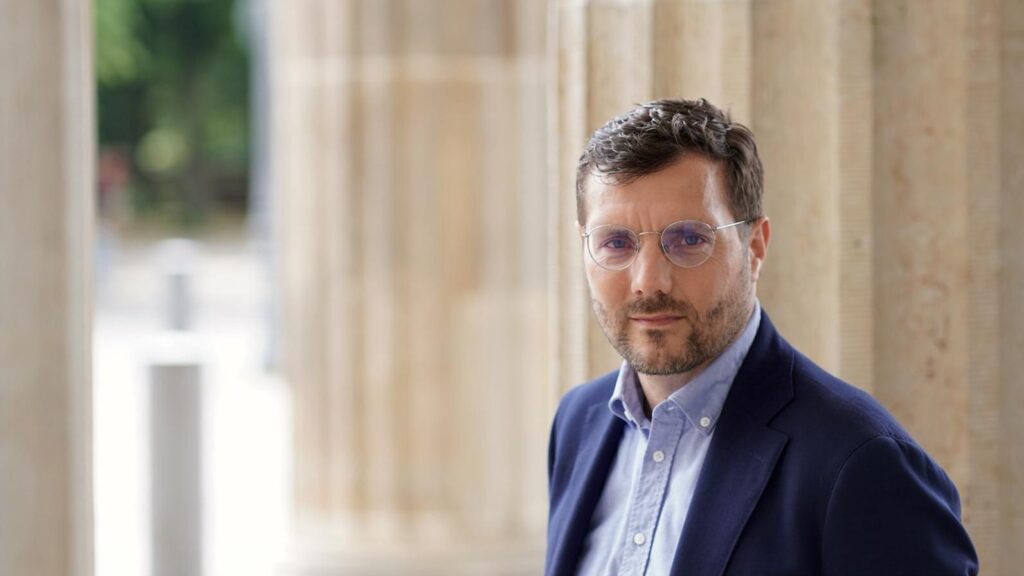
Titus Techera is an editor for the Logos Initiative & teaches politics in the Manhattan Institute Logos Fellowship. He is a cultural critic writing for American think tanks including the Liberty Fund, the Acton Institute, the Claremont Institute, ISI, and AIER, as well as conservative publications ranging from the Washington Free Beacon to First Things and the Asia Times. He is the executive director of the American Cinema Foundation, host of the ACF movie podcast, and lectures on cinema in universities across America.

Techera attended the 5th Conservative Summit in Bratislava, organized by the Ladislav Hanus Institute, where he participated in the panel ‘How to return to the spiritual and cultural foundations of Europe.’
Music and cinema were the basis of education in the 20th century. They are somehow being replaced by social media in the 21st. Conservatives rarely understand this and almost never do anything about it. Conservatives can change their ways—or they can be replaced by the kind of political conflicts that became obvious with the rise of Trump, with the Brexit campaign, and any number of other shocks that threaten regime change throughout Europe. These events elicit strong passions and create indelible memories; conservatives, on the other hand, can only claim a limited nostalgia—they have no other grasp on what is memorable, yet they cannot expand into the newly ‘liberated’ territory opened up by these conflicts. Hence, the rise of populists who are figures of social media.
Perhaps conservatives are afraid of the ugliness of popular entertainment; perhaps many intelligent or scholarly people simply cannot survive in the noisy world of the mass media democracies. Perhaps, too, rich people or business-minded people simply lack the ambition to act at a national, or even international, scale. They are small men. But altogether, the result is a great irresponsibility. However, ‘the Right’ is not absent—it’s just a different Right. I remind you of such things as the Bronze Age Pervert, who mixes interpretations of Schopenhauer or introductions to 20th-century musical modernism with insults and vituperations I cannot repeat in a respectable publication. There are millions of people, especially young men, interested in such a ‘right-wing culture,’ but they have nothing to do with conservatism.
Conservatism used to rely on a combination of politicians and intellectuals, largely ignoring the arts; but it turns out that without the popularity and beautification offered by the arts, it’s hard even to find new politicians worth mentioning, so conservatism ended up stuck with increasingly mediocre exponents, or without any at all—just intellectuals talking to each other.
Angel Studios is a remarkable enterprise, an attempt to offer the American Christian audience the sorts of movies that Hollywood won’t make. One can look at three different genres. The thriller: In 2023, Angel Studios had a blockbuster with Sound of Freedom, a Christian true story of a noble man in law enforcement fighting off human trafficking. Then, the biography: In 2024, Angel Studios bought the Todd Komarnicki movie Bonhoeffer: Pastor. Spy. Assassin., on Dietrich Bonhoeffer’s life & martyrdom. The documentary: In 2025, Angel Studios made a miniseries based on my friend Rod Dreher’s non-fiction bestseller Live Not By Lies, a warning against resurgent totalitarianism in the West and an attempt to inherit the resources, cultural and spiritual, of the Central European peoples who suffered under totalitarianism. I’m not sure how successful Angel Studios is, but it’s worth learning from their example, both because they look for stories outside the ‘liberal consensus’ and because they are trying to change the funding & distribution models for cinemas to appeal directly to communities interested in such works of art or entertainment.
No, European cinema is, as is traditional, dependent on state subsidies and on a small class of people involved in the movie-making business, so there is very little innovation. Probably, political support to renew the arts is necessary to get rid of old, boring projects and start competitions that allow the young to choose new artists or themes. Or, Europeans could find ways to get money and reach an audience in America to jumpstart new businesses here.
Yes, it’s clear that the arts no longer have any ideological power; they can neither indoctrinate audiences nor give artists subjects worth pursuing. The task of the artist now, therefore, is to find out ways of making works of art that escape ideological ‘nostalgia’ and instead take responsibility for societies left to grow wild under the influence of digital technology.
Let me recommend only European films, from the North, the South, the East, as well as Central Europe, from the last decade, which deal with some of the major problems our civilization is facing. In chronological order, Ruben Östlund’s The Square, 2017, shows that modern art cannot face the double pressure of competing with social media and achieving a moral transformation of its audience. The movie satirizes progressive cowardice, yet it managed to win the Palme d’Or in Cannes; it was also nominated for the Oscars.
Florian Henckel von Donnersmarck, who made The Lives of Others in 2006, came back to his subject, beauty in relation to tyranny, in 2018, with Never Look Away, a Bildungsroman that examines Nazi Germany, Communist East Germany, as well as capitalist, democratic West Germany. It, too, was nominated for a couple of Oscars, as well as the Golden Lion in Venice.
Terrence Malick’s A Hidden Life, 2019, is a beautiful story about a martyr, Franz Jägerstätter, an Austrian peasant, a conscientious objector, murdered by the Nazis. Malick captures the old European life wiped out in the World Wars. The film was nominated for the Palme d’Or.
Andrey Konchalovsky’s Dear Comrades, 2020, tells the story of the bloody Soviet massacre at Novocherkassk in 1962—totalitarianism eating its children, students, and workers in a model new industrial city. Although it was shortlisted, it did not get an Oscar nomination.
Finally, Paolo Sorrentino, who won the Oscar for The Great Beauty in 2013, has recently returned to his native Napoli with a pair of coming-of-age films about a young man and a young woman, The Hand of God, in 2021 (nominated for the Golden Lion and the Oscars), and Parthenope, 2024 (nominated for the Palme d’Or), either of which would be a fitting Italian contribution to cinema. Parthenope especially is an examination of the almost tragic self-destruction of love starting with the sexual revolution of the ‘60s.