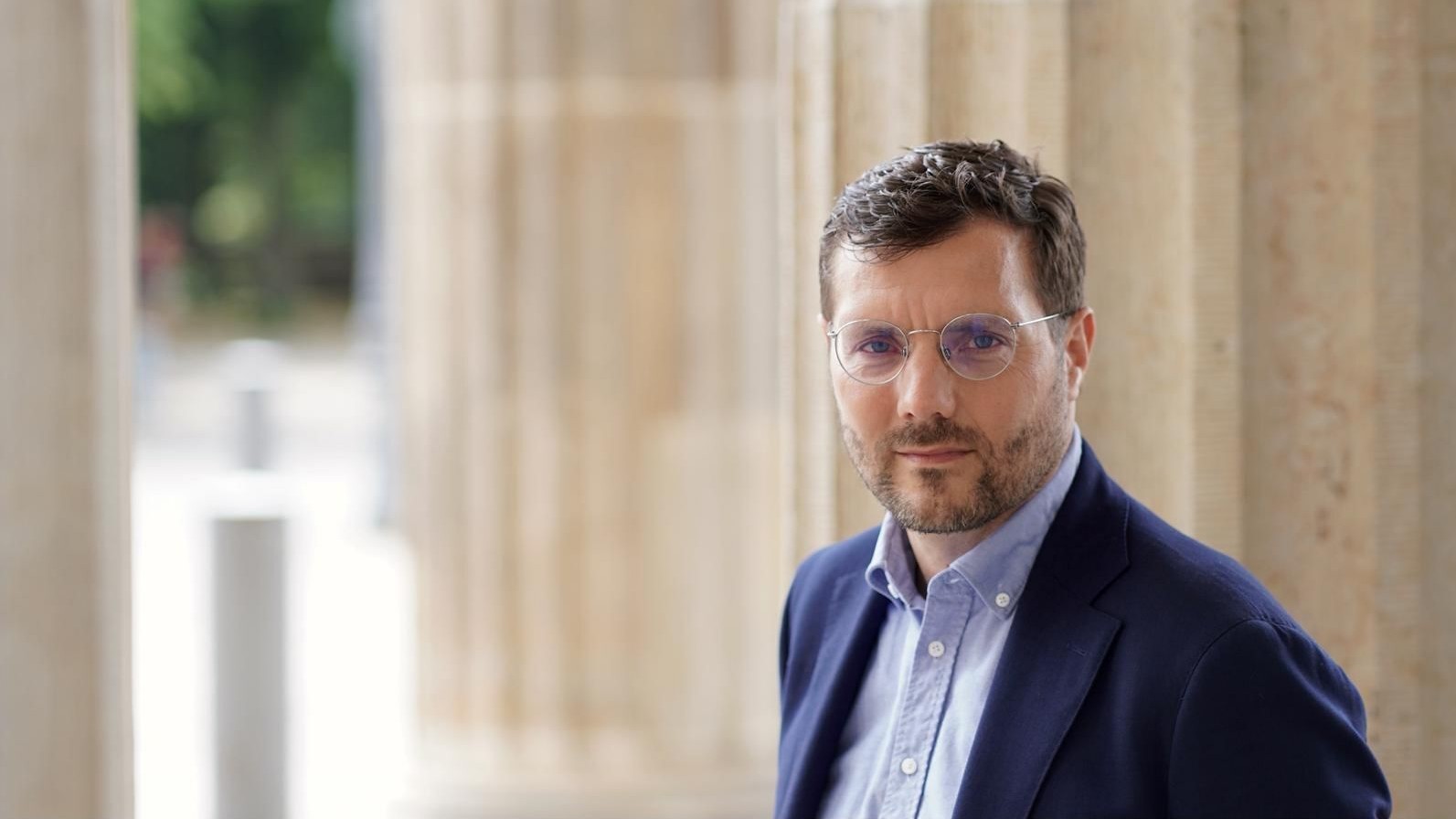
AfD MEP Alexander Sell
Photo: Courtesy of Alexander Sell / AfD
“If the European Union starts to consider democratically elected governments illegitimate simply because they do not share the dominant political line in Brussels, then the problem is no longer Viktor Orbán.”
Negotiations between the European People’s Party (EPP) and right-wing parties in the European Parliament (EP) to tighten migration policy, including the creation of return hubs in third countries, have triggered a strong reaction from socialists, liberals and greens, but also intense internal pressure within the EPP itself, especially from Berlin.
According to German MEP Alexander Sell (ESN/AfD) this is due to the fact that in Germany, the CDU, the EPP’s dominant party, governs in coalition with the SPD, and maintains a strict cordon sanitaire against the AfD, a principle that the Socialists are also trying to impose in the European Parliament.
Sell believes that the controversy in Brussels reflects a political shift that has not yet been accepted in Germany. In this interview, the MEP discusses the pressure on Manfred Weber, the situation inside the CDU, the migration debate, Germany’s role in the EU and the consequences a German financial crisis could have for the European project.
Because the cordon sanitaire is mainly a German phenomenon. In Germany, there is no contact with the AfD, not even informal. In the Bundestag and at regional level even speaking to us can create political problems.
In the European Parliament the situation is different, because the EPP is not only the CDU but many national parties with different political realities. In Italy, Spain or France there is already cooperation with parties on the right, so that veto cannot be applied in the same way. The problem is that German politics is trying to export its logic to Brussels, and that creates tension inside the group.
A lot. The CDU governs with the SPD, and in their coalition contract there is a commitment not to cooperate with parties considered extremist. The Social Democrats are using that agreement to pressure the CDU also in the European Parliament.
They argue that if the EPP votes together with parties on the right, then the CDU would be violating the spirit of the coalition pact in Germany. That puts Weber in a very difficult position, because he has to deal with the political reality in Brussels while at the same time managing the internal balance in Berlin.
So the pressure is not only ideological; it is also a question of domestic politics in Germany.
Exactly. That is the contradiction. In the German coalition agreement there is talk about return hubs outside the EU, and the CDU defended that position at the national level.
But then the Social Democrats in Brussels oppose that same policy, even though it is written in the agreement they signed in Berlin. So the CDU says they are the ones breaking the deal, not the Christian Democrats.
What we are seeing now is an internal German conflict that has been transferred to the European Parliament, and that is why the debate here is so tense.
There will definitely be tension inside the EPP. Delegations like the Spanish, the Italian or several from Eastern Europe need tougher migration policies and do not want to depend permanently on the socialists and the greens to pass legislation.
If the EPP steps back because of German pressure, the problem will not disappear. The political reality is that those majorities exist, and sooner or later the same situation will come back in another vote.
That is why I think this is not a one-time conflict, but something that will continue as long as the balance inside the Parliament keeps changing.
Yes, I think so. The EPP is in a very comfortable position if it wants to use it. They can negotiate with the left or with the right depending on the issue, and that gives them a lot of power.
We already saw this in the resolution on Venezuela, when there was no agreement with the socialists and it passed with votes from the right. That was a clear signal that the traditional majority is no longer the only possible one.
What we are seeing now is that the political map of Europe has changed, but some parties are still trying to behave as if nothing had happened.
Because the cordon sanitaire was created to prevent a coalition between the CDU and the AfD. If you add our votes, in many polls we are close to 50% together, sometimes even more in eastern Germany.
The Social Democrats and the Greens know that if such cooperation became possible, they would lose power for many years. That is why they insist on keeping the blockade at any cost.
But the more the political balance changes, the harder it becomes to justify that position, especially to conservative voters who see similar coalitions in other European countries.
It is possible, especially in eastern Germany. In some states we are close to 40%, and in those conditions it becomes very difficult to form a government without the AfD.
If they want to avoid working with us, the CDU would have to cooperate with left-wing parties, even with successors of the old communist party. For many conservative voters that is very hard to accept, and inside the CDU there is already strong pressure to change that strategy.
So I would say the situation is becoming more and more unstable, and at some point something will have to change.
Yes, clearly. There are EPP members who talk to us privately, which did not happen before. Publicly they keep the distance, but in reality many of them know that the political situation is evolving.
Some of them even say that the AfD today represents positions that used to be normal inside the CDU. And when they look at the polls in Germany, they understand that we are not a temporary phenomenon but a political force that will probably end up in government.
That changes the atmosphere, even if it is not always visible from the outside.
Yes, the economic crisis. Germany is entering a very difficult phase, with growing debt, industrial problems and demographic decline. For decades, Germany has financed a large part of the European budget, but that will not continue indefinitely.
If Germany weakens financially, the whole Union will have to change, because the current system depends heavily on German contributions. And that is something many people in Brussels still do not want to admit.
I would say it is a transition. The Union as we know it depends on an economic model that is no longer sustainable, and that means reforms will be unavoidable.
Competences, spending and sovereignty will have to be redefined. That will create conflicts between member states, but it could also be an opportunity to build a different kind of Europe, one that is more realistic and more stable.
Yes. We see constant blockages in energy policy, foreign policy and migration. Many decisions have been taken for ideological reasons, for example in climate or energy policy, and those decisions have weakened the European economy.
When the economic base becomes weaker, political capacity also declines. That is why the Union often looks paralysed—not because there is no will, but because the room for manoeuvre is smaller than before.
We want a Europe based on cooperation between sovereign states, not a centralized structure that decides more and more from Brussels.
We believe many citizens across Europe think the same, and that is why parties with similar positions are growing in many countries. The political direction of Europe is changing, and the institutions will eventually have to adapt to that.
Yes, definitely. If the cordon sanitaire breaks in Brussels, it will be harder to maintain it in Germany. Politicians at the national level will not be able to explain why something is acceptable in the European Parliament but forbidden at home.
And if the EPP keeps the blockade because of political pressure, then the conflict will not disappear. It will return in every important vote, especially on migration.
That is why this debate is not only about one regulation. It is about the future political balance in Europe.