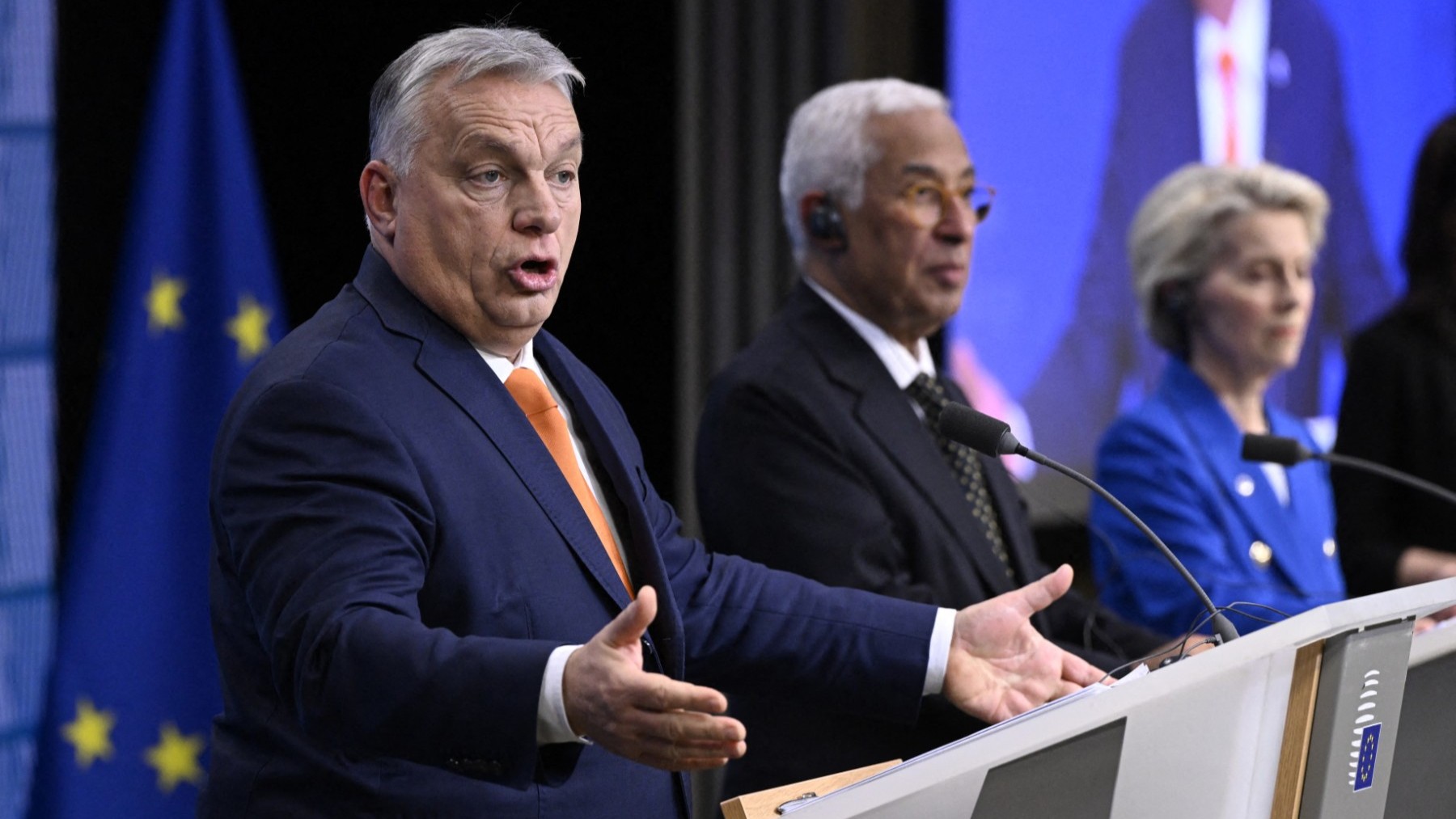
Hungary’s Prime Minister Viktor Orbán speaks during a press conference next to President of the European Council António Costa (C) and President of the European Commission Ursula von der Leyen (R) following the European Council meeting at the EU headquarters in Brussels on December 19, 2024.
JOHN THYS / AFP
Zoltán Kiszelly is a Hungarian political analyst currently serving as Director of the Center for Political Analysis at the Budapest-based Századvég Foundation. We talked to him about the Hungarian elections to be held on Sunday, April 12th, and why it has such significance from a European perspective.
This election is the most important in Europe this year, because the Hungarian government’s position has a major impact on the future of European integration. The question is whether the alternative that Prime Minister Viktor Orbán has presented so far can continue to exist, or whether the EU will move forward without it. In Brussels, it is clear that everything is being done to ensure that this alternative fails.
The government—yes. In most member states, the parties that represent this alternative do exist, but the problem is that the governments of EU member states—and before Donald Trump, the Democrats in the United States—have pursued policies that are bad for the majority of people. Europeans have at least become aware of this since the migration crisis. The problem is that they are unable to replace this elite.
In Hungary, the government is in power because it has provided answers to people’s problems that appealed to the majority, and it came to power with majority support. The issue is that the European Commission and most member state governments can no longer provide a good standard of living for the majority of their populations—and neither do they want to, nor are they able to. As a result, they are not happy to see this kind of alternative emerge. Because then, as happened with migration, people might say they want a country like Hungary.
They fear that elections in other countries could bring similar governments to power. Romania nearly shifted in 2024, France will hold elections next year, it’s unclear how long the German coalition will last, and there will be elections in Poland. They fear the emergence of a blocking minority. Hungary alone cannot create this, but if it maintains this alternative and other countries shift as well, then a blocking minority could form that would halt the “ever-closer union.”
The European Commission already suspended EU funds for Hungary in April 2022, right after the last Hungarian election, because they believed that without money the Orbán system would collapse—but it didn’t. The Ukrainian conflict only intensified this dispute. Germany and Brussels want to project a unified image outward, where all member states support the same policies no matter what.
Hungary’s refusal undermines that unity—not only externally, where not all 27 countries support certain measures, but also internally, because this alternative continues to exist within the Union. What bothers them is not just that Hungary stands out, but that this alternative could become popular among a majority of Europeans over time. They fear that this could spread to other member states.
This brings us back to the idea of a blocking minority. That is their concern, and that’s why they want to remove this alternative from governmental level. That’s why funds were withheld. After 2010, austerity was imposed on Greece to discourage others from following that path. After Brexit, the UK was treated harshly to deter others from leaving. And now Hungary is being pressured so that no one else is tempted to oppose Brussels.
Let’s call these what they are—intelligence operations. Only intelligence services can wiretap figures like Sergei Lavrov and Péter Szijjártó, and now these recordings are being leaked. The intelligence agencies of major powers outside Europe—the Americans, Russians, Chinese, Israelis, Turks—all have an interest in the success of the Fidesz government. They consider the alternative Hungary represents within the EU important for their own strategic interests.
For example, Russia and Turkey are interested from an energy perspective, China from a trade perspective, and the U.S. in terms of protecting traditional values. So these governments are certainly not working against Hungary. The opposing intelligence efforts must be coming from within the European Union, targeting Hungarian politicians and leaking such materials.
I don’t think this will be effective. There is nothing new in these leaks. It has long been known that Hungary cooperates with Russia. Nothing has come out that would fundamentally change people’s opinions.
The real threat is Brussels’ policy, because they no longer have good proposals. Look at what they are offering: redistribution of migrants—no thanks; taking out new war loans that will have to be repaid; money spent on war instead of research, development, schools, or hospitals. They suggest producing weapons instead of cars—of course weapons are necessary, but everyone sees that it’s not a good investment.
There are no good offers coming from Brussels. Tisza’s proposal is essentially to fall in line. Fidesz offers an opt-out, which Brussels does not want to allow.
When Tisza leader Péter Magyar says that we should give up a small part of our sovereignty, he is essentially advocating for falling in line.
Most people fear change because they believe they would be the losers of that change. Magyar talks about the need for change but doesn’t specify what kind. The majority sees that they would likely lose out. The Hungarian government’s protection of fuel and utility prices illustrates this very clearly.
The previous opposition was fragmented. Even when they cooperated, it was a “rainbow coalition.” And former prime minister Ferenc Gyurcsány was part of it—now he is not. As long as Gyurcsány and left-wing parties were involved, they couldn’t attract voters from the right or the centre.
Now, without Gyurcsány and without traditional left-wing parties in the alliance, they can appeal more to centrist voters. This is a political project—it’s neither this nor that, neither hot nor cold. Essentially, Tisza has unified the voter base of previous opposition parties.
That is why it now appears to be a viable challenger: it’s no longer a coalition, but a single electoral force that has absorbed the voter bases of other parties. That is the source of its strength.