Migrants storm a barbed-wire fence as they attempt to cross the land border with Spain’s African enclave of Ceuta near Fnideq in northern Morocco on September 15, 2024.
AFP
The recent wave of violence involving young Moroccans in Torre Pacheco (Murcia) has once again exposed a familiar pattern across Europe: assaults, social unrest, and institutional silence. Are we witnessing random youth crime, or is something deeper and more structural at play?
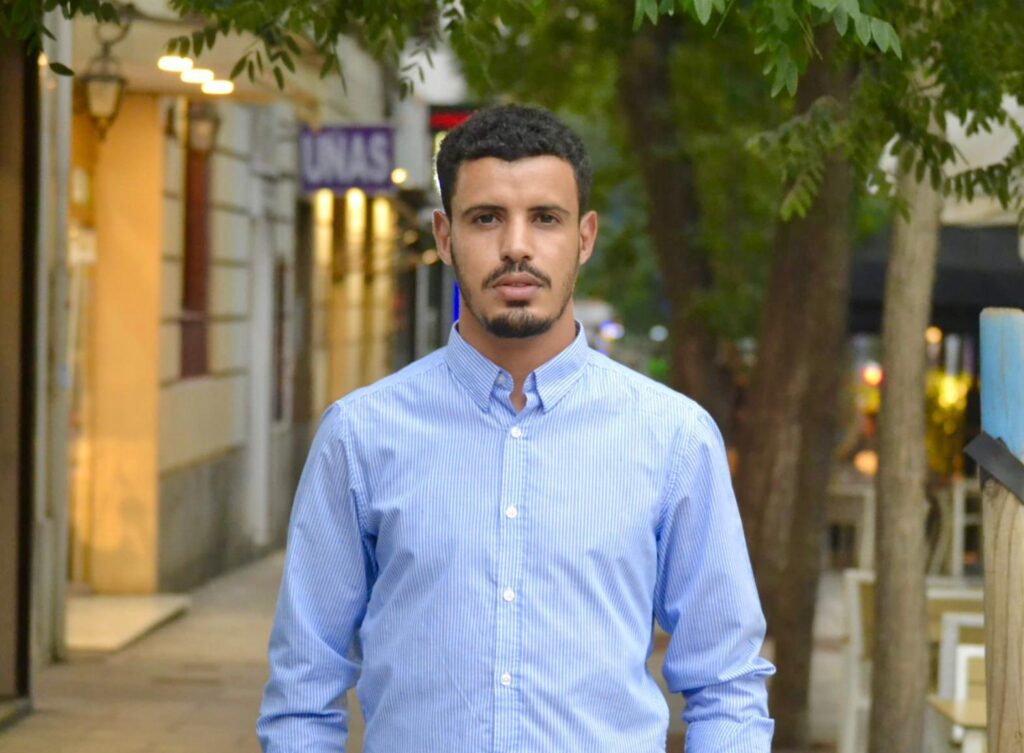
For Taleb Alisalem, a Sahrawi writer and analyst exiled to Spain, the answer is clear: Morocco is using immigration as a political weapon to blackmail European governments, particularly the Spanish one. His experience as an activist for Western Sahara’s self-determination and knowledge of Moroccan power structures make him a credible voice to analyse what many prefer not to see. In this interview, he denounces how the regime of Moroccan king Mohamed VI has infiltrated communities, corrupted institutions, and turned Europe into a hostage of its expansionist agenda.
It’s much more. What we see in Torre Pacheco, Almería, Aranda de Duero, or Barcelona are not isolated events but symptoms of a deliberate strategy. Morocco has spent years instrumentalising immigration as a tool of political pressure. It uses migrants as pawns: it unleashes them when it needs something, radicalises them when it wants, and controls them from here through mosques and cultural associations.
Absolutely. Morocco’s control over mosques in Europe is total, especially in Spain and France. Imams are appointed and funded by Rabat. Every week, sermons are emailed from Morocco. They can promote peaceful coexistence—or hatred, if it suits the regime. Morocco has the power to activate or deactivate radicalisation at will, depending on its political objectives.
They don’t just allow it—they enable it. A deep-rooted guilt complex in Europe prevents people from naming this reality. Any attempt to denounce it is labelled racist or far-right. But this isn’t about ideology: it’s a genuine security and sovereignty issue. Morocco is not a democracy. It is a theocratic dictatorship disguised as one, operating like a geopolitical mafia.
That’s the big question. Pedro Sánchez’ handing over of Western Sahara wasn’t just a diplomatic shift but a capitulation. And not the first one. Felipe González has a mansion in Morocco. Zapatero travels to Rabat to give highly paid speeches. So does José Bono. And then there’s what we don’t know: what does Morocco have that gives it leverage over the Spanish government? Many of us suspect the Pegasus spyware is part of the answer.
Morocco wields media influence and knows how to play its cards. When the Moroccogate scandal broke in Brussels—with over 60 MEPs implicated in a Moroccan bribery network—it barely lasted a week in the headlines. Any other country would have been crucified. But Morocco covers everything up. Even the better-known Qatargate used the network Morocco had already built.
France is complicit. Morocco is a geostrategic extension of Paris. They understand and protect each other. Whenever Spain has a Rabat crisis, France stays neutral or sides with Morocco. And in Brussels, they use their weight to secure trade deals that violate international law regarding Western Sahara.
Millions of euros in EU cooperation funds are handed over to Morocco, supposedly to stop immigration. But Morocco uses that money to strengthen its army, finance propaganda, or continue its occupation of the Sahara. Meanwhile, European farmers—especially Spaniards—face absurd regulations, while Moroccan products enter without proper controls. We surrender food and economic sovereignty to a country that openly claims Ceuta, Melilla, and the Canary Islands.
It’s not exaggerated at all. Morocco’s former prime minister said that after Western Sahara, the following targets would be Ceuta, Melilla, and the Canary Islands. And they’re not hiding it. Rabat has even reactivated an official committee for its “recovery.” Meanwhile, the Spanish government funds them with armoured vehicles, gifts them weapons, or buys their silence.
The occupation of Western Sahara wasn’t just military. Morocco brought in settlers so that we, the Sahrawis, are now a minority in our land. They tried everything to “Moroccanise” us. We’re a spiritual, peaceful, nomadic people, very different from Moroccans. They look down on us. We suffer racism, attacks, and threats. Even here in Spain, there are neighbourhoods I avoid for safety. But no one says anything—because the aggressor is Moroccan.
Legally, all of Europe should be on our side. International law supports us. But in practice, only Algeria and Mauritania stand by us. They do it for justice, but also for strategic reasons: Morocco has a clear expansionist plan. Algeria knows that if Rabat takes the Sahara, its next move will be the Algerian southwest. That’s why they recognise the Sahrawi Republic. Spain should do the same, out of principle and out of self-preservation.
By waking up, informing themselves, and removing the ideological blindfold, Morocco has built a network of blackmail, radicalisation, and corruption across Europe. If we don’t stop it now, the cost to our societies will be enormous. And the worst part is that our governments are letting it happen.