Stefan Andonovski
Stefan Andonovski on Facebook, 10 February 2026
North Macedonia has placed digitalization at the heart of its political and economic strategy. With the creation two years ago of a dedicated Ministry of Digital Transformation, the government aims to turn the country’s human capital into its main strategic asset for future growth.
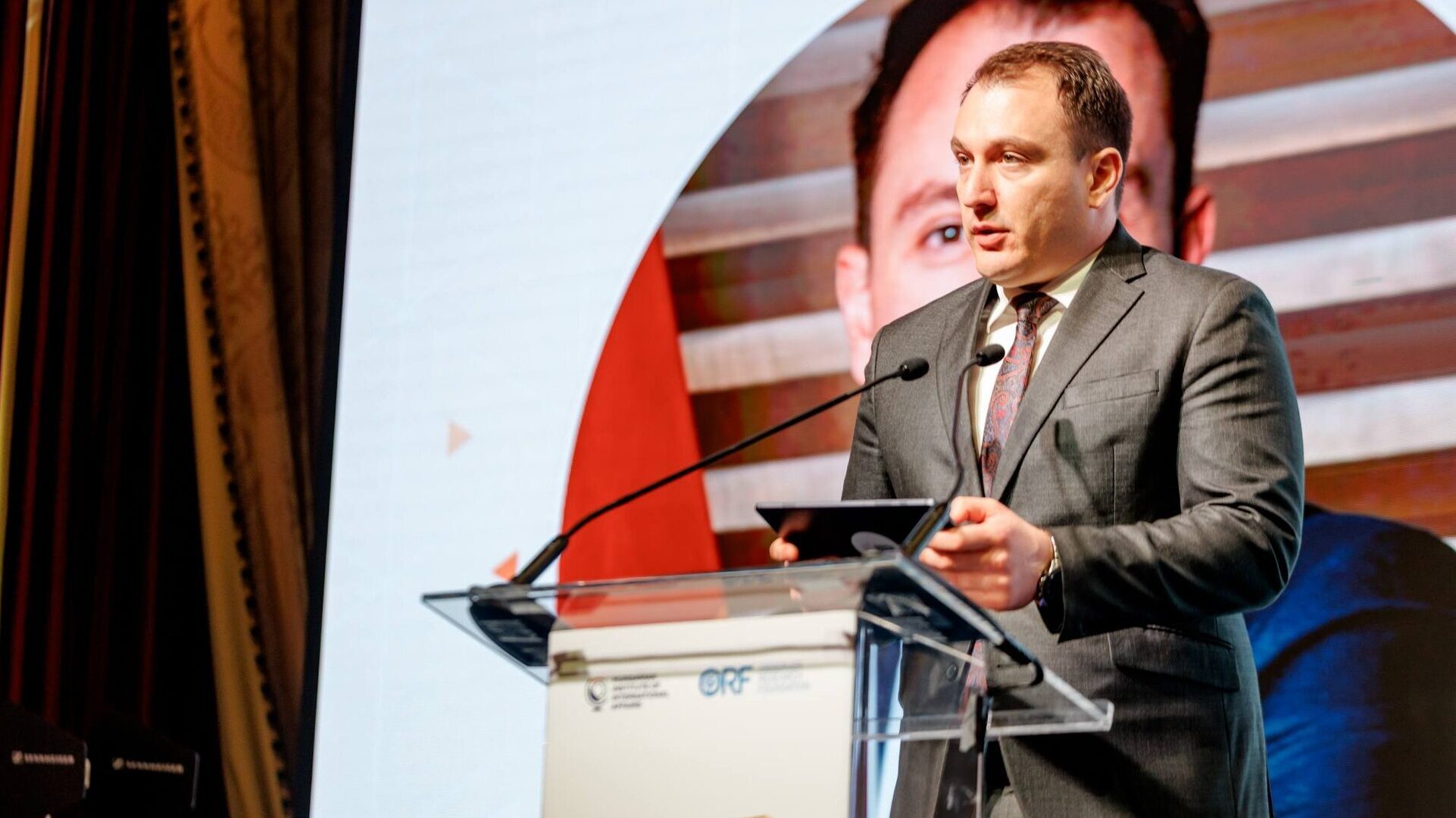
Speaking at the Budapest Global Dialogue, Minister Stefan Andonovski defended a pragmatic vision of European integration, focused more on concrete results—such as inclusion in SEPA or the end of roaming charges—than on institutional symbolism.
At a time marked by renewed debate over a ‘two-speed Europe,’ he insisted that Skopje’s priority is the effective implementation of integration, not rhetorical commitments.
The conversation also addressed key geopolitical issues: the role of the Balkans as an energy and logistical corridor between East and West, the need to avoid overregulation that could stifle digital innovation in Europe, and investment opportunities in technological infrastructure, cybersecurity, and digital services.
It is a small country in the center of the Balkans. We often say it is not a country of many people but a country of competing interests. We are at a historic crossroads: both the East-West and the North-South corridors run through our territory. That means key transport infrastructure and energy corridors as well.
If we consider Europe’s dependency on gas or electricity, North Macedonia lies at the center of those flows. That is why we made the strategic decision to make digitalization one of the pillars of this government. Two years ago, we established for the first time a Ministry of Digital Transformation, convinced that the knowledge of our citizens—our human capital—will be the resource of the future.
My responsibilities are structured around three pillars: delivering digital services to citizens and businesses through national platforms; cybersecurity, because there is no digitalization without protection and trust; and institutional interoperability, meaning the instant exchange of information between public administrations through a national platform.
In addition, we are steering our strategy toward attracting investment in data centers, artificial intelligence, and computational capacities. We need to diversify foreign direct investment.
It is not a new idea. In the past, there was discussion of a ‘two-speed Europe,’ where Central and Eastern European countries were expected to move more slowly. However, countries such as Poland, Hungary, Slovakia, Slovenia, and Croatia have demonstrated GDP growth beyond expectations.
Now there is renewed talk of an internally integrated Europe and another group of candidate countries joining in phases. We are not opposed to this approach. 80% of our trade is with the EU, and of that, nearly 90% is with Germany. Our economic interdependence is clear.
What we ask for are concrete results. This year we were integrated into SEPA, the Single Euro Payments Area, and we are already seeing smoother transactions. We are not concerned about not having a commissioner or immediate voting rights in every area; we want real and rapid implementation.
The Balkans have always been on the frontier of civilizations. During the 2015 migrant crisis, Macedonia was protecting Europe from within Europe: migrants were entering from Greece or Bulgaria, both EU member states. We registered everyone crossing our territory to protect the system as a whole.
Being at this crossroads requires vigilance, but not isolation. In an interconnected world, you cannot close the door to other civilizations. If Europe wants to reduce its dependency on Russian gas and bring in gas from Azerbaijan, it needs corridors that pass through the Balkans. If it wants to connect Greek or Albanian ports with the European interior, it needs integrated networks.
The Balkans should not be treated as Europe’s backyard but as a strategically central position.
Cybersecurity and digitalization should not be conceived as building a bunker but as building a bridge—a bridge that connects and is resilient.
Europe tends to overregulate the digital market. That stifles innovation. If we want to foster innovation, we must allow innovators to innovate. Europe has enormous potential thanks to its education systems, but if we continue overregulating, we risk becoming the “old man of the world,” while Asia, Latin America, and the United States move ahead.
We do not need more reports or projects without tangible outcomes; we need to finance real innovation.
I am convinced that the next major digital innovation will not come from Western Europe but from Central or Southeastern Europe. It may not be Macedonia, but it could be Poland, Hungary, Slovenia, Croatia, or a combination of these countries.
We have excellent education, inspired young people, and experience working with scarce resources. We know how to optimize. That is a competitive advantage.
We have no alternative to European membership due to our trade, cultural, and civilizational interdependence. But as we move toward accession, we must also develop regionally.
In the Western Balkans, there is already a free-roaming zone. We are working on mutual recognition of electronic signatures. In addition, we are cooperating with Ukraine and Poland on developing a national super app for electronic services, inspired by models such as Diia.
There are regional economic cooperation forums that can be strengthened even before formal EU accession. This will help create common standards and boost GDP growth.
Why not Macedonia?
If you are considering digital investment, it is the right country. We have one of the best fiber-optic and internet coverage rates in the world. We graduate 1,500 IT specialists every year. Moreover, we have abundant energy and water resources. It is an optimal place to invest in the digital sector.