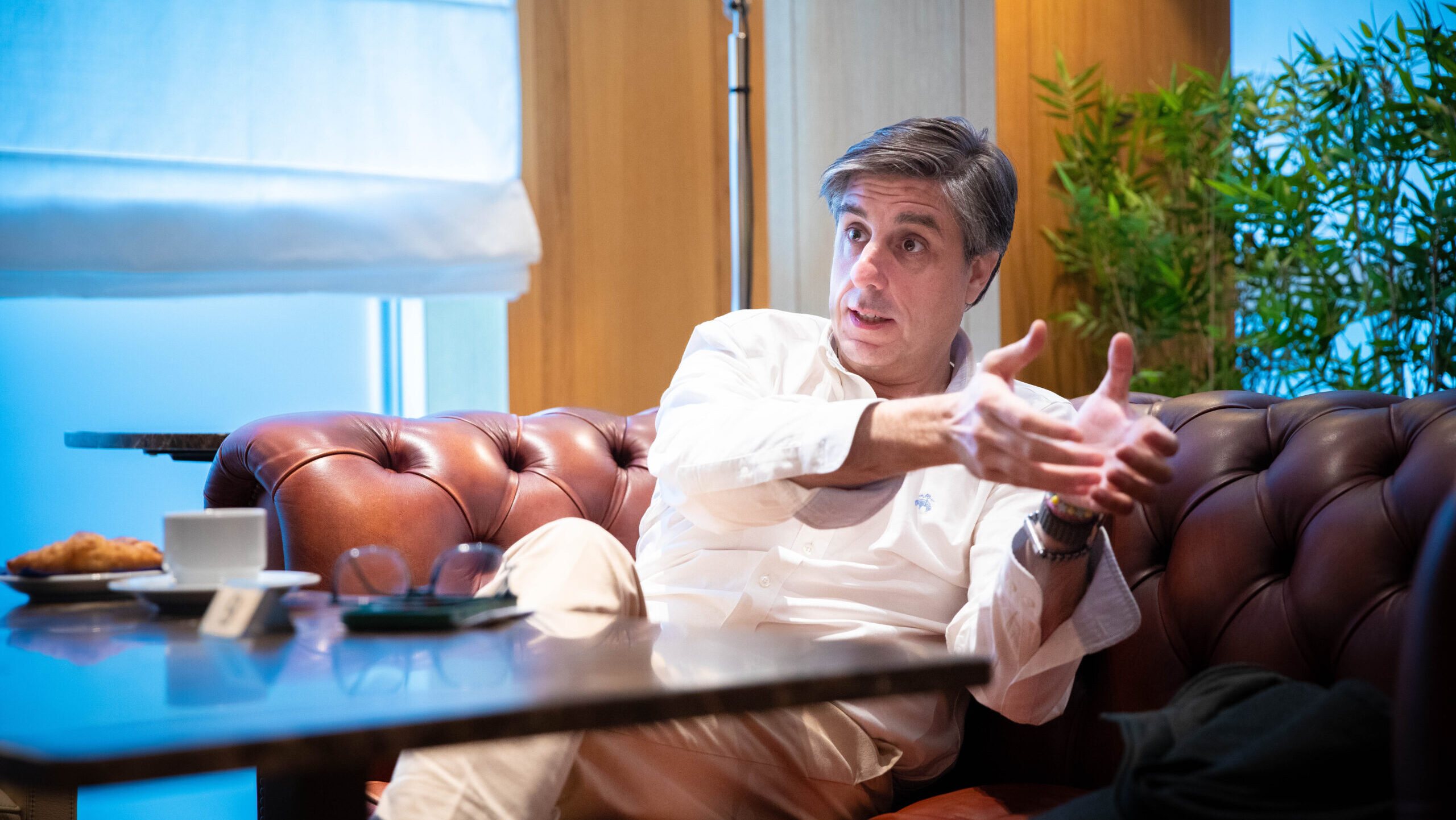
Jorge Martín Frías
Javier Villamor
“If the European Union starts to consider democratically elected governments illegitimate simply because they do not share the dominant political line in Brussels, then the problem is no longer Viktor Orbán.”
Jorge Martín Frías is a VOX Member of the European Parliament and director of the Disenso Foundation. In his political work, he has focused on one of the structural problems of the European economy: the excessive bureaucracy that limits the competitiveness of small and medium-sized enterprises (SMEs). His proposal, recently debated and approved in Brussels, seeks to simplify the regulatory framework and ease the burden on entrepreneurs, in contrast with a system that today favors large oligopolies.
In this interview, Martín Frías explains how the regulatory maze has suffocated the productive sector and reflects on the social and political consequences of a model designed by the EU institutions. He also warns that the same pattern of control affecting SMEs could be repeated in an emerging and crucial field like artificial intelligence.
Here, he offers key insights for understanding the European Union’s current crossroads, divided between those calling for more economic freedom and those within the Commission who continue to defend a centralizing model based on regulation and control.
The intention on the part of VOX, and consequently of Patriots [for Europe], is to fulfill the mandate with which we stood for election: to undo all the bureaucracy and regulation that is strangling industry, small businesses, and, ultimately, the European taxpayer. What is relevant is that, for the first time, we have managed to get the [European] People’s Party to backtrack by approving a text that acknowledges the negative consequences the Green Deal has had on European companies. That shows that there was an alternative and that we were right.
How far one can trust the People’s Party remains to be seen. They won’t do it out of conviction, because they lack ideas and principles; they will do it because the polls tell them that the majority of society is beginning to suffer the consequences of their policies. That is what makes them backtrack. What is clear is that, if it weren’t for the Patriots, nothing would move.
Small businesses cannot afford to maintain legal departments with dozens of employees to confront a regulatory web. Only large corporations can do so. In this way, local business networks are destroyed, and economic and political power is concentrated. We see this in sectors such as agriculture or livestock: everyone warned of the consequences of the Green Deal, and now, no one takes responsibility. The result is that those with greater economic capacity are favored, while those who sustain the real economy are sinking.
The Commission’s policies are completely detached from reality and from the interests of ordinary people. Everything translates into regulations that only benefit those with high incomes. We see it with the electric car: the market is manipulated to eliminate the traditional vehicle, unaffordable costs are imposed, and in the end, only the rich can access those subsidies. It is an elitist model that marginalizes the average citizen.
The European taxpayer is completely forgotten. Million-euro decisions are taken with their money, often to finance projects or even regimes contrary to the supposed ideals of the Union. It is urgent to restore the role of the taxpayer, who today is completely trampled upon.
We agree on some diagnoses, yes, but the approach is different. Draghi seeks technical adjustments; we advocate fundamental changes. Even so, it is positive that even opposing groups recognize that there has been a brutal loss of competitiveness and that the Commission’s policies have not worked. That opens the door for our proposals to be considered, even if we are painted as far-right demons.
We are already seeing that the Commission wants to apply the same bureaucratic logic to artificial intelligence, without a doubt. Instead of creating a favorable ecosystem, it talks about limits, tariffs, and controls that only large multinationals can meet. In the end, Europe becomes a socialist cage while the United States innovates and China regulates to strengthen its strategic power. Here, regulation is driven by fear, not by strategic interest.
Without a doubt. The project will only survive if the legitimate common-sense demands that we Patriots defend are incorporated. If the Commission insists on intensifying its bureaucratic agenda and on using artificial intelligence as an instrument of control, it risks destroying what remains of democratic legitimacy in Europe. We are at a very critical moment: either freedom and competitiveness are restored, or we will move towards a model that sidelines citizens and favors the powerful.