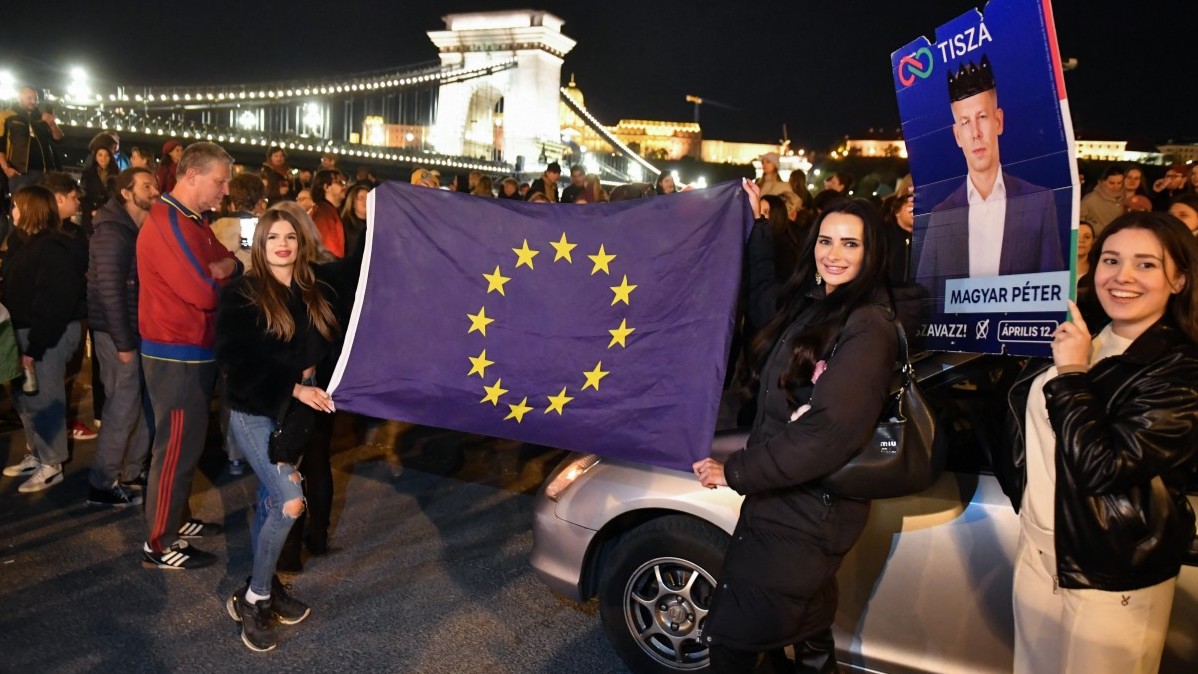
Participants display an election campaign poster of Hungary’s prime minister-elect, Péter Magyar and a flag of the European Union during a gathering to celebrate the victory of the Tisza Party near the Széhenyi Chain Bridge in Budapest late on April 13, 2026, one day after Hungary’s parliamentary elections.
FERENC ISZA / AFP
An MEP from the Alternative for Germany (AfD), Petr Bystron, has called for a European Parliament committee of inquiry to examine the alleged influence of the European Commission on Hungary’s recent election.
Bystron argued that Brussels exerted “massive pressure” on Hungary by freezing billions in subsidies and applying economic measures. He linked these claims to findings by the United States House of Representatives, which examined foreign influence on digital information flows.
“Since 2015, the EU has repeatedly influenced democratic elections in member and third countries—from Georgia to Moldova and Romania to EU elections themselves,” Bystron said, adding that “now it was Hungary’s turn.”
He further stated: “If Member States are put under pressure just because they do not dance politically to the whistle of Ursula von der Leyen, this is an attack on democracy. Citizens have a right to transparency. Sovereignty and free elections must be protected.”
Last week, we reported on a study by MCC Brussels analysing online performance during the final week of March 2026.
The report compared the social media presence of Viktor Orbán and opposition leader Péter Magyar, highlighting structural differences in how their accounts are classified on platforms. Orbán’s account operates as a political page, subject to stricter rules, while Magyar’s “public figure” profile faces fewer restrictions.
Despite reaching similar audiences of around two million views, Magyar’s content generated more than three times the engagement, with a reported rate of 4.5 percent. The study also noted the “disappearing comments” pattern, with thousands of comments on posts by Fidesz candidates, which were visible to page administrators but hidden from the public. The phenomenon was recorded across more than 6,500 posts on 106 accounts, suggesting something more than isolated glitches.