

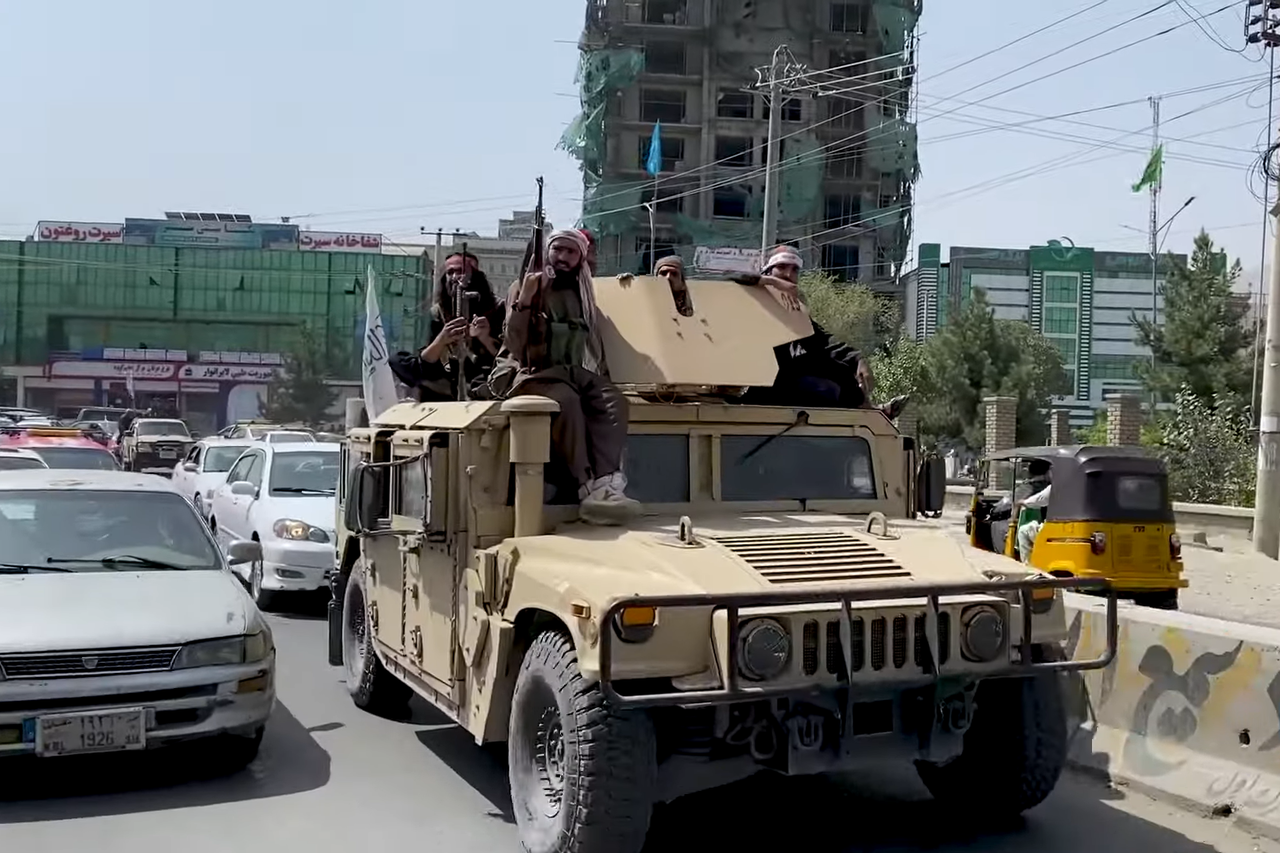
Taliban fighters in a captured Humvee after the Fall of Kabul, August 2021
Voice of America News (cropped by author)
The European Union is preparing to open a direct channel of communication with the Taliban, as Brussels seeks to address the growing deadlock over the return of Afghan nationals whose asylum claims have been rejected or who are subject to deportation orders.
According to reporting cited by Brussels Signal, EU officials are planning to host a Taliban delegation in the coming months. The discussions are expected to focus on re-admission arrangements—including documentation, identification procedures, and logistical coordination for returns. Likewise, Euractiv has reported that the meeting could take place before the summer, likely to involve EU officials and representatives from member states alike.
Since the Fall of Kabul in 2021, when the Taliban returned to power in Afghanistan following the collapse of the Western-backed government, the EU has not maintained formal diplomatic relations with Kabul. The regime is not recognised by most of the international community, and cooperation on migration and migrant returns has effectively been suspended.
As a result, deportations of Afghan nationals have become increasingly difficult in practice, even in cases involving rejected asylum applications or criminal convictions.
Some member states have already explored limited and technical contacts with Taliban representatives since 2022. Germany has debated operational contacts for deportation cases involving security risks, while Austria has repeatedly called for the resumption of returns. Countries including the Netherlands and Denmark have reportedly examined indirect channels for documentation and identification purposes. These efforts are described as strictly technical and not involving political recognition.
Elsewhere, observers predict that the war in Iran could trigger a new migration crisis toward Europe. While a mass exodus has yet to materialise, Iran’s population of nearly 90 million means that even a relatively small outflow, if instability deepens due to conflict, economic collapse, or institutional breakdown, could translate into significant migratory flows. Unusually, such movement could include urban and middle-class groups with education and resources, alongside minorities who may feel exposed in a deteriorating security environment.




.png)