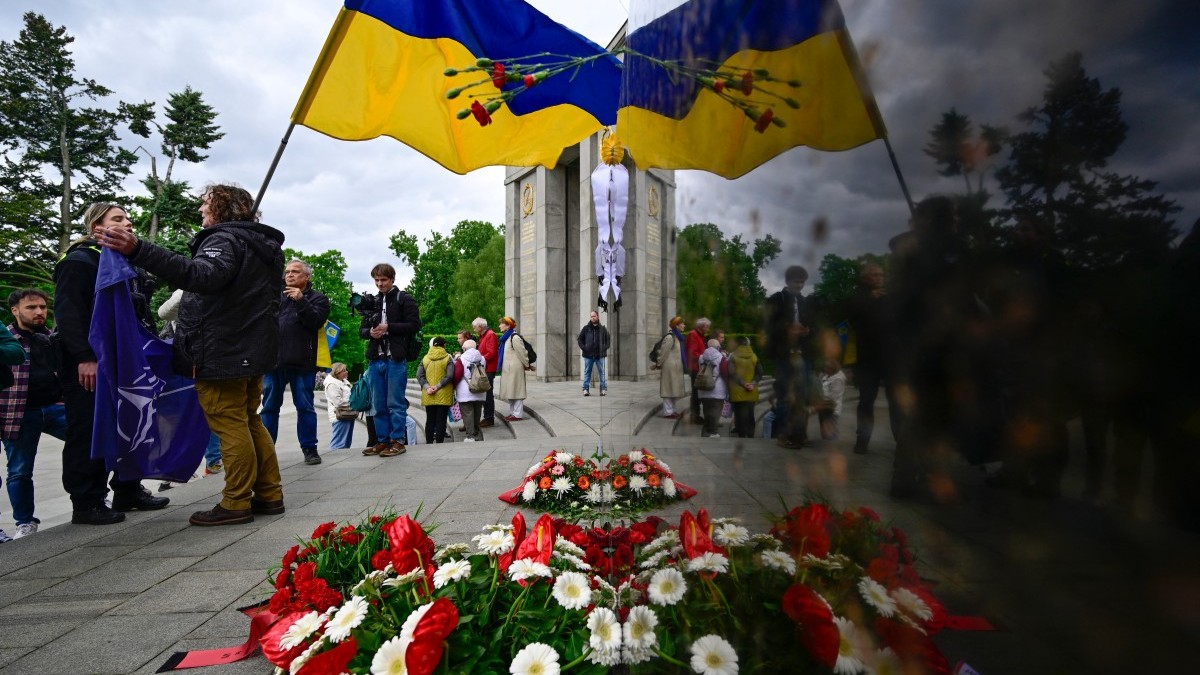
A man holding a Ukrainian flag is addressed by a police woman as wreaths lie at the Soviet War Memorial Tiergarten in Berlin on May 8, 2026 to commemorate the anniversary of the 1945 victory against Nazi Germany.
JOHN MACDOUGALL / AFP
European Union member states agreed on Wednesday, July 15th to extend temporary protection rights for Ukrainian refugees until March 2028, while introducing a significant policy shift that excludes newly arriving men of military age. This decision, requested by Kyiv to help secure vital military manpower, means that the emergency protections—originally triggered after Russia’s 2022 invasion—will no longer cover new applicants who fail to satisfy their domestic military obligations back home. Under Ukrainian wartime laws, men aged 23 to 60 are generally prohibited from leaving the country.
The newly approved limitation is strictly forward-looking and will not impact the approximately 4.4 million Ukrainians who are already residing within the 27-nation bloc under temporary protection status. “Taking into account Ukraine’s evolving defence needs, going forward temporary protection will be granted only to those who satisfy their military obligations in Ukraine,” the EU stated, clarifying that existing beneficiaries will maintain their current rights to live, work, and claim benefits. Currently, Germany, Poland, and the Czech Republic continue to host the largest communities of displaced Ukrainians.
According to official EU data, adult men make up roughly 27% of the total Ukrainian population currently benefiting from the bloc’s protection, while women and minors account for 43% and 30% respectively. As the conflict continues through its fifth year, Brussels has noted that it is also exploring long-term legal residence pathways for integrated refugees, alongside voluntary repatriation assistance programs for individuals who wish to return home once security conditions on the ground improve.
Furthermore, while the European Commission is promising to hand over billions of euros for the reconstruction of Ukraine, a study by Germany’s ifo Institute—as we recently reported—suggests that many refugees will not return after the conflict. Under the most optimistic scenario, the expected return rate is just 47%, meaning well over two million Ukrainians would remain across different member states, a trend mirroring that of Syrian refugees following the official end of the war there in December 2025. In the most pessimistic scenario, which involves potential territorial losses and weak economic development, just 3% would return. This shift heavily impacts Germany, which has seen a tenfold increase in Ukrainian asylum seekers since Kyiv relaxed exit rules for young men in August.