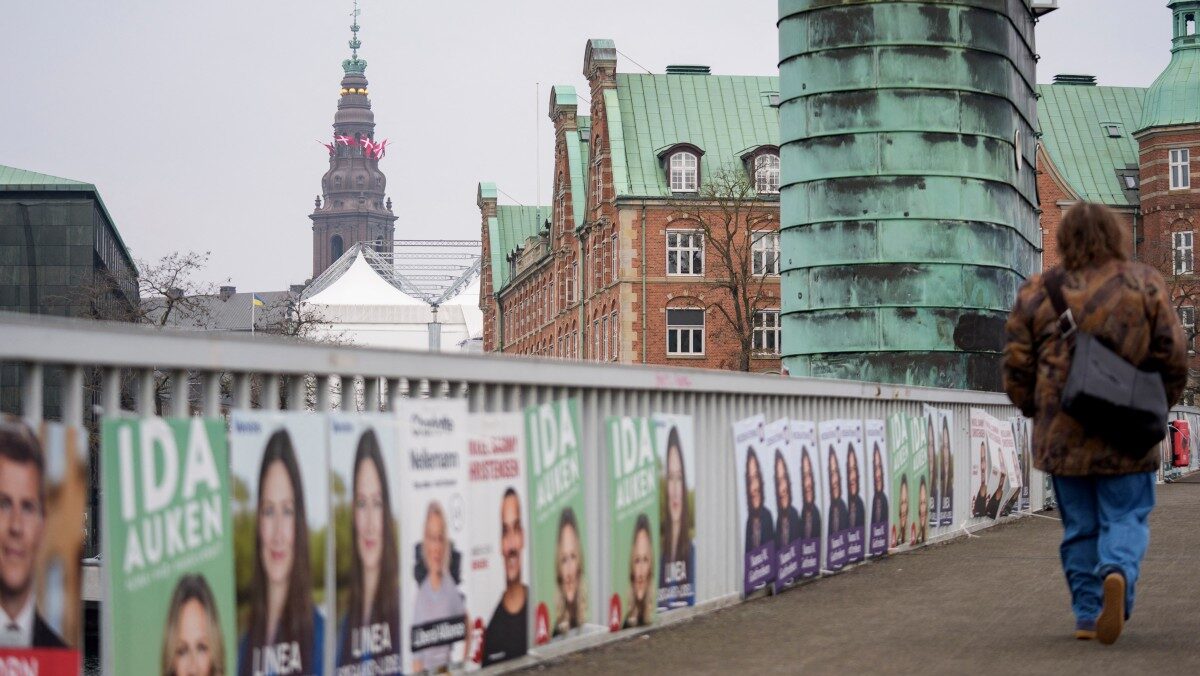
Danish flags are seen on top of the Parliament building, Christiansborg Castle, as a pedestian passes election posters, in Copenhagen, on March 24, 2026 during the parliamentary election in Denmark.
RASMUS FLINDT PEDERSEN / AFP
Ahead of today’s Danish parliamentary election, around 200 Go’On petrol stations lowered petrol and diesel prices for several hours, drawing large numbers of drivers.
The petrol stations dropped prices by DKK 3.35 (€ 0.45) per litre and diesel by DKK 2.25 (€ 0.30) between 7 and 10 a.m., causing queues and traffic disruptions in cities, including Aalborg and Herlev.
The initiative was part of the Danish People’s Party’s (DF) campaign, which has focused on fuel prices as a key election issue. However, Go’On director Mick Kjær clarified that the company covered costs exceeding an agreed limit with DF, stressing that the move did not constitute direct party support. “We want to contribute to the debate on fuel prices, but we don’t actually wish to be partisan,” Kjær said, adding that the contribution aligns with rules on party support.
The stunt prompted mixed reactions from the public. Some welcomed the temporary reduction as financial relief, while others noted that it would not influence their vote.
In another election-related stunt, artist Kristian von Hornsleth raised ire by what he called an “art project.” The artist asked on Instagram, “Do you want to sell your vote for an original artwork for DKK15,000? If so, I would like to buy it. You now have the opportunity to participate in my new art project, “Democracy for sale.” He then instructed voters to cast their vote for the socialist Red-Green Alliance and document it with a photo.
The Red-Green Alliance publicly criticised the campaign, calling it “deeply undemocratic” and asking for its removal. The Danish criminal law forbids both the selling and buying of votes.
Denmark’s elections feature a large number of parties, including the Social Democrats, DF, the Denmark Democrats, the Red-Green Alliance, and several smaller left- and right-leaning parties. Polls suggest shifts in support, with some centrist parties losing ground while smaller parties gain, reflecting a broader left-right polarisation.