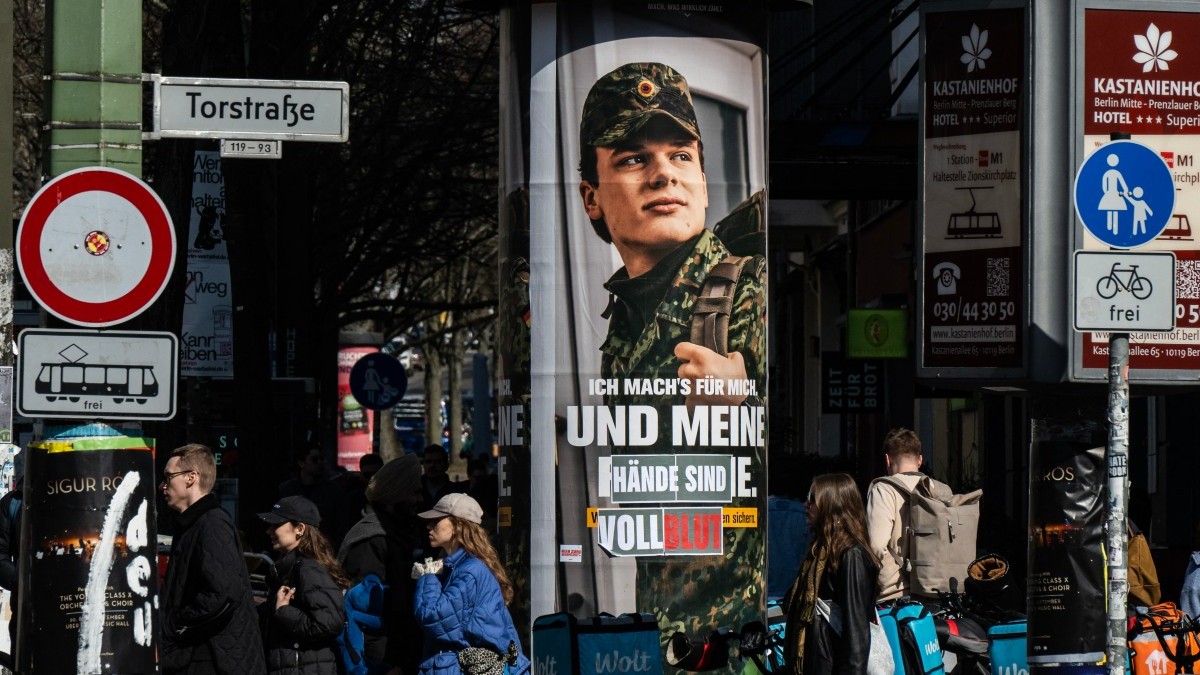
An advertising poster for the Bundeswehr is altered to read: “…and my hands are covered in blood,” in Berlin on March 22, 2026.
JOHN MACDUGALL / AFP
German defense minister Boris Pistorius (SPD) has sought to calm growing criticism over a controversial provision in the country’s new Military Service Act, following days of backlash over reported restrictions on travel abroad.
The debate centers on a clause stating that men aged 17 to 45 must obtain approval from the Bundeswehr for stays abroad longer than three months. The rule, which came into force at the beginning of the year, triggered widespread concern and political criticism.
Pistorius moved to clarify the situation, insisting that the requirement will not apply under current conditions. “Whether 17 or 45 years old or in between, everyone is of course allowed to travel and currently does not need a permit for this,” he said.
He also stressed that longer stays abroad do not need to be reported. To formalize this, the defense ministry is preparing an administrative decree introducing a general exemption to the approval requirement. “I have already arranged for the corresponding decree, on which my experts are already working, to be implemented quickly,” he added.
Despite the reassurance, the minister defended the rule itself as a necessary precaution. In the event of a “case of tension or defense,” when compulsory military service could be reinstated, authorities would need to know who is available and who is abroad.
The controversy follows strong reactions to reports last week that Germany would require young men to seek army approval before leaving the country. Critics, including figures from the Alternative for Germany (AfD), highlighted the double standard. AfD politician Götz Frömming argued that while “young Germans will have to ask the Bundeswehr for permission if they want to leave our country for more than three months … young Syrians or Ukrainians can continue to come and go as they please.”
The broader reform aims to strengthen the Bundeswehr, with plans to increase troop numbers from just over 180,000 to at least 260,000.