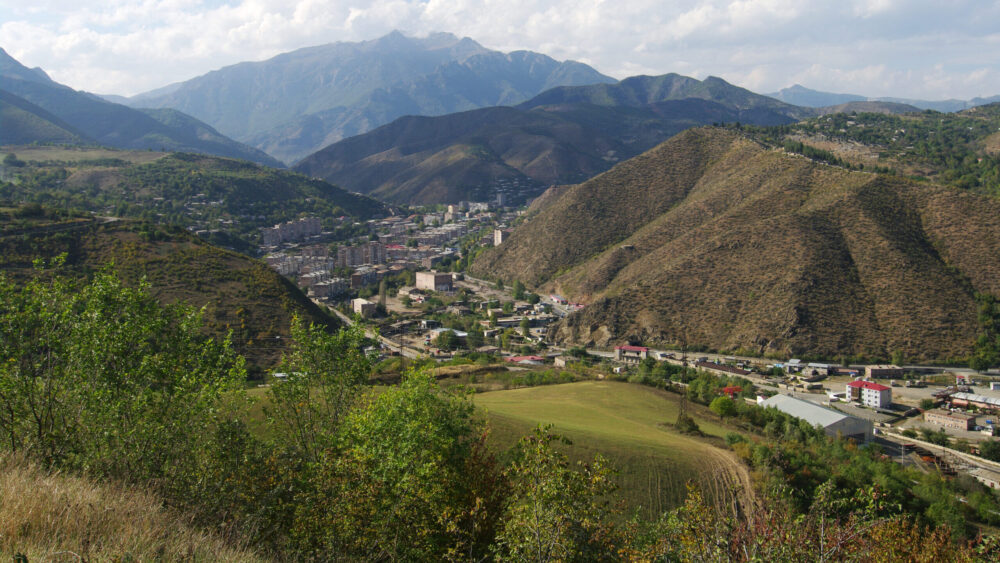
View of Kapan, southern Armenia, near the Azerbaijan border
Russian and Iranian officials appear to be rehabilitating the idea of a permanent connection between Azerbaijan and its Nakhchivan exclave—which will pass through Armenia. U.S. involvement in such a project has long caused suspicion between the two loosely allied authoritarian regional powers.
Early indications of a shift in attitude came on Thursday, August 14, when Iranian foreign minister Abbas Araghchi noted that “what Armenia is now telling us is that they have complied with all of Iran’s red lines.” Iranian objections to the plan were based on the potential deployment of U.S. troops close to its border with Armenia, but Armenian deputy foreign minister Vahan Kostanyan told Iran’s mouthpiece Press TV that such a possibility is “out of the question.”
Not all of Iran’s officials stuck to the script, however, with Ali Akbar Velayati, one of Supreme Leader Ali Khamenei’s senior advisers, declaring that such a U.S.-owned corridor would “turn into a graveyard of the mercenaries of Donald Trump,” with or without Russian involvement.
As for the Kremlin itself—which viewed earlier proposals for a land corridor as encroaching on Armenia’s sovereignty—some thawing of attitudes seems to be underway. Foreign Ministry representative Maria Zakharova responded to last week’s Trump-brokered peace meeting between Baku and Yerevan, saying that it “merits a positive assessment,” while Russia hopes “this step will advance a peaceful agenda.”
Nakhchivan is a landlocked autonomous enclave of Azerbaijan. Baku is ambitious to develop a working physical connection to it, which would typically involve running a ‘corridor’ through Armenia, to which Yerevan was actively opposed. Now, like Russia and Iran, it may be warming to the idea.