JAAFAR ASHTIYEH / AFP
Palestinians in the West Bank and central Gaza voted on Saturday in municipal elections—the first since the Gaza war began—with low turnout and a restricted political field.
Nearly 1.5 million voters are registered in the West Bank, alongside around 70,000 in Gaza’s Deir el-Balah, according to the Ramallah-based Central Elections Commission.
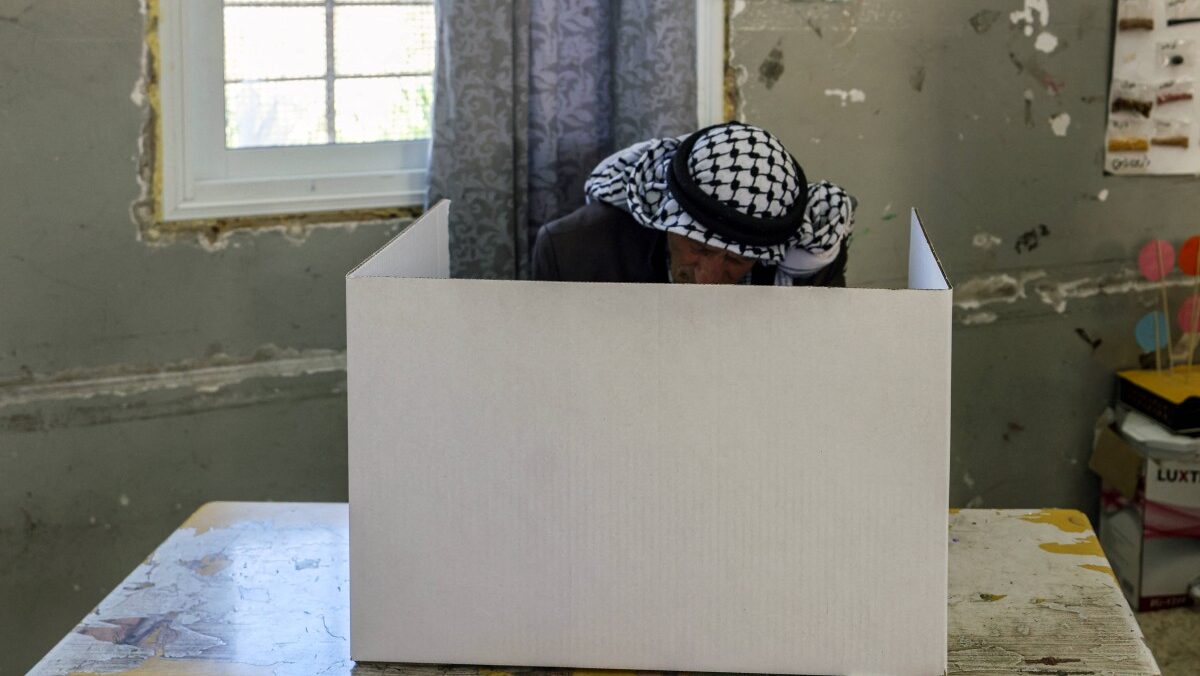
Early footage from Al-Bireh and Deir el-Balah showed sparse queues at polling stations. Turnout stood at 15% by late morning, rising to 24.53% by 1 p.m., the commission said.
An AFP journalist reported near-empty polling stations across parts of the West Bank, even as foreign diplomats visited to observe proceedings. Commission chief Rami Hamdallah urged voters to participate, calling the vote “important … for our Palestinian people.”
After voting in Al-Bireh, 55-year-old Khalid Eid expressed hope for change in local councils.
“We must see change every four years through elections … We can’t change the situation but we hope to replace people … people who might be better and help develop the community,” he said.
Most electoral lists are aligned with President Mahmoud Abbas’s secular-nationalist Fatah movement or consist of independents.
Hamas—Fatah’s main rival and the ruling authority in Gaza—is not participating.
In many municipalities, Fatah-backed lists are competing against independents supported by smaller factions, including the Marxist-Leninist Popular Front for the Liberation of Palestine.
Some candidates complained of obstruction. Mohammad Dweikat, head of a list in Nablus, said several candidates were detained until after the registration deadline had passed.
Municipal councils oversee local services such as water, sanitation, and infrastructure, but do not legislate. With presidential and parliamentary elections frozen since 2006, they remain one of the few functioning electoral mechanisms under the Palestinian Authority (PA).
The PA continues to face criticism over corruption, political stagnation, and declining legitimacy. International donors have increasingly linked financial support to governance reforms, particularly at the local level.
The European Union described the vote as “an important step towards broader democratisation and strengthened local governance.”