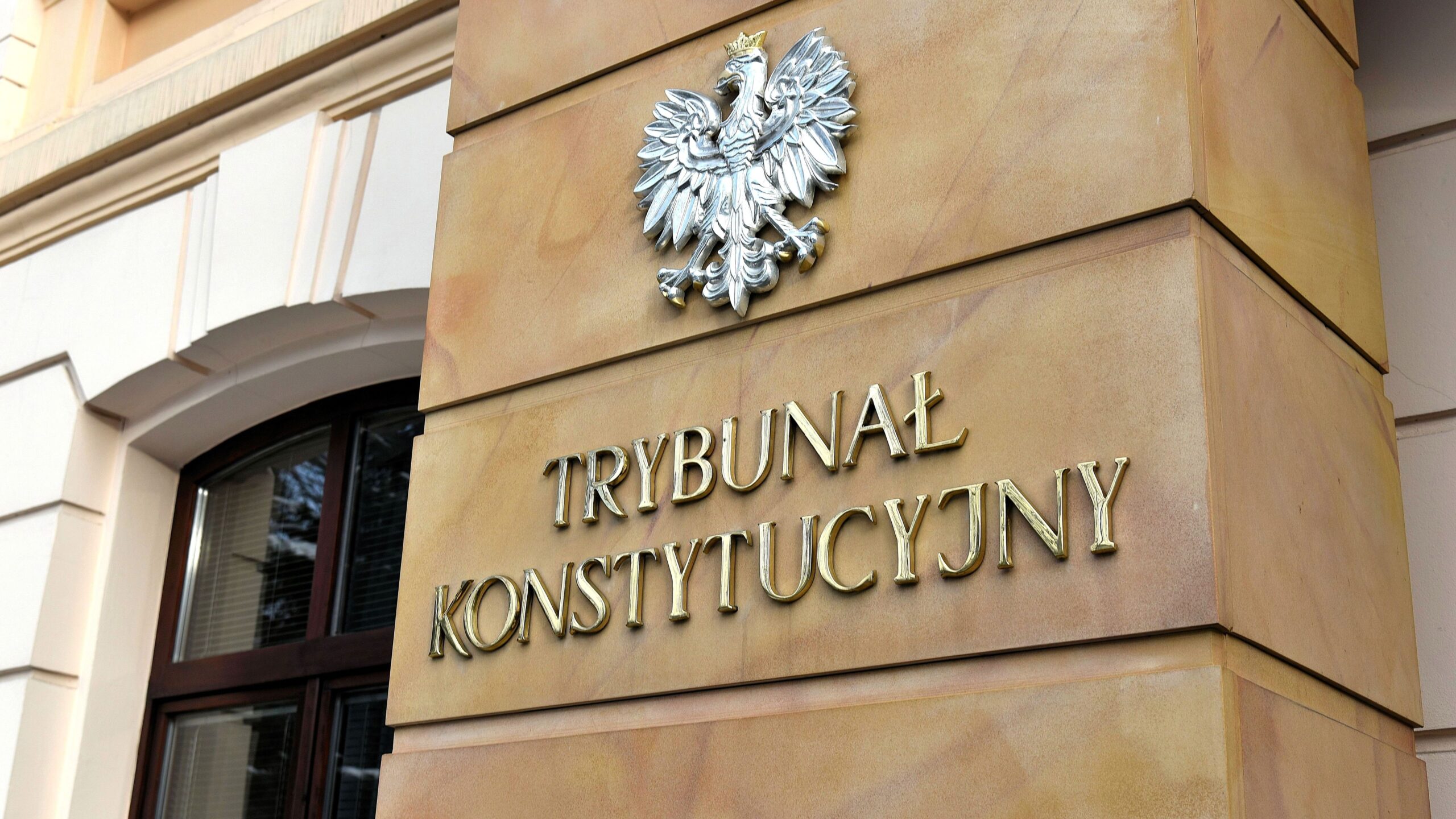
Entrance to Poland’s Constitutional Tribunal
Entrance to Poland’s Constitutional Tribunal
In a unanimous decision, Poland’s Constitutional Tribunal (TK) ruled on Tuesday, July 28th that a government regulation allowing the registration of foreign same-sex marriage certificates is partly unconstitutional, finding that it exceeds the scope of technical administrative changes and conflicts with the constitution’s definition of marriage.
The regulation, introduced by the digital affairs ministry following rulings by the Court of Justice of the European Union (CJEU) and Poland’s Supreme Administrative Court (NSA), is due to enter into force on August 23.
The liberal Tusk government does not recognise the legitimacy of the Constitutional Tribunal, and has said it will ignore its latest ruling. Katarzyna Kotula, the government official responsible for equality policy, likewise said the tribunal’s judgment “has no legal force whatsoever.”
Under Polish law, same-sex couples cannot marry or enter into civil unions. Earlier this year, a bill that would have granted limited legal rights to unmarried couples was vetoed by conservative president Karol Nawrocki.
Until recently, same-sex couples legally married abroad were unable to register their marriage certificates in Poland. Following the CJEU’s ruling, the digital affairs ministry revised civil-status forms by replacing separate fields for “man” and “woman” with a combined “man/woman” designation, allowing registry offices to record both opposite-sex and same-sex marriages.
Lawmakers from the national-conservative Law and Justice (PiS) party challenged the regulation, arguing that the minister had exceeded his statutory authority by altering the legal treatment of marriage under the guise of an administrative update.
The tribunal agreed. It held that the revised forms effectively allow relationships that do not meet the constitution’s definition of marriage as a union between a man and a woman to be officially recorded as marriages.
Some constitutional lawyers dispute that interpretation, arguing that although Article 18 places “marriage, being a union of a man and a woman,” under the protection of the Republic of Poland, it does not explicitly prevent parliament from recognising other forms of legally protected unions.