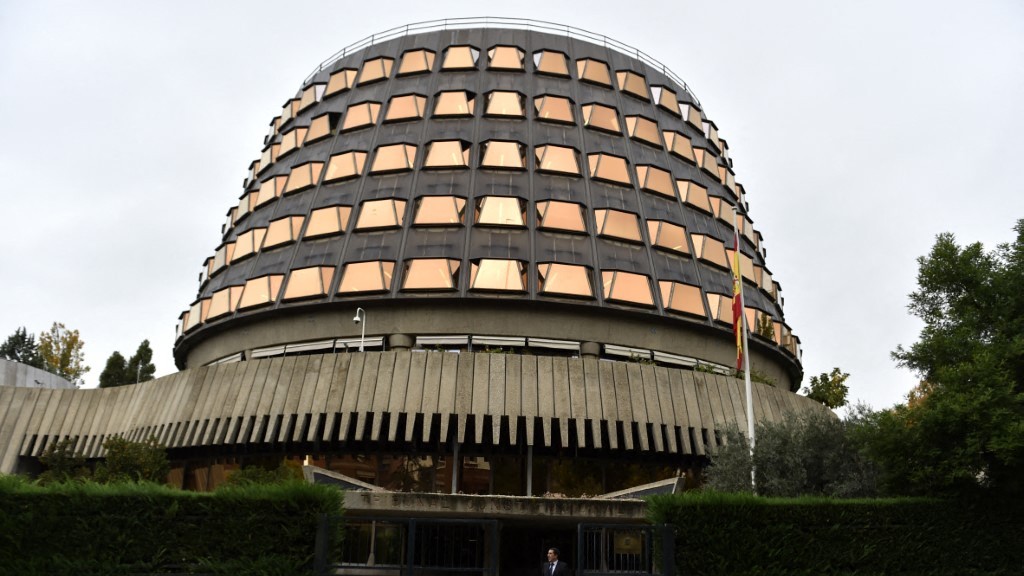
The building of the Spanish Constitutional Court in Madrid
Gerard Julien / AFP
The Constitutional Court of Spain on Thursday, June 26th, ruled in favour of Pedro Sánchez’s political amnesty for the Catalan separatists by six votes to four, Spanish media reports.
The six justices of ‘the leftist bloc’ of the Spanish top court endorsed the draft resolution presented by vice president of the Court, Justice Inmaculada Montalbán. Four justices “from the professional wing,” who question the amnesty law’s legality—Ricardo Enriquez, Enrique Arnaldo, César Tolosa, and Concepción Espejel—have already announced their dissenting opinions, El Debate said.
The approved resolution, which is the final say on the matter domestically in legal terms, states that “Constitutional silence cannot be interpreted as a prohibition of such an institution,” referring to the fact that amnesty as a legal institution is not defined in the Spanish basic law. “Anything that is not constitutionally prohibited remains, in principle, within the scope of the legislator’s decision, without requiring express constitutional authorization,” the ruling says.
The majority of the justices said the granting of amnesty by a parliament is not contrary to the principle of separation of powers.
The ruling comes just after the European Commission described the legislation granting amnesty to Catalan separatist leader Carles Puigdemont as a “self-amnesty” in a letter to the Court of Justice of the European Union (CJEU). Brussels’ intervention happened just before the CJEU holds its first oral hearing on the preliminary question submitted by Spain’s Court of Auditors, scheduled for July.
Spain’s controversial amnesty law grants immunity from punishment to Puigdemont, other leaders of the 2017 illegal referendum on the independence of Catalonia from Spain, and a wide range of other crimes and criminals simply for being Catalan separatists. The law was adopted in May 2024 by Spain’s congress of deputies, in a very close vote of 177 to 172.