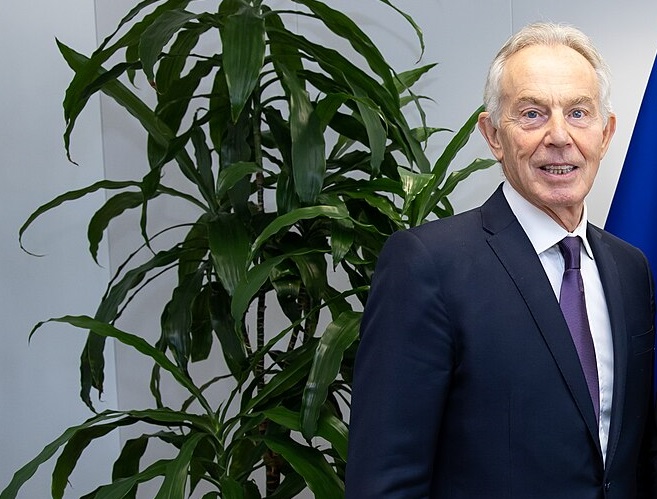
Leaving greenery behind him? Tony Blair, Executive Chairman of the Tony Blair Institute for Global Change, at the European Commission.
Bogdan Hoyaux / European Union (cropped).
Former British Prime Minister Tony Blair’s think tank has criticised the current government’s energy policy, arguing that rapid decarbonisation efforts are driving up utility costs and jeopardising security of supply. The report has sparked renewed debate in the UK over the balance between climate goals, energy independence, and the cost to the consumer.
In its report, the Tony Blair Institute for Global Change accused Energy Secretary Ed Miliband of contributing to rising energy prices through his policies. The think tank said the government was attempting to transform the energy system into a low-carbon model too quickly—recommending instead a review of certain measures, particularly the target of achieving near-complete decarbonisation of electricity generation by 2030.
The document claims that current energy policy has not adequately adapted to the changing economic and geopolitical environment and risks undermining the fundamental objectives of security of supply and affordability. It also warned that an overly rapid transition could increase the burden on consumers while global demand for fossil fuels remains high.
The institute further accused the government of “leading the UK in the wrong direction” with its energy policy and argued that it should lift its ban on new oil and gas licences in the North Sea. The report echoed the criticisms of U.S. president Donald Trump, who said Britain was
sitting on top of the North Sea, one of the world’s largest reserves, but they’re not using it.
The institute also argued that the energy profits levy discourages investment in a resource-rich region. It called on the government to lift restrictions on new oil and gas exploration licences and reduce the 38% tax rate imposed on the industry. According to the report, removing these barriers could unlock an estimated 7.5 billion barrels of oil and gas, valued at around £165 billion (€190 billion).
The British government rejected the criticism, stressing that the transition to clean energy will reduce prices in the long term and strengthen the country’s energy independence. While officials claimed that continued dependence on fossil fuels leaves the country vulnerable to geopolitical tensions and global price volatility, the Tony Blair Institute countered
In a country responsible for less than 1% of global emissions, the Labour Party’s policy is not climate leadership, but climate theatre.