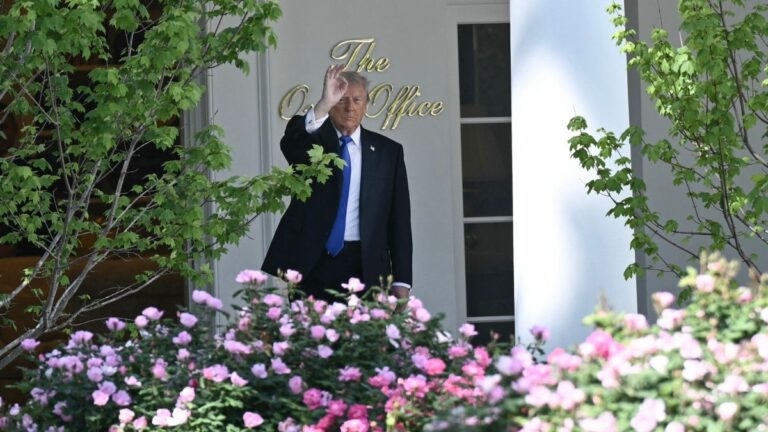
US President Donald Trump steps off Air Force One upon arrival at Joint Base Andrews in Maryland on January 22, 2026.
MANDEL NGAN/AFP.
A major U.S.-based think tank called on President Donald Trump to seize—in what it describes as an historic opportunity—to push for the collapse of Iran’s Islamic Republic after the failure of diplomatic talks.
The Jewish Institute for National Security of America (JINSA) says the Iranian regime is at its weakest point following widespread protests and mass killings of demonstrators, now largely hidden from global view by severe internet restrictions. Speaking on Iran International’s English-language podcast Eye for Iran, JINSA president and CEO Michael Makovsky said U.S. policy should explicitly aim for the regime’s collapse.
JINSA vice president for policy said recent months have created a rare strategic opening. “This is a moment like no other,” said Blaise Misztal, also warning that hesitation could allow Tehran to recover.
The think tank urged the Trump administration to abandon negotiations, escalate pressure on the Islamic Revolutionary Guard Corps, and build mechanisms to support Iranian opposition movements. Misztal argued that Western governments have long treated Iran’s nuclear ambitions, missile programme, and support for militant groups as separate issues—rather than as symptoms of what he described as the ideological nature of the theocracy.
Their comments come as Trump faces scrutiny over whether his rhetoric will be matched by action. Earlier this month, he voiced support for Iranian protesters and warned Tehran against using force.
Rising tensions are already having regional and international effects. The U.S. has announced the deployment of additional naval assets to the Middle East, while several European airlines have suspended or reduced flights to destinations across the region due to security concerns.