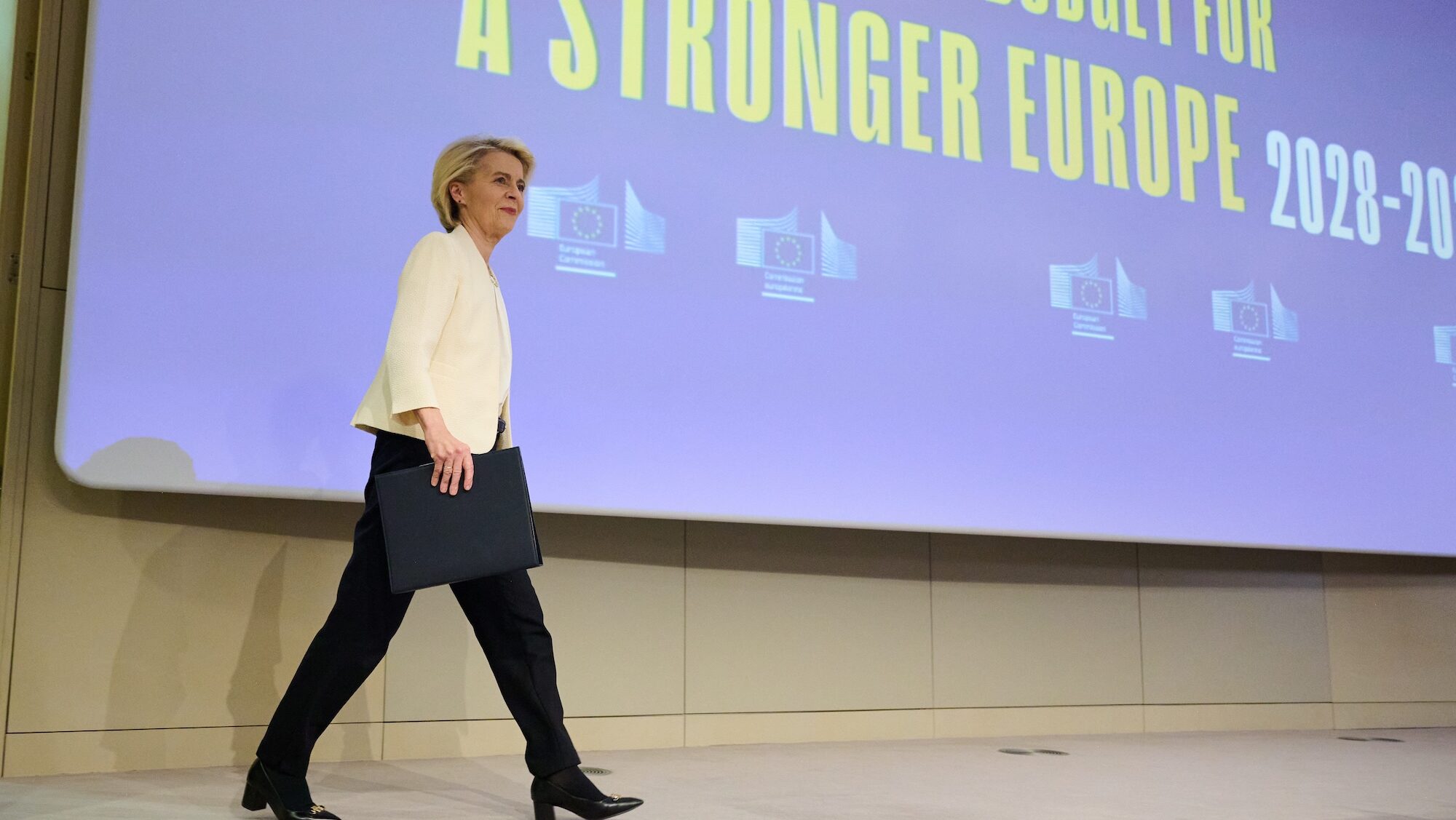
EU Commission President Ursula von der Leyen
Dati Bendo © European Union, 2025 / EC – Audiovisual Service
The next two years in Brussels will be about one thing above all else: the budget, as in the next Multiannual Financial Framework (MFF) for the next seven-year fiscal period of 2028-2034. And the way it looks now, this MFF could be the hardest one to agree on to date.
On Wednesday evening, July 16th, the EU Commission finally presented its long-awaited budget proposal, and while Commission chief Ursula von der Leyen celebrated it as “larger, smarter, and sharper,” it’s safe to say that barely anyone seems to be satisfied with it.
Not only does the Commission want to increase the total EU budget by around €800 billion, from €1.2 trillion to €2 trillion—massively increasing the mandatory member state contributions—but it also put forward an elaborate plan to restructure everything, the exact thing lawmakers both in Brussels and the capitals have been warning against for months.
“The next MFF is the most ambitious ever proposed,” said von der Leyen on Wednesday evening. “It is more strategic, more flexible, and more transparent,” she added, promising a “results-oriented” but simpler design, which many suspect is just a lot of words for ‘power grab.’
The core of these reforms revolves around merging most of the direct funding mechanisms into one giant cash-pot—or, rather, 27 tailor-made ones for each country—called the “National and Regional Partnership Plans” (NRPP), collectively worth €865 billion. This money will have to cover everything from cohesion, regional development, and agricultural funds, to social policy, internal security, and even border management.
Each country’s share will be given to capitals in one sum, allowing them to redistribute it to regions and sectors in a “flexible” way instead of the current individual mechanisms and region-based allocation model, which was meant to ensure that the subnational entities that most need funding would have a predictable and constant stream of assistance.
Since the cohesion and agricultural (CAP) funds alone make up nearly €800 billion in the current MFF, the size of this new super cash pot indicates that both of them will face massive cuts. What’s more, diluting them with additional mechanisms is seen as a threat to their original function, which is helping less-developed regions catch up with the EU average.
In particular, cohesion funds for poorer regions will be reduced by nearly 30%, while the agricultural subsidies will see another 25% cut, translating to a staggering €100 billion that will be missing from the sector starting from 2028. Anticipating the move, EU farmers’ organizations staged another major protest outside the Commission on the same day, vowing to continue the fight for an independent CAP and against the budget cuts for the sake of Europe’s food security.
NO BUDGET 👉 NO CAP 👉NO FARMERS 👉NO SECURITY
— COPA-COGECA (@COPACOGECA) July 16, 2025
WE MARCH TO SUPPORT #EUFarming
You can too 👇
Sign the petition📝 https://t.co/nIyDojTDGj pic.twitter.com/oMATDVDyRR
What’s perhaps even more concerning is that rule-of-law conditionality will be added to every element of the MFF, similar to how it was first introduced in 2020 for the pandemic recovery funds, which was immediately used to suspend vital funds for the conservative governments of Poland and Hungary.
This means that from 2028, the Commission will be able to freeze all kinds of funding, including the entirety of a country’s cohesion and CAP, based on arbitrary allegations of member states violating “EU values” at any given time, allowing for constant ideological and political blackmail from Brussels.
“The respect for the rule of law is unconditional; it’s a must for all funding from the EU budget,” von der Leyen said, adding that the NRPP “will make the rule of law and fundamental rights a condition and a focus for the reforms,” otherwise known as a ‘cash-for-reforms’ model.
Budget Commissioner Piotr Serafin also underlined that this will be “smart conditionality,” meaning that even if the Commission decides to freeze NRPP funding, it can also decide to unlock some elements and disburse them directly to the beneficiaries, circumventing member state governments.
In practice, Serafin added, this will mostly concern a new funding mechanism dedicated solely to NGOs, called ‘AgoraEU,’ which “will promote shared values, including democracy, equality and the rule of law and support the European cultural diversity, its audiovisual and creative sectors, media freedom and civil society involvement.”
You get the picture. Brussels will be able to take away funding for agriculture and rural development at will to increase voter dissatisfaction, while ensuring that it can keep promoting its own political agenda through directly funded and ideologically biased NGOs and media, thus attacking undesirable governments on two fronts.
So, if cohesion and CAP are slashed, where will all the additional funds that boost the budget to €2 trillion end up?
According to the plans, the Commission wants to create a new €410 billion “European Competitiveness Fund,” which will primarily cover the green and digital transitions, including decarbonization and the Clean Industrial Deal, as well as defense, of course, with between €131 billion earmarked in subsidies for boosting the EU’s defense industry.
Another €200 billion for the so-called “Global Europe” program, which includes foreign aid and assistance to neighboring countries and strategic regions; €175 billion for the Horizon Europe research program; as well as a €107 billion “administrative” pot to cover increased salaries of EU employees. Meanwhile, border and migration management will only get €34 billion in total, which is three times as much as it currently gets, but still not nearly enough to tackle the crisis.
In addition, a separate instrument worth €100 billion is to be created just for Ukraine, to be disbursed over the next seven years starting from 2028. That’s on top of any previously agreed instruments (such as the €40 billion Ukraine Facility) and any military aid that Kyiv would get before and during those years, depending on how the war develops.
As you probably noticed, the Ukraine fund is identical to the cuts from the CAP’s agricultural subsidies, which is why critics, such as Hungarian PM Viktor Orbán, were quick to call this move “a dangerous gamble” on Wednesday. “Ukraine would get a massive funding boost, while European farmers lose out. This plan risks sidelining rural Europe and threatening families across the continent,” Orbán commented on X.
⚠️🌾 A shocking new EU budget leak reveals a dangerous gamble: Ukraine would get a massive funding boost, while European farmers lose out. This plan risks sidelining rural Europe and threatening families across the continent. Brussels must not abandon Europe’s farmers to bankroll… pic.twitter.com/J74f27q1ND
— Orbán Viktor (@PM_ViktorOrban) July 16, 2025
Another major question was how to repay the EU’s €800 billion loan that was taken out jointly to finance post-pandemic economic recovery, and which the bloc will have to start repaying in two years.
Instead of asking for additional contributions from the member states, the Commission decided to introduce EU taxes instead—called “own resources”—on electric waste, tobacco products, and large companies (with an annual turnover of at least €100 million), expecting to generate close to another €60 billion annually.
This is not a popular solution either; as documents recently leaked to the europeanconservative.com already showed, the idea is to tax revenue, not profit, which is feared to only exacerbate the flight of large companies from Europe and undermine national control over taxation.
The final budget will have to be approved by all member states unanimously, so expect long months of negotiations ahead. They have two years to come to an agreement on every detail. While we know that many member states have major problems with this plan (20 of them explicitly rejected merging the CAP and cohesion funds, for instance), the Commission would not have put it forward if it were not confident that the final result would be close to its original vision, whatever the initial opposition.