Germany’s public broadcasters are facing questions over political balance after new figures revealed a striking gap between voter preferences and who actually receives airtime on the country’s most influential television talk shows.
Despite leading national opinion polls, the Alternative for Germany (AfD) has made only ten appearances this year across the flagship political programs of ARD and ZDF. That amounts to just 4.7% of all invitations handed out to politicians, even though more than one in four voters now back the party, according to the latest ZDF Politbarometer.
Broadcasters are legally required to present a wide diversity of opinions while maintaining objectivity and impartiality. If television invitations reflected the political landscape shown in current polling, AfD representatives would have appeared almost six times more frequently than they actually have.
Instead, Germany’s governing and establishment parties continue to dominate prime-time political discussion. Politicians from the CDU and CSU accounted for 91 appearances, representing more than 43% of all invitations, despite polling at 23%. Despite polling at only 12%, the SPD appeared 56 times, representing over a quarter of all political guests—more than double its expected share under proportional representation.
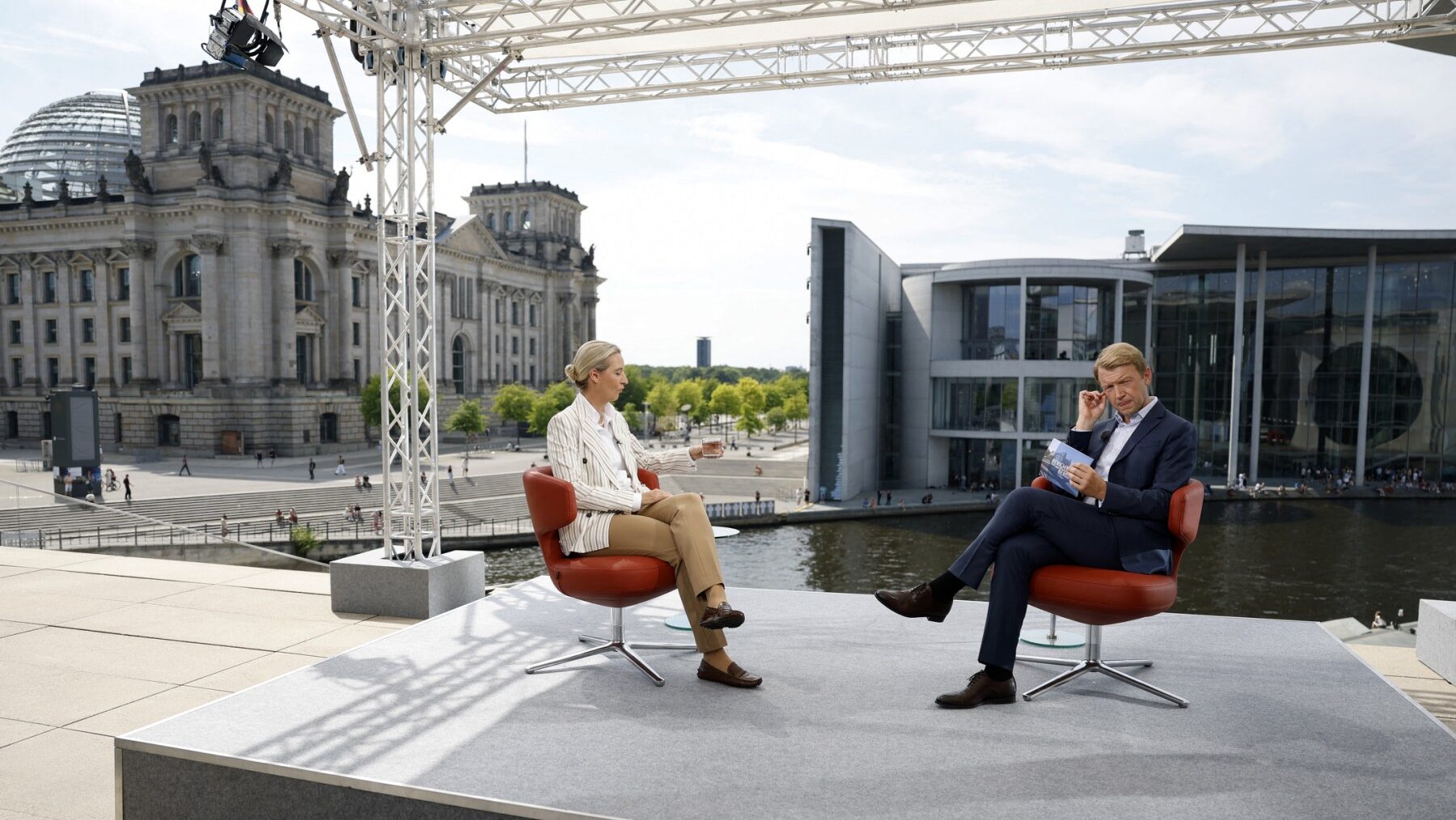
The AfD’s limited presence is not only reflected in the number of invitations but also in the subjects its politicians are asked to discuss. Party co-chair Tino Chrupalla, the AfD politician invited most often this year with three appearances, was primarily questioned on foreign policy. During one appearance, he also discussed economic policy, but he was not invited to focus on issues such as migration, domestic security, or social policy, subjects that have become central to the party’s political platform.
Measured by overall airtime, the AfD’s presence also remains minimal. Programs featuring at least one AfD representative totaled roughly 12 hours through mid-July.
Out of an estimated 185 to 190 hours of political talk show broadcasting, only around 6% featured any AfD politician at all.
The figures show that Germany’s television political landscape bears little resemblance to the current electoral one. While the AfD has emerged as the strongest force in national polling, the firewall against the biggest conservative force in Germany is still active in all parts of the media.