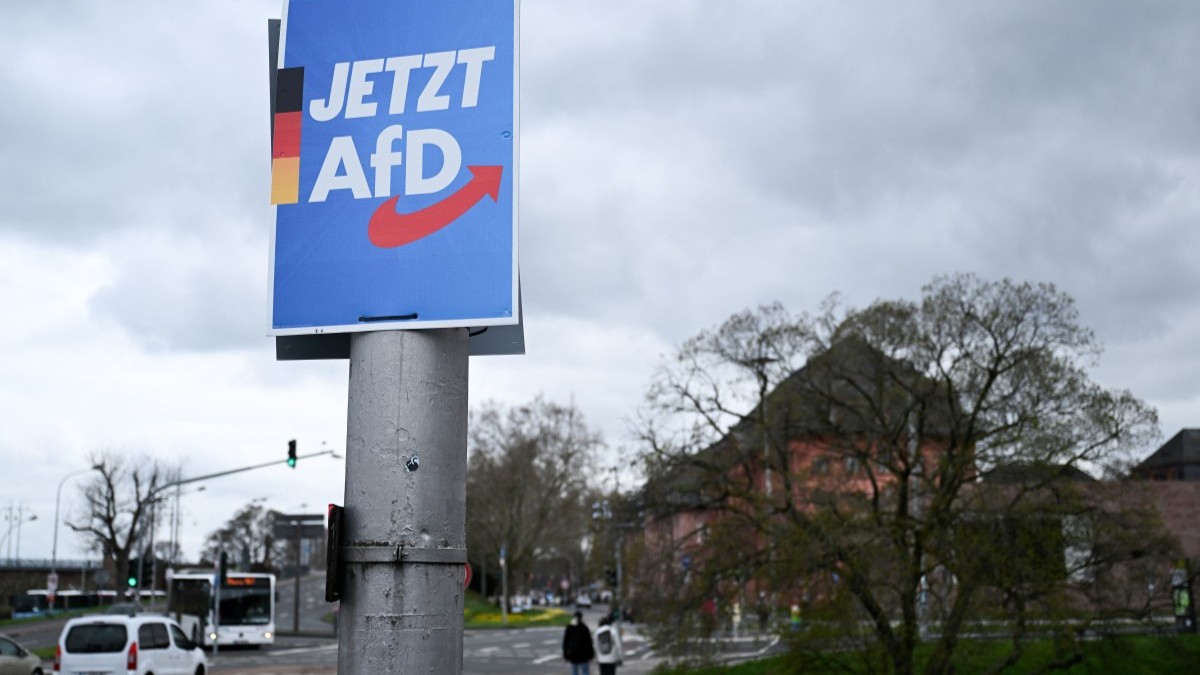
An AfD electoral poster pictured in Mainz, western Germany, on March 17, 2026, ahead of the March 22 regional elections in Rhineland-Palatinate
KIRILL KUDRYAVTSEV / AFP
The regional elections taking place this weekend in the German state of Rhineland-Palatinate have become a more significant political event than usual.
Pre-election polls suggest that Alternative für Deutschland (AfD) could obtain around one fifth of the vote, more than double the result achieved in 2021, when it remained at around 8%.
The steady growth of the right-wing populist party not only confirms an upward trend seen in almost all recent elections but also increases pressure on the CDU and on the European People’s Party, in the midst of a political confrontation over immigration both in Germany and in Brussels.
The latest survey conducted by INSA between March 10 and 17 places the CDU and the SPD in a very tight race for first place, with percentages around 28%, while the AfD consolidates itself as the third force with support at 20%.
Germany, INSA poll:
— Europe Elects (@EuropeElects) March 19, 2026
Rhineland-Palatinate regional parliament election
CDU (EPP): 28%
SPD (S&D): 27%
AfD (ESN): 20%
GRÜNE (Greens/EFA): 9%
FW (RE): 5%
LINKE (LEFT): 5%
Fieldwork: 10-17 March 2026
Sample size: 1000
➤ https://t.co/obOCVirbpF pic.twitter.com/ZQMKbmREqI
If these figures are confirmed, the party would clearly more than double its result from the previous regional elections, a jump that many analysts consider historic for this western German state, where conservative voters have traditionally been divided between the major parties.
AfD’s advance is largely explained by the growing importance of issues such as immigration, security, and dissatisfaction with federal policy during the campaign.
The party has focused its message on the need to limit the entry of asylum seekers, strengthen border controls and return powers to the federal states. This discourse is finding increasing support among voters who believe that traditional parties have failed to respond to their concerns.
This growth also has consequences that go beyond Rhineland-Palatinate. In Berlin, the CDU is in the middle of a strong internal and external controversy over its relationship with the AfD, especially after several parliamentary debates on tightening migration policy.
While the Christian-democratic leadership insists on maintaining the so-called cordon sanitaire, sectors of the party are calling for tactical agreements to push through reforms on asylum and security, which has caused tensions both within Germany and in the European Parliament.
The migration issue has become the main point of friction. In this context, AfD’s result in the regional elections will be watched very closely. The greater its electoral support, the more difficult it will be for the CDU to maintain its current strategy without opening an internal debate about possible changes.
Moreover, a strong AfD strengthens conservative and patriotic parties in the European Parliament, where the balance of power has already begun to shift after the last European elections and where migration policy has become one of the central issues.
At the regional level, parliamentary arithmetic suggests that the only clear majority after the election would be a grand coalition between the CDU and the SPD, since all traditional parties continue to reject any agreement with the AfD.
However, this type of broad coalition, increasingly common in Germany, is seen by some of the electorate as a sign of a lack of real alternatives, which in turn fuels the growth of parties that present themselves as opposition to the established political system.
This weekend’s vote will therefore not only decide the government of Rhineland-Palatinate, but will also serve as a new thermometer of the political change taking place in Germany.