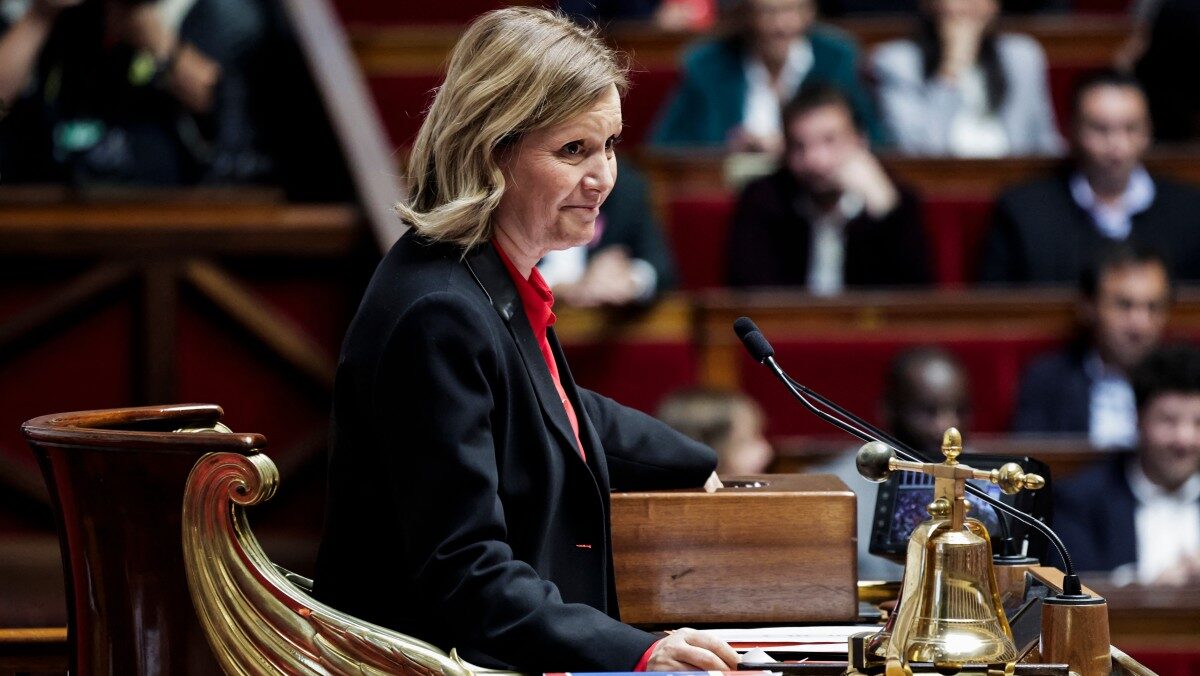
President of the French National Assembly Yaël Braun-Pivet speaks during elections for members of the National Assembly office and committee chairmen in Paris on October 1, 2025.
Stephane de Sakutin / AFP
On Wednesday, October 1st, a new parliamentary session opened in the French National Assembly—a time for the institution’s leadership positions to be renewed. Since the legislative elections in the summer of 2024, the Rassemblement National (RN) has been excluded from key parliamentary responsibilities. A pact between the Left and the Centre has kept the party out of all symbolic roles essential to the functioning of parliament. Now, the RN intends to get back in the game and settle the score.
The bureau of the French National Assembly comprises 21 strategic positions (six vice-presidents, three questeurs in charge of financial matters, and twelve secretaries), whose role is to oversee debates and ensure the smooth running of the deputies’ work. These positions are renewed annually by election. Last year, an agreement was reached between the Left and the Centre to oust the RN, even though, with its 126 MPs, it represents the largest parliamentary group. This approach—particularly anti-democratic, as it aimed to deprive a party representing millions of French people of any participation in the functioning of the parliamentary institution—has also been seen in the European Parliament against conservative groups.
This year, the centrist bloc, also known as the ‘common base,’ which brings together the presidential camp with the Centre-right, believes that too much power has been given to the Left in the distribution of roles and that the time has come to rebalance things—in favour of the RN. Regarding the six vice-presidential posts, the president of the National Assembly, Yaël Braun-Pivet, of Macron’s Renaissance party, defends the need to “strive to reproduce the political configuration of the Assembly within the bureau,” according to Article 10 of the Assembly’s rules of procedure. She has proposed a proportional distribution among political groups, with two vice-presidents from the Left, two from the Centre and two from the RN. The government coalition currently holds three. The Left has refused an amicable agreement, and this distribution will therefore be put to a vote, which should allow for a convergence of interests between the centrist bloc and the RN and its allies in the Union des Droites pour la République (UDR)—contrary to what happened last year.
Although the positions at stake are mainly symbolic and honorary, the move is nonetheless significant. The presidential camp recognises that sidelining the RN, as it did last year, is not an acceptable long-term strategy and that it is morally indefensible to exclude France’s leading party from the Parliament’s governing bodies in this way.
For its part, the RN has also changed its position. Faced with the obstruction encountered by her party last year, Marine Le Pen did not want to fight and resigned herself to being sidelined. This time, she decided that it was important to stake her claim, and, to that end, she reached an agreement with the presidential camp through negotiations that may have been considered despicable and formal but were nevertheless useful.
In a politically tense context where the new prime minister, Sébastien Lecornu, still lacks a majority, the ability of the Right and the Centre to engage in dialogue may prove decisive. For the time being, Le Pen has announced that she does not wish to automatically bring down the prime minister and is awaiting his general policy speech, which is scheduled for next week. An agreement seems to be taking shape behind the scenes: “Respect us and we will respect you.” Such bargaining is not to everyone’s liking. In the presidential camp, some MPs regret that the issues of the Assembly’s organisation are being mixed up with those of a no-confidence vote.
The vote for the nine main members of the Assembly’s bureau on Wednesday, October 1st, will be followed on Thursday, 2nd, by the vote for the 12 secretaries. In addition, there will be appointments for the eight chairs of the parliamentary committees. One position is particularly coveted: the chair of the finance committee, which, according to the constitution, should normally go to a “member of the opposition.” The question is who, today, embodies the opposition. The position was previously held by Éric Coquerel, a member of the far-left party La France Insoumise (LFI). The RN is claiming this central position as the largest opposition group in absolute terms, outside of any coalition.
The Left has expressed its strong indignation at the prospect of the RN regaining executive parliamentary functions. The four left-wing parties, united in the now moribund coalition of the New Popular Front (NFP), believe that the cordon sanitaire in the Assembly must be maintained at all costs. “Let’s not allow an anti-republican, xenophobic and climate-denying party to become normalised and further corrupt our institutions,” said Cyrielle Chatelain, president of the Green Party group, in a statement released earlier this week—forgetting in the process that an RN MP has the same electoral legitimacy as a Green representative.