Ukraine’s push for fast-track EU membership is facing resistance from key member states, with Germany and France pushing back against plans backed by European Commission president Ursula von der Leyen.
EU ambassadors met over dinner in Brussels on Wednesday, March 4th, where von der Leyen’s chief of staff, Björn Seibert, outlined the Commission’s latest enlargement strategy.
According to Euractiv, the Commission is considering a radical change to the process to speed up and facilitate the admission of new countries to the European Union, in the name of a principle of ‘progressive integration:’ this would involve giving priority to countries joining the bloc without full voting rights, even before they have carried out far-reaching internal reforms in areas such as the fight against corruption and the rule of law. The fast-track procedure would allow them to become members without enjoying all the benefits of European Union membership—particularly regarding public aid.
The French and German ambassadors have made it clear that they are not in favour of this plan, due to the significant differences of opinion that exist among member states on the issue of Ukrainian accession.
At the end of January, Chancellor Merz already spoke very clearly on the subject of Ukraine’s accelerated accession in unequivocal terms: “Accession on 1 January 2027 is out of the question. It’s not possible.”
In any case, any accession process would require a unanimous vote, which would be difficult to obtain. Hungary is likely to block it, regardless of the government that emerges from the April elections. For Viktor Orbán, easing the procedure in favour of Ukraine would amount to nothing less than a “declaration of war” on Hungary, he said on Wednesday in Brussels.
In addition to Germany, Austria and Sweden have also emphasised the need to stick to accession conditions rather than seeking speed at all costs. France is on the same line—and is supposed to hold a referendum to ratify the new accession.
Dutch prime minister Rob Jetten has also remained very cautious. “We are very open to the idea of broader support,” he told reporters on Wednesday in Brussels. “But going too fast is, in my opinion, not the right way forward.” “For the moment, it is not possible to set a date for enlargement to Ukraine,” he added.
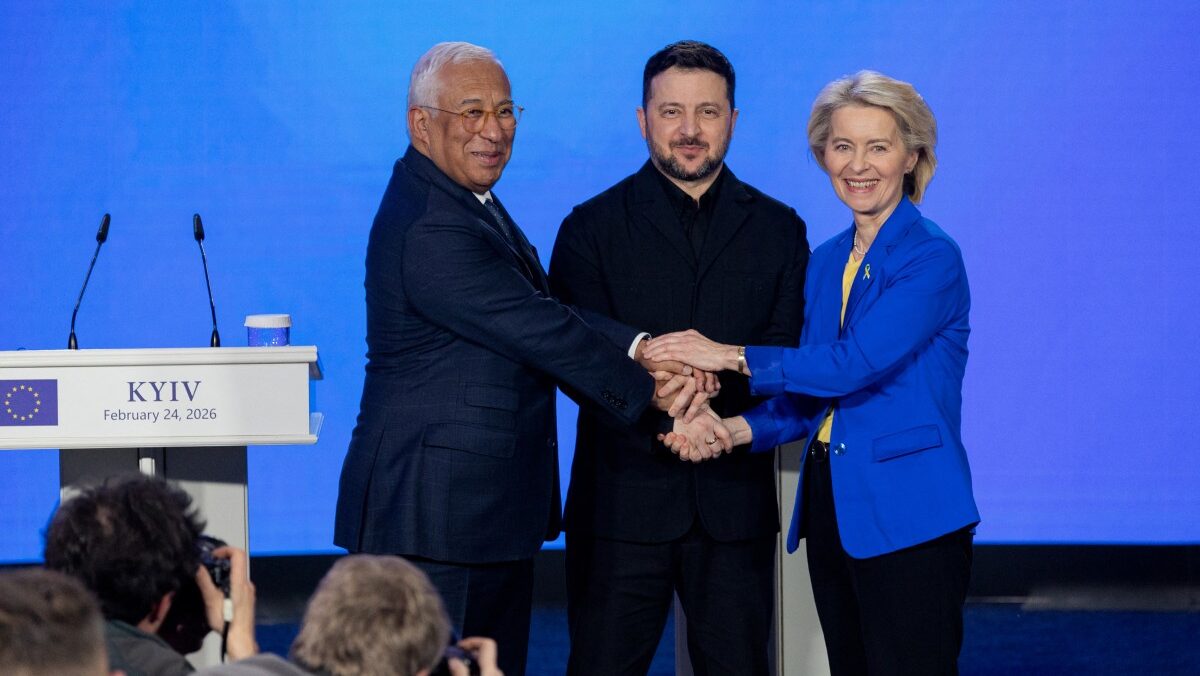
France and Germany have said they want to work on an alternative compromise solution that would garner the support of all member states. But von der Leyen has no intention of giving up. On February 24th, she publicly acknowledged in a speech to Zelensky in Kyiv that the 2027 date was not tenable. But behind the scenes, the Commission still maintains that a specific solution must be found for Ukraine, lest it find itself isolated once the peace talks have reached a conclusion.
For his part, President Zelensky is keeping up the pressure on the 2027 date. He fears that Putin will oppose the accession process as part of the peace talks.