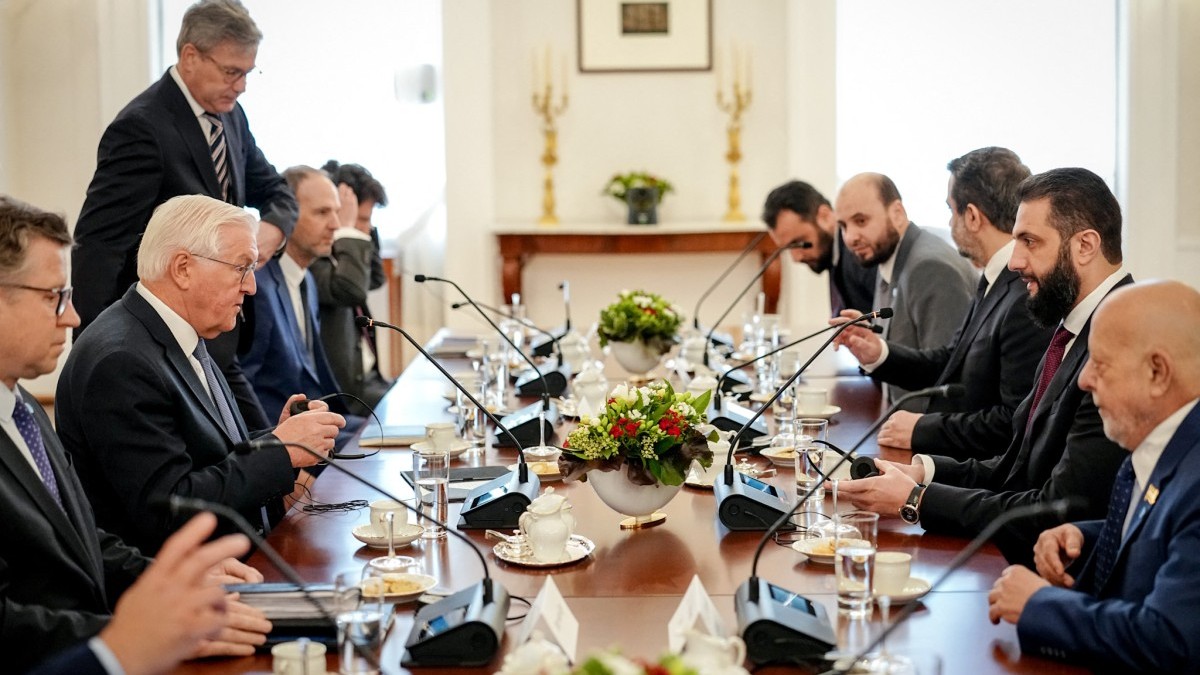
German President Frank-Walter Steinmeier (2L) meets with Syrian President Ahmed al-Sharaa (2R) and delegates at the Bellevue presidential palace in Berlin on March 30, 2026.
KAY NIETFELD / POOL / AFP
Ahmed al-Sharaa, formerly known as Abu Mohammed al-Julani, the man who for years led a jihadist militia in Syria, arrived in Berlin yesterday with full state honours. Today he will be received by Chancellor Friedrich Merz, Germany’s highest political authority, in a visit that until recently would have seemed unthinkable.
The image from yesterday is already one for the history books. Red carpet, honour guard and official smiles for Syria’s new interim president, the same man who led the offensive that overthrew Bashar al-Assad at the end of 2024 at the head of HTS, an organisation long regarded as the direct successor to Al-Qaeda-style armed Islamism in Syria.
Sharaa has arrived in Germany for his second visit to Europe. pic.twitter.com/ccoiU9vGOV
— Qalaat Al Mudiq (@QalaatAlMudiq) March 29, 2026
In the space of a few months, al-Sharaa has gone from being treated as a former rebel commander to becoming one of the West’s preferred interlocutors. He has travelled to Paris, Washington, Moscow and now Berlin.
Sanctions are beginning to be lifted, economic forums are multiplying and European governments are now openly talking about reconstruction, investment and the return of refugees.
Yet one only has to step a few metres away from the official protocol to find a very different reality.
Last night, several streets in Berlin were filled with Syrians celebrating the visit. There were flags, chants and scenes of jubilation. For a significant part of the Syrian diaspora, Assad’s fall still represents liberation and the beginning of a new chapter.
#Syrians in #Germany are preparing to welcome their president, Ahmed al-Sharaa, in #Berlin now. pic.twitter.com/vBTwW0Ihxx
— Qusay Noor (@QUSAY_NOOR_) March 29, 2026
And yet that same scene reveals a deeper contradiction. For years, German politicians, humanitarian organisations and much of the European left insisted that the hundreds of thousands of Syrians taken in by Germany would return home as soon as Assad disappeared. It was one of the main arguments used to justify that this migration was temporary.
Assad is gone. Syria has a new government. Europe has effectively recognised the country’s new authorities. And still, almost nobody is returning.
Germany is home to nearly one million Syrians who arrived during the 2015 migration crisis and the years that followed. Before taking office, Friedrich Merz argued that, once the civil war was over, Syrians would no longer have grounds to remain under asylum protection. Al-Sharaa’s visit had precisely two central objectives: to open the door to economic reconstruction and to begin negotiating the return of refugees.
As AfD sarcastically put it on X this morning, “It’s fortunate that jihadist and al-Qaeda fighter Abu Mohammed al-Julani is in Berlin: From here he can prepare the remigration of all Syrians in the asylum system—and take them back to Syria with him on the return flight.”
Gut, dass Dschihadist & Al Qaida-Kämpfer Abu Mohammed al-Julani in Berlin ist: Von hier aus kann er die Remigration aller Syrer im Asylsystem vorbereiten – und sie beim Rückflug mit nach Syrien nehmen. Natürlich ohne die Zusage irgendwelcher Gelder auf Kosten der Steuerzahler. pic.twitter.com/Q3ZnufUTQB
— AfD (@AfD) March 30, 2026
The problem is, Syrians in Germany are not very keen to return to a devastated country where there are hardly any jobs, intermittent violence and a state increasingly dominated by Islamist factions.
While Merz seems determined to end the influx of Syrians into Germany, and his government deported the first Syrian since 2011 last December, the official narrative of the return of Syrian refugees to their homeland happening soon has collided with reality.
In private, many European leaders admit as much. The promised mass return will probably never happen. There may be a few symbolic expulsions, perhaps the deportation of criminals or rejected asylum seekers. But the vast majority will remain in Europe.
And while Berlin becomes accustomed to that contradiction, there is an issue that is being discussed.
Since al-Sharaa came to power, Syria has not become the stable and reconciled country that some had portrayed. Sectarian clashes continue, the Islamic State remains active in some areas, and religious minorities are living under growing pressure.
Syrian Christians—Armenians, Assyrians, Arameans and Melkites—have for months reported kidnappings, murders and attacks on villages and churches. In several regions in the west and north-east of the country, massacres and silent expulsions have been reported. Local priests speak of entire families abandoning their homes after receiving direct threats from armed groups close to the new authorities.
For years, much of Europe’s political elite dismissed any warning about Islamism as exaggerated or alarmist. Now they are welcoming with full honours a leader whose political career emerged precisely from that world.