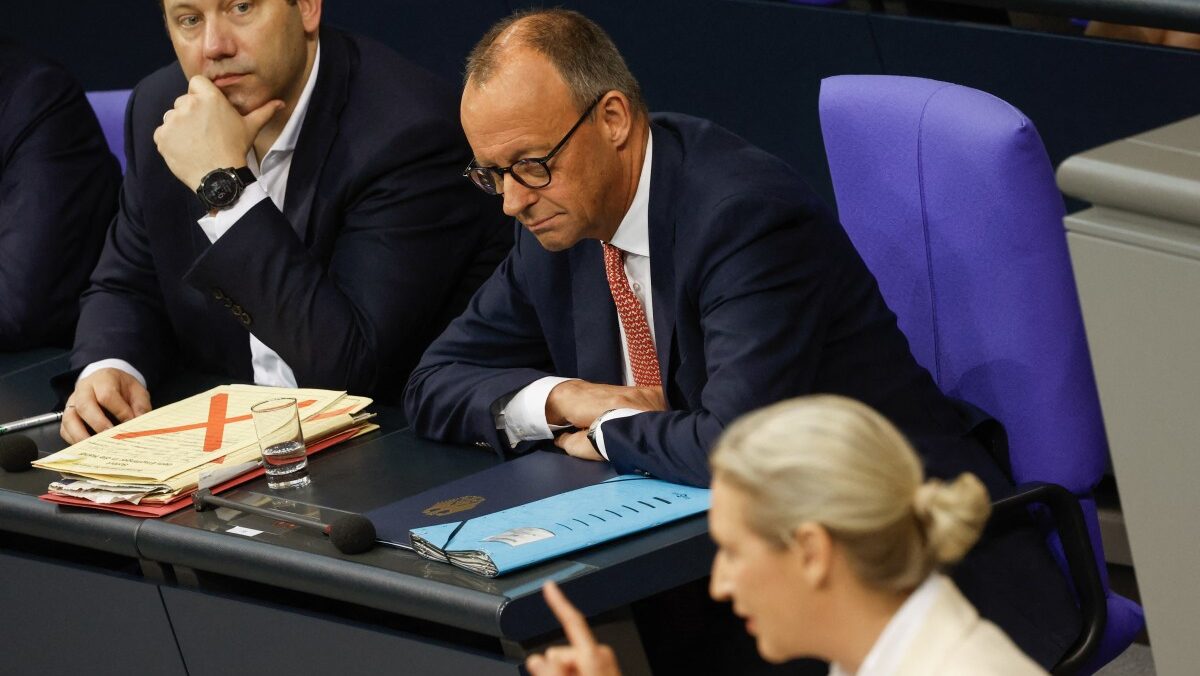
The co-leader for Alternative for Germany (AfD) Alice Weidel gives a speech as German Chancellor Friedrich Merz and German Finance Minister and Vice Chancellor Lars Klingbeil (L) look on during a general debate on the budget of the Chancellery at the Bundestag, the lower house of parliament, in Berlin, on July 9, 2025.
Odd Andersen / AFP
According to the latest YouGov poll commissioned by the news agency dpa, Alternative für Deutschland (AfD) now holds 25% of voter support, just two points behind the CDU/CSU, which has fallen to 27 %. In just one month, the conservative party has narrowed the gap with Friedrich Merz’s bloc by three percentage points. It is the AfD’s best result ever in a national poll.
Merz’s popularity—or lack thereof—is doing little to halt this trend. After taking office in May, he promised that “citizens would feel improvements before summer.” However, only 22 % of Germans perceive any progress under his leadership. 32 % believe the country’s situation has worsened, and 37 % see no change at all. Even among his own voters, the results are modest: only 44 % of CDU and CSU supporters think Merz is leading one of the best governments in recent decades. 41 % openly disagree. The CDU leader has paid the price for selling illusions too quickly.
Concern within the CDU ranks is growing—not so much because of AfD’s current figures, but because of its future prospects. 26 % of respondents believe AfD could overtake the CDU in the next election, and another 26 % foresee a technical tie. Only 31 % believe the CDU will remain the country’s leading party.
Sonntagsfrage von YouGov zur Bundestagswahl: CDU/CSU 27 % | AfD 25 % | SPD 14 % | GRÜNE 11 % | DIE LINKE 10 % | BSW 5 % | FDP 3 % | Sonstige 5 %
— Wahlrecht.de (@Wahlrecht_de) July 16, 2025
➤ Übersicht: https://t.co/Gzilw3J3L9
➤ Verlauf: https://t.co/Zh9Dkcic7w pic.twitter.com/SvRhJz8z7S
AfD’s progress is taking place despite—or rather because of—ongoing attempts to isolate it politically and in the media. While other traditional parties lose support (SPD, Greens, FDP), AfD is solidifying its position as the main alternative to the establishment. Official rejection has not slowed its rise; instead, it has strengthened its narrative as the party that’s been excluded for saying what many people think.
In this context, efforts to discredit AfD seem to reflect less of a genuine ideological debate and more of an attempt to stop—through institutional means—what can no longer be stopped at the ballot box.