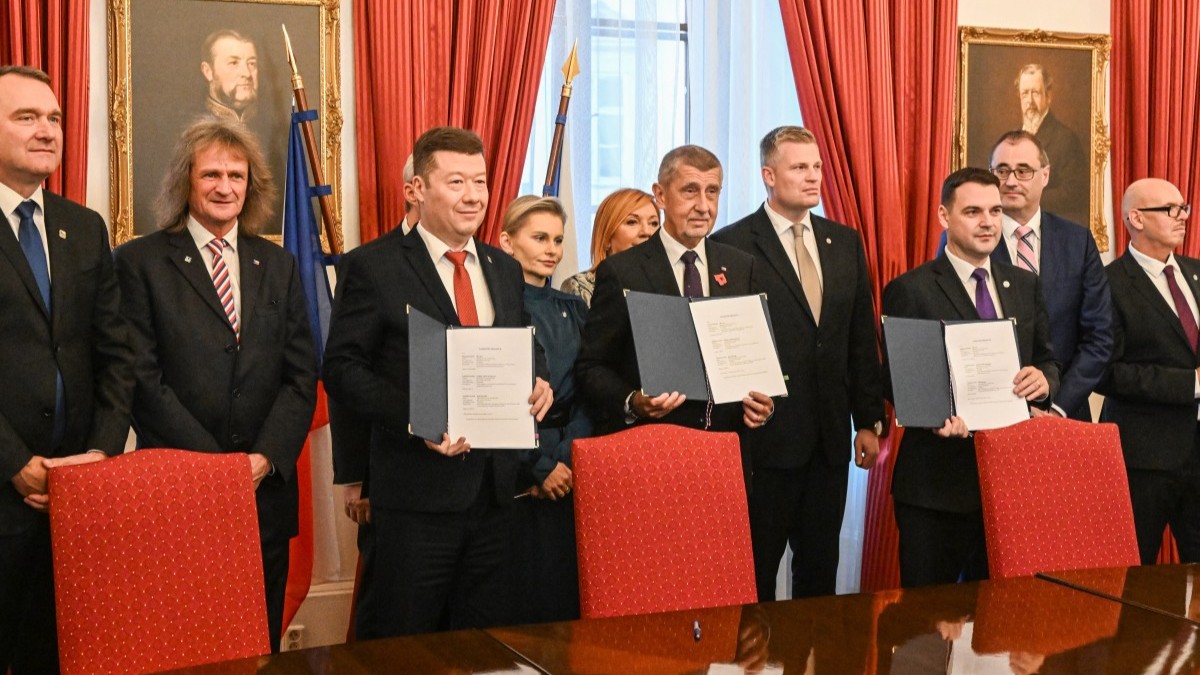
ANO leader and prime minister candidate Andrej Babiš (C) poses with his coalition partners after signing a new coalition government agreement at the Czech Parliament in Prague on November 3, 2025.
Michal Cizek / AFP
Czechia’s likely next prime minister, Andrej Babiš (ANO), signed a coalition agreement on Monday afternoon with the Freedom and Direct Democracy (SPD) and Motorists for Themselves (Motoristé sobě) parties, following his impressive election victory last month.
A draft of his government’s programme emerged ahead of this signing, indicating that officials will seek a leading position in the charge against Brussels’ ‘green’ agenda.
Politico said the administration hopes to “derail EU plans for a new emissions trading system,” or ‘ETS2,’ which critics describe as new ‘green’ taxes. Notable opposition to the scheme has also emerged in Poland.
National media also highlights the government’s aim “to reduce regulated energy prices.”
All three coalition parties promised in their election programmes to challenge the European Union’s climate targets. And there has, unsurprisingly, been a particular focus on the combustion engine ban from the Motorists for Themselves party, whose chairman Petr Macinka has dismissed the ‘climate emergency’ as “pure propaganda.” Brussels will be especially dismayed, then, by reports that Macinka could become Babiš environment minister.
More generally, the coalition parties attacked the EU’s ‘Green Deal’ as “unsustainable,” stressing that the bloc “has limits.”
The upcoming government’s approach to EU environment laws has been the subject of concern among pro-Brussels officials since the Czech elections were concluded. Brussels-friendly MEP Ondřej Krutílek said towards the end of last month that Babiš’ criticism of the ETS2 scheme is “completely out of line.”
Andrej Babiš je se svou kritikou ohledně ETS2 úplně mimo. pic.twitter.com/EQtxVQF3sO
— Ondřej Krutílek (@ondrejkrutilek) October 22, 2025
If Babiš and his allies opposed to elements of the green agenda do succeed in forcing change, the effects of this will no doubt be felt beyond the EU. Spectator Australia columnist Mark Higgie joked that it would be “fun” to watch (eco zealot) UK Prime Minister Keir Starmer “squirming if the EU junks its planned 2035 ban on new combustion-engine cars.”