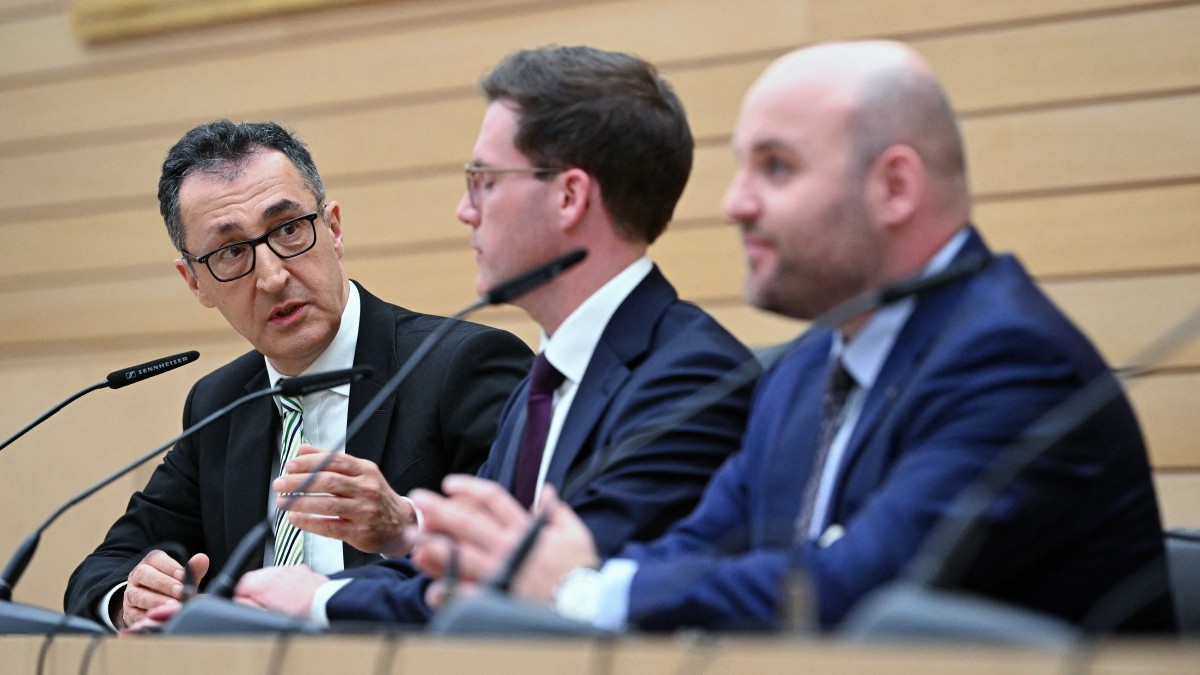
Cem Özdemir, top candidate of the Greens, Manuel Hagel, top candidate of Christian Democratic Union (CDU) and Markus Frohnmaier, top candidate of the far-right Alternative for Germany (AfD) (L-R) address a press conference at the regional parliament after exit polls were announced in the state elections on March 8, 2026 in Stuttgart, southern Germany.
THOMAS KIENZLE / AFP
The most striking fact of the regional elections held this Sunday in Baden-Württemberg is not who won the vote, but who continues to grow. The Alternative für Deutschland (AfD) achieved its best historical result in a western German state, with support approaching 19% and nearly doubling its previous election performance.
For years, the party had concentrated its electoral strength in the former East German territories. However, Sunday’s results confirm that its advance is no longer limited to that political geography. Also in the West—traditionally more resistant to its message—AfD is consolidating a stable electoral base. And that has just disrupted the entire political system of recent years.
In several constituencies the growth was particularly visible.
In Mannheim I, for example, the party’s candidate secured the direct mandate after narrowly defeating the candidates of the Christian Democratic Union (CDU) and the Greens. In Pforzheim, another of its emerging strongholds, the party became the most voted force in the proportional second vote.
Beyond the shifting numbers, the result shows that AfD is consolidating itself as the country’s third major force and as the main opposition party in the German political landscape.
If AfD’s rise was the most surprising element of the day, the battle for first place was decided by extremely narrow margins.
Alliance 90/The Greens managed to edge ahead of the CDU by a small margin, although the regional electoral system ultimately granted both parties the same number of seats in the state parliament.
The Green candidate, Cem Özdemir, entered the race with a clear advantage in public recognition. A former federal Minister of Agriculture and a well-known figure in German politics for decades, his campaign relied on a mix of political experience and strong media presence.
For the CDU, however, the result leaves a bittersweet taste. The party hoped to recover leadership in one of the country’s most economically important states, home to industrial giants such as Porsche and Mercedes-Benz. However, the party of Friedrich Merz, Manfred Weber and Ursula von der Leyen failed to gain enough momentum to clearly distance itself from the Greens.
The parliamentary tie now opens a complex scenario of negotiations to form a government.
If there is a party that clearly emerges weakened from these elections, it is the Social Democratic Party of Germany (SPD).
The Social Democrats fell to around 5% of the vote, a result that represents a dramatic drop compared to previous elections. In practice, their support has been cut in half in just one electoral cycle, heading down the same path as its French counterpart.
For decades, the SPD was one of the pillars of the German political system. Today, however, it appears trapped between two simultaneous pressures: on the one hand, the growth of the Greens within the left-wing political space; on the other, the shift of part of its former working-class electorate towards options such as AfD.
Some analysts call this effect the “Lepenisation” of politics, when the working-class vote traditionally associated with the left moves toward identity-based parties as a reaction to the increasingly endophobic drift of traditional parties.
Election night also brought bad news for the Free Democratic Party (FDP). The liberal party failed to surpass the 5% threshold required to enter the regional parliament and was left out of the chamber.
The result is particularly significant because Baden-Württemberg had for decades been one of the territories where liberals achieved their strongest results.
Die Linke also fell below the representation threshold, although it managed to place slightly ahead of the FDP in the number of votes.
The elections in Baden-Württemberg are only the first of several electoral contests scheduled in Germany this year. In the coming weeks, voters will also head to the polls in Rhineland-Palatinate, Berlin, Saxony-Anhalt and Mecklenburg-Western Pomerania.
The country’s political map appears increasingly fragmented. Traditional parties still dominate the institutions, but their ability to concentrate the vote is no longer what it was a decade ago.
The sustained growth of AfD, the weakening of the SPD and the difficulties faced by the liberals show a political system that is being reordered. And Baden-Württemberg, one of Germany’s economic engines, has once again served as a laboratory for that change.