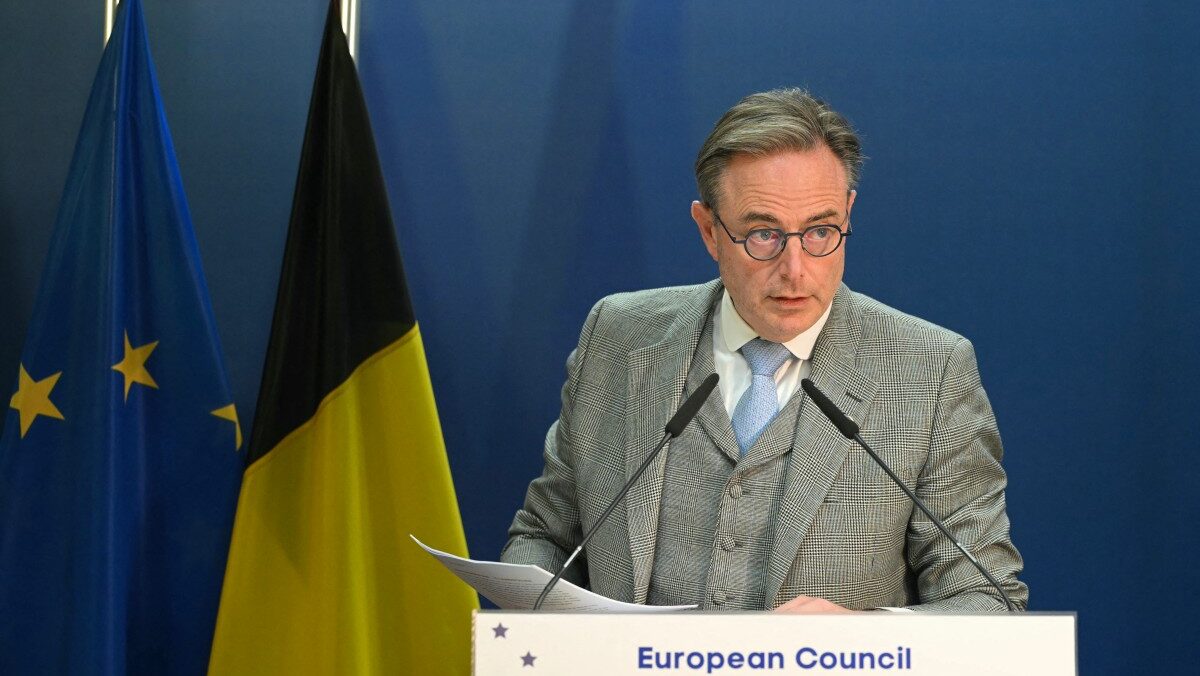
Belgium’s Prime Minister Bart De Wever speaks during a press conference as part of the European Council meeting gathering the 27 EU leaders to discuss Ukraine, European defence, recent developments in the Middle East, competitiveness, housing and migration, in Brussels, on October 23, 2025.
Nicolas Tucat / AFP
The European Council meeting held on Thursday and Friday in Brussels once again revolved around the war in Ukraine and the uncertain future of the bloc on defense, competitiveness, and migration. Yet behind the formal statements of unity, Belgium’s resistance to approving a new €140 billion loan for Kyiv set the tone for increasingly tense discussions.
The country’s famed “capacity for compromise” this time turned into an act of prudence, leaving the EU’s largest-ever financial operation in favor of Ukraine on hold.
The summit began with a videoconference intervention by Ukrainian President Volodymyr Zelensky, who, once more, called for military and financial support “until final victory.” EU leaders reiterated their “permanent and unwavering support” for Ukraine’s sovereignty and territorial integrity, according to the text endorsed by 26 of the 27 member states.
The official conclusions reaffirmed a pledge to continue providing “comprehensive political, financial, economic, humanitarian, and military assistance” and to prepare “strong and credible security guarantees” for Kyiv. However, the proposal to finance the new loan using profits from frozen Russian assets—about €200 billion, most held by Euroclear in Brussels—triggered a full-blown diplomatic storm.
Belgian Prime Minister Bart De Wever, leader of the Flemish nationalist N-VA party, blocked the initiative and forced the pro-Ukrainian majority to water down the final text significantly. “It’s completely insane for Belgian taxpayers to be held responsible if something goes wrong,” he warned, pointing to the “huge financial and legal risks” of a mechanism that could breach international law and undermine trust in Europe’s financial system.
After hours of negotiations and phone calls with Commission advisers, the Council approved a deliberately vague communiqué: the European Commission is merely “invited” to present “options for financial support,” with the final decision postponed until the December summit. The formula preserved a façade of unity while confirming what is already evident—the consensus on Ukraine is no longer as solid as Brussels claims.
Privately, several diplomats admitted that Belgium’s stance gave voice to a growing unease among other member states concerned about the economic cost and political fatigue of the conflict. “If Russian assets are claimed or lost, who guarantees the money will still be there? No one answered,” De Wever reportedly quipped, according to EU sources present in the room.
Council President António Costa tried to contain the divisions by insisting that “support for Ukraine is an existential issue for Europe.” Ursula von der Leyen repeated that the financial risks were “manageable,” supported by European Central Bank President Christine Lagarde. But Belgium stood firm—quietly backed by a few governments that, while not opposing the plan openly, share Brussels’ skepticism over such a massive loan amid stagnant growth and overstretched budgets.
From Budapest, Viktor Orbán—who did not formally block the text—praised Belgium’s “sense of realism,” seeing it as indirect support for his call to reconsider the EU’s all-out war strategy against Russia. Similar murmurs were heard in Rome and Bratislava, where domestic pressure is mounting to cut the ever-rising “Ukraine bill.”
According to the European Commission’s own figures, since February 2022, the EU and its member states have transferred more than €177.5 billion to Ukraine in various forms of aid, including €20.5 billion in 2025 alone. Yet the Council’s statement underlines that the bloc will continue to “address Ukraine’s pressing financial needs for 2026 and 2027,” suggesting that the flow of funds is far from drying up.
In parallel, the 27 leaders agreed to maintain pressure on Moscow “through additional sanctions,” celebrating the adoption of the 19th sanctions package, which includes a ban on Russian liquefied natural gas imports. Cooperation with the United States was also highlighted—despite mixed signals from Washington, where Donald Trump has toughened energy sanctions on Russia but remains reluctant to deepen military involvement.
Beyond Ukraine, the European Council devoted much of its agenda to strengthening the continent’s defense by 2030, boosting the arms industry, and reducing “strategic dependencies” on foreign suppliers. Brussels envisions a Europe “capable of acting on its own,” though that ambition sits uneasily with a revitalized NATO and an increasingly skeptical European public wary of military spending.
The final document also stresses the need to balance the green transition with industrial competitiveness—a nod to countries like Germany and France, struggling with deindustrialization and soaring energy costs. Issues such as regulatory simplification, affordable housing, and migration were discussed, but the shadow of Ukraine loomed large over them all.
For now, the financial package for Kyiv remains suspended. Once again, the EU has postponed what it cannot decide—displaying unity only on paper. Meanwhile, Kyiv keeps asking for funds, Brussels keeps promising them, and Europeans—ever more divided and weary—wonder how long this open-ended commitment can last.