Thomas Fazi
MCC Brussels
The second day of the Battle for the Soul of Europe conference confirmed that the European political debate is no longer fought solely within official institutions but on two decisive fronts: the defense of freedom of expression in the face of a growing web of official censorship mechanisms, and mass immigration understood as a civilizational risk that threatens the cultural continuity of the continent.
If the opening day focused on Europe’s identity, the second centered on fundamental freedoms. A Europe without freedom to dissent and without control over its borders is a Europe that renounces itself.
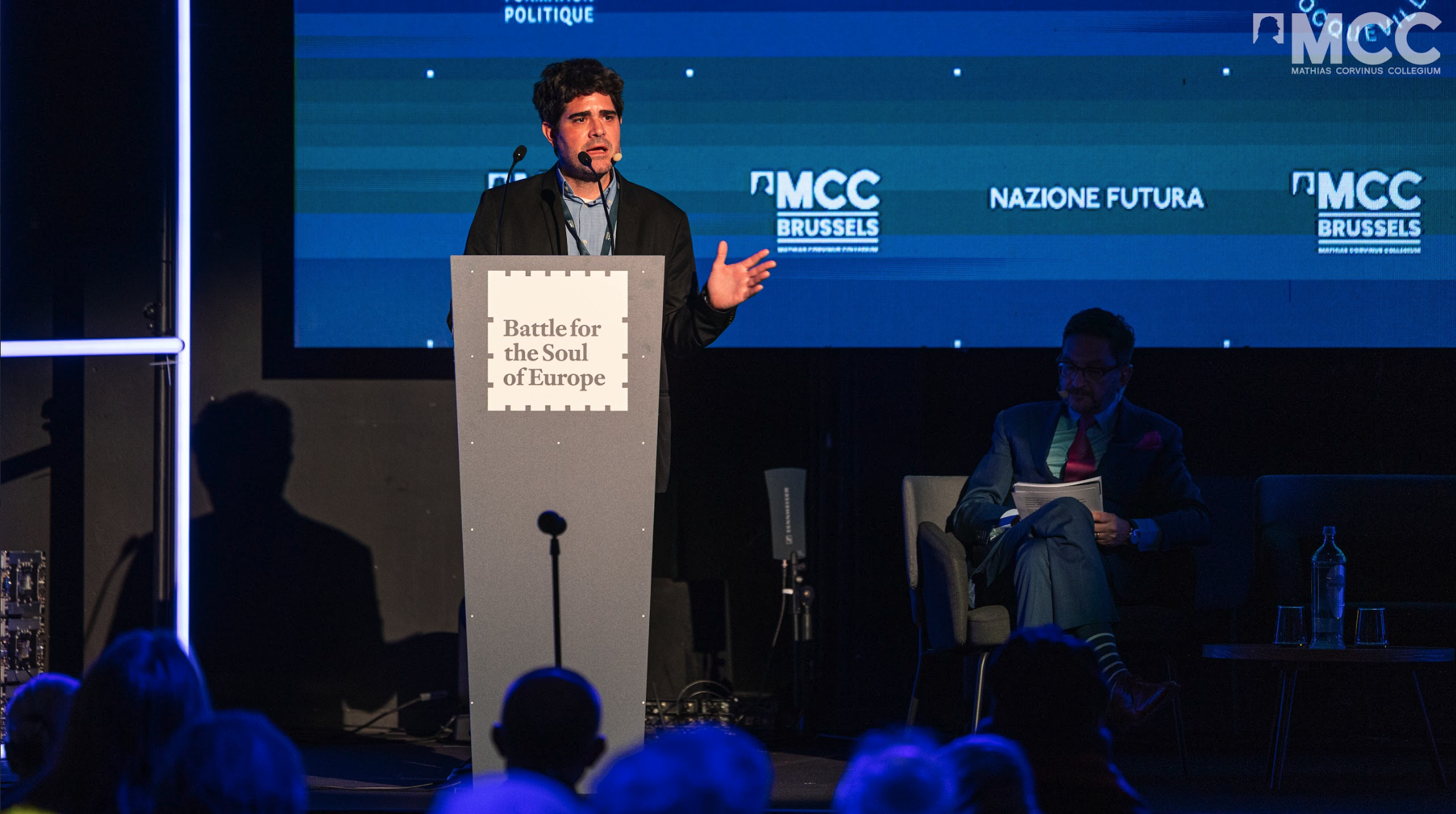
The panel dedicated to freedom of expression was opened by writer Thomas Fazi, who stated that the European Union in recent years has built the most intrusive system of speech control in the entire Western world. His analysis showed that the measures adopted in the name of combating disinformation, such as the Digital Services Act, do not truly aim to counter false news but rather to grant Brussels the power to decide which opinions may circulate.
To demonstrate this, Fazi recalled several recent episodes in which European institutions disseminated information that later proved false, such as the supposed ‘Russian hacking’ of Ursula von der Leyen’s plane—debunked even by friendly media outlets hours later. For him, such cases illustrate that “the main producers of disinformation today are governments themselves,” which turns the current regulatory architecture into a censorship system by another name.
Fazi added that the use of organizations designated as trusted flaggers—almost all dependent on European funding—turns oversight of public discourse into an ideological filter rather than a neutral exercise. The introduction of the new Democracy Shield only deepens this trend by allowing preventive electoral surveillance, which, according to the speaker, institutionalizes censorship as a political tool.
The remarks by British member of the House of Lords and former MEP Claire Fox reinforced these concerns by warning that official language is normalizing concepts such as “psychological harm” or “emotional safety” to justify the removal of uncomfortable content. This cultural shift, she noted, is producing a generation of young people taught to believe that words are dangerous and must be regulated by the state, representing a break with Europe’s liberal tradition.
Fox also denounced the “Sovietization of public discourse,” a phenomenon in which self-censorship arises not only from fear of legal sanctions but also from social, institutional, and media pressure. Her message was clear and direct: without the freedom to dissent, European democracy loses its substance. And the expanding network of regulations, combined with the tendency to label any criticism of official orthodoxy as “hate,” is turning that danger into reality.
The other major theme of the day was immigration, addressed as a challenge that goes beyond administrative management to become a question of cultural survival. Fabrice Leggeri, former director of Frontex, described the current situation as “migration chaos leading to civilizational chaos.”

He explained that the asylum system has been distorted and is used in many cases as a way to enter the EU illegally via unfounded applications that undermine any attempt at expulsion. He also pointed to an institutional climate that tends to favor foreigners over citizens, encouraged by NGOs and European bodies that view any defense of national identity with suspicion.
For Leggeri, this attitude has obvious consequences for public safety. He recalled that in Paris, more than two-thirds of sexual assaults in public transport are committed by non-European migrants, a figure that—he noted—rarely appears in media debates. His proposed solution is direct and unapologetic: fully restore the EU’s external borders, normalize expulsions, and abandon the “friendly treatment culture” promoted by NGOs that, in his view, seek to weaken state authority.
Irish journalist Eoin Lenihan offered an even more dramatic example. He explained how Ireland became an open-border country for two decades, to the point that 90% of asylum applications in the early 2000s were deemed unfounded without significant deportations taking place. The current situation—which includes fires in reception centers, riots, and a crisis of public trust—is, for him, not an accident but the inevitable consequence of a policy that avoided any form of control for fear of being accused of xenophobia.
Portuguese politician Antonio Tânger Corrêa explained how his country has come to receive mass immigration that, in just a few years, now means immigrants account for almost 20% of its population. Many migrants arrived simply by signing an employment-seeking document at the airport, a procedure Corrêa described as the “deliberate destruction” of the Schengen legal framework. For him, the real impact is not only economic or social but cultural: he claimed that Portugal is having “its soul stolen,” as symbols, traditions, and social cohesion are replaced by a multicultural model advancing without democratic debate and with the approval of media outlets financed by Brussels.
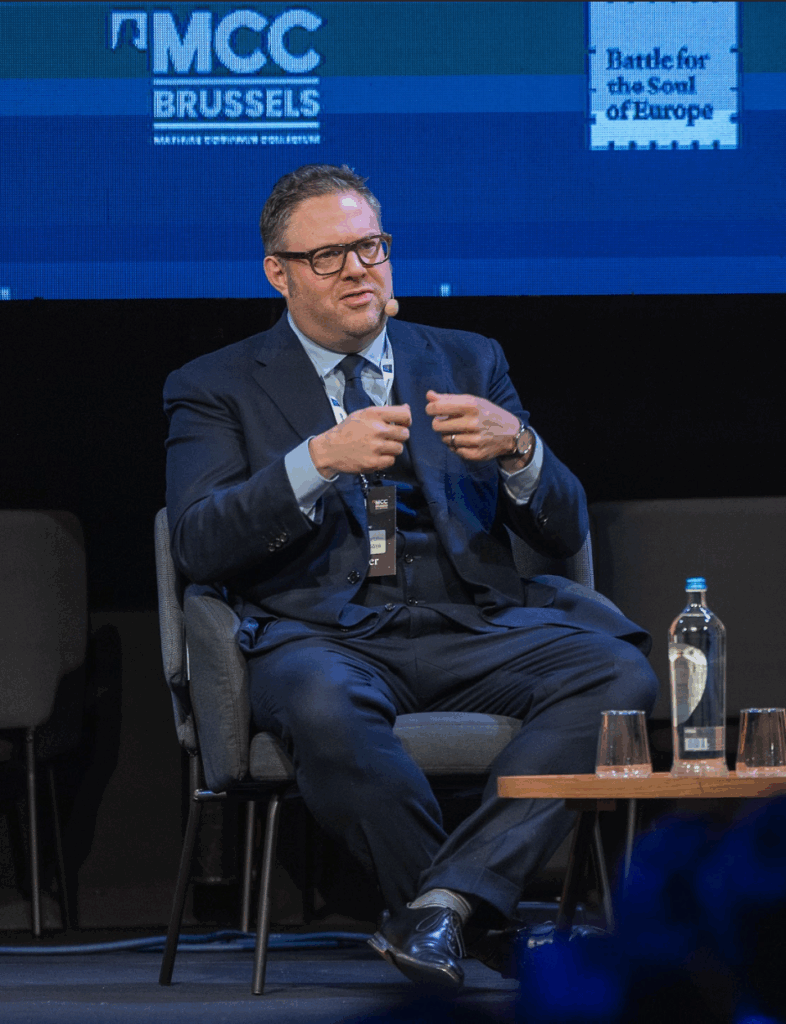
The two thematic areas converged in a more passionate reflection on the state of Europe’s political system. Canadian sociologist Mathieu Bock-Côté warned that part of the European elite perceives that migratory and multicultural policies have lost social support and is responding by reinforcing institutional mechanisms that limit governments’ ability to change them—even if they win elections. This phenomenon, which Bock-Côté defines as a “neo-Soviet drift,” is based on two simultaneous strategies: controlling public discourse through anti-disinformation laws and reinterpreting the rule of law to prevent reforms that question the existing model.
The result is a system where elections continue to be held, but their outcomes are deemed legitimate only if they align with what the establishment considers acceptable—Romania, for example. According to the speaker, this disconnect between the popular vote and the actual capacity to govern fuels the rise of patriotic and national-conservative parties, which denounce the hollowing out of democracy.
The day ended with a message that, far from apocalyptic, was combative. Europe, the speakers insisted, can still recover its course, but only if it restores two fundamental freedoms: the freedom to speak without fear and the freedom to decide who enters and who belongs. Without these two pillars, Europe risks becoming a political space without a soul, incapable of defending its heritage and its future.