Andy Burnham became Britain’s new prime minister on Monday, promising to return power to ordinary people while setting out plans for a larger state, greater public ownership and closer control of the economy.
Burnham formally took office after King Charles III invited him to form a government. He replaces Keir Starmer after winning the leadership of the governing Labour Party, meaning British voters will not have a direct say on their new prime minister until the next general election.
He is Britain’s seventh prime minister since the country voted to leave the European Union in 2016—a period of political instability that has seen six changes of leader in ten years.
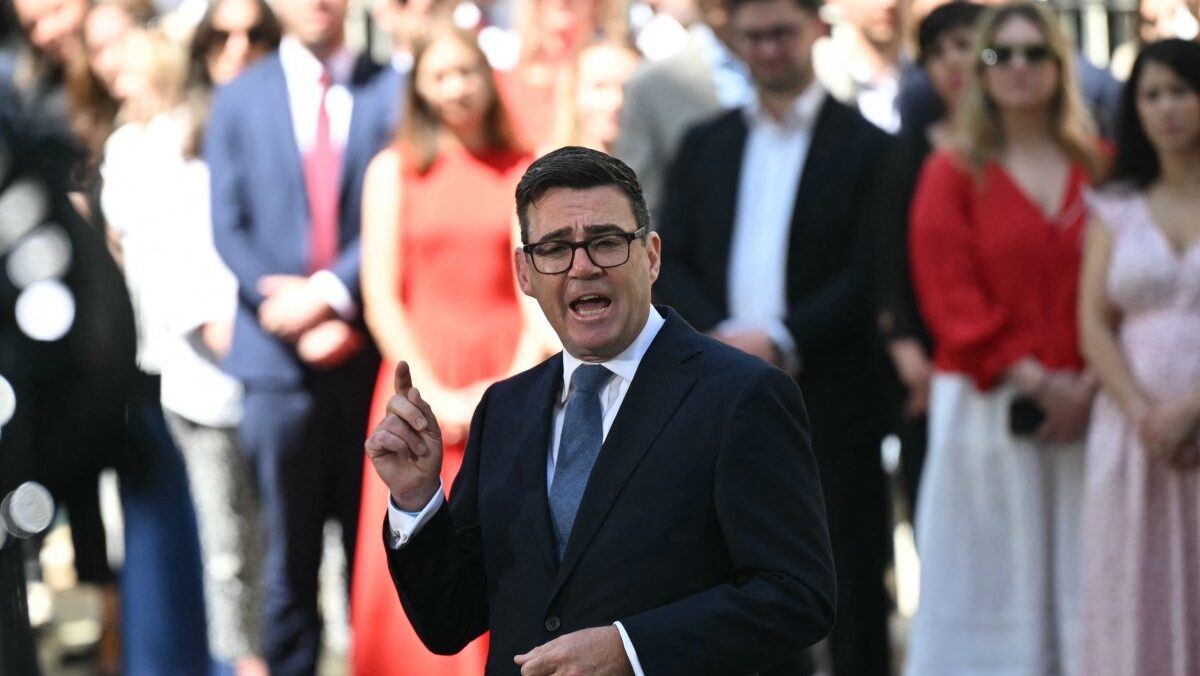
Speaking outside 10 Downing Street, Burnham acknowledged that voters were “fed up with politics” and admitted that Labour had “not been good enough”.
“We will make this moment a circuit-breaker for Britain, bringing forward the biggest changes in the last 40 years,” he said, promising both “a new political model and a new economic model”.
The new prime minister blamed many of Britain’s problems on decisions made during the 1980s, when Margaret Thatcher’s Conservative government privatised state industries and reduced the power of trade unions. Burnham said political power had become too concentrated in London, while deindustrialisation had left large parts of the country in decline.
He promised to transfer greater authority from the central government to local areas and place essential services under “stronger public control”. A ten-year “Plan for Britain”, including measures to support domestic industry through government purchasing, will be published later this year.
Burnham also announced that his first instruction as prime minister would be to end rough sleeping. Further measures intended to ease the cost-of-living crisis will be unveiled on Tuesday, alongside an explanation of how they will be funded.
Notably absent from his first speech was any mention of immigration or border control, despite opinion polls identifying immigration as one of the issues of greatest concern to British voters. Burnham offered no indication of whether he would reduce legal migration, stop illegal Channel crossings or make it easier to deport foreign criminals.
As political commentator Matt Goodwin has pointed out, the central promise of Burnham’s premiership already contains a considerable contradiction. Although he says he will return power to the British people, his government remains committed to institutions and policies that place important decisions beyond their direct control.
Labour has shown no willingness to withdraw Britain from the European Convention on Human Rights, whose rules have repeatedly been used to prevent the deportation of illegal migrants and foreign criminals. Burnham also takes office as his party seeks closer alignment with the European Union, despite the 17.4 million people who voted for Brexit in 2016.
His proposed expansion of public ownership and state intervention would meanwhile hand more power to government bodies, regulators and officials. Simply transferring authority from London to regional administrations does not necessarily give ordinary citizens any greater control, as the records of the devolved governments in Scotland and Wales demonstrate.
Burnham must also reconcile his expensive domestic programme with growing demands for higher defence spending. Warren Stephens, the US ambassador to Britain, warned the new government against delaying investment in AUKUS, the nuclear submarine partnership between Britain, the United States and Australia.
President Donald Trump has separately urged Britain to develop its North Sea oil and gas reserves, arguing that cheaper domestic energy could help address the country’s economic difficulties. Labour has instead pursued net-zero policies that restrict new drilling.
Burnham has promised to maintain Britain’s commitment to NATO, its nuclear deterrent and its alliance with the United States. He has also suggested that defence spending should be used to support British manufacturers.
The new prime minister therefore enters Downing Street promising national renewal and popular control, but leading a Labour government committed to higher spending, an expanding state, continued rule by foreign courts and closer ties with Brussels.
Whether Burnham returns power to British voters—or merely redistributes it among another collection of officials and public bodies—may define his premiership.