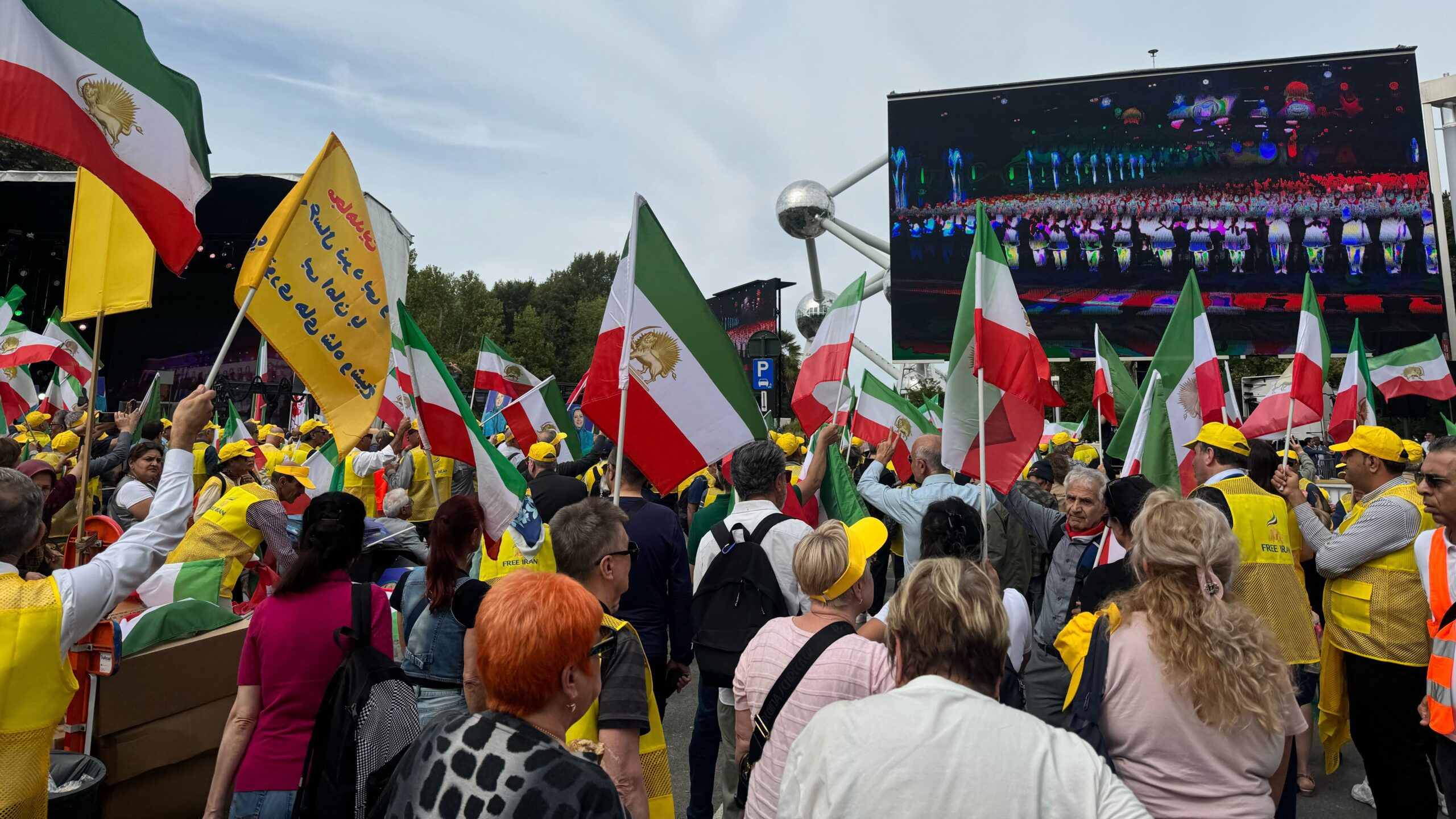
Protesters at the rally organized by the National Council of Resistance of Iran (NCRI) on September 6, 2025
Javier Villamor / europeanconservative.com
On Saturday, September 6th, Brussels’ Atomium became the stage for one of Europe’s largest gatherings of the Iranian diaspora. Convened by the National Council of Resistance of Iran (NCRI), thousands of demonstrators assembled at the Heysel Plateau to demand a shift in the European Union’s policy towards the regime in Tehran.
The march, held on the 60th anniversary of the People’s Mojahedin Organization of Iran (PMOI/MEK), sought to project the image of an organized opposition ready to seize what they describe as “the structural weakness of the ayatollahs” to deliver the “final blow” to it.
The demands were precise: more sanctions, an end to impunity, and above all, the inclusion of the Revolutionary Guards (IRGC) on the EU list of terrorist organizations. NCRI President-elect Maryam Rajavi stressed that the objective is to establish a “democratic, secular and non-nuclear republic,” with a separation between religion and state, and appealed to European governments to recognize the right of Iranians to organize to overthrow the “clerical dictatorship.”
The rally also displayed unusual international backing for this opposition event on European soil. Former U.S. Vice President Mike Pence addressed the crowd and argued that Iran’s future lies in being “democratic, secular, and non-nuclear.” He added that “the greatest threat to this regime is not America or Israel, but the Iranian people themselves,” a message that connects with the maximum pressure strategy championed in Washington and now projected onto Brussels.
Among Europeans, Alejo Vidal-Quadras stood out. He is a former vice president of the European Parliament and a victim of an attack attributed to Tehran. Aware of the symbolism of his case, he declared that “if being targeted by this regime is the price for defending human dignity and democracy, I wear it as a badge of honor.” His words, met with applause, reinforced the narrative that the battle against the ayatollahs is not fought only in the Middle East but also on European soil.
The NCRI and its network of diaspora communities chose the Atomium not only as a symbol of Brussels but as a loudspeaker aimed at the institutions of the European Union. Belgium, host of the protest, has also been one of the countries pushing hardest for the IRGC to be included in the EU’s terrorist list. Although the final decision depends on the Council and requires solid legal grounds, the political signal is unequivocal: increasingly, governments consider appeasement unsustainable.
For the organizers, the window of opportunity is twofold. On the one hand, they see a regime weakened by internal repression, economic crisis, and involvement in regional conflicts. On the other, they perceive in Europe a political climate increasingly hostile to foreign interference after several cases of espionage and terrorism attributed to Tehran on EU territory. Hence, they insisted that Brussels stop separating the nuclear file from the issues of human rights and internal security.